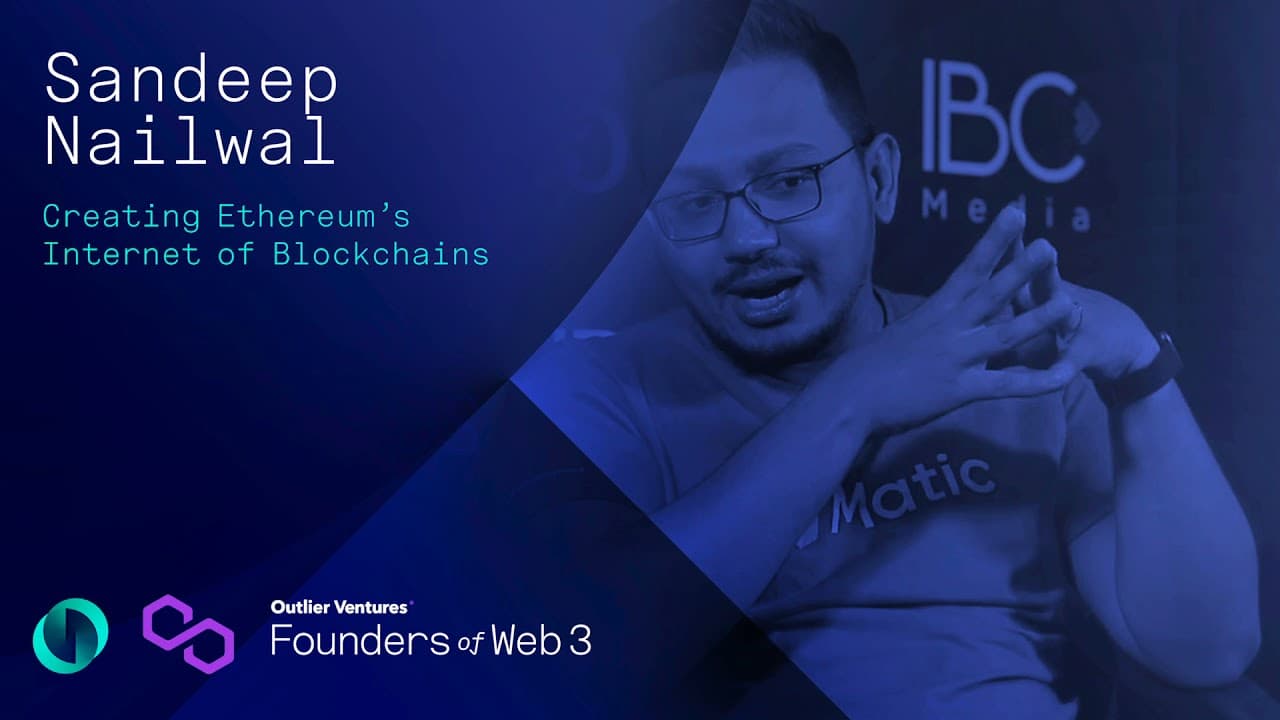
Creating Ethereum’s Internet of Blockchains, with Sandeep Nailwal of Polygon (Matic Network)
TL;DR
In this interview, Sandy, the Co-founder and COO of Matic (now Polygon), discusses the journey of Matic as a scalable blockchain solution and the expansion of their vision to become Ethereum's internet of blockchains with Polygon.
Transcript
if you're an early stage web3 founder apply to our award-winning accelerator programme basecamp outlier ventures dot io slash base camp we write your first 50 000 check and give you access to 200 mentors including many of the leading web 3 founders and a network of 1 000 of the world's leading investors and exchanges we've helped over 30 startups f... Read More
Key Insights
- 😫 Matic's focus on the EVM-based approach and decentralized validation sets it apart from other scaling solutions.
- 🪡 Polygon's expansion to become a multi-solution Ethereum scaling project reflects the need for flexibility in the decentralized ecosystem.
- 😀 The Indian blockchain talent pool faced challenges due to government regulations and social perceptions, contributing to slower adoption in the country.
- 👾 Ethereum's dominance in the blockchain space and its reputation as a programmable settlement layer remain strong, driving projects like Polygon to build upon its infrastructure.
- 🥳 Polygon's treasury, fueled by their token holdings, allows them to incentivize third-party development and build a robust ecosystem.
- 👍 The collaboration between Outlier Ventures' accelerator program and Polygon has proven successful in helping startups find product-market fit and navigate the scaling landscape.
Install to Summarize YouTube Videos and Get Transcripts
Explore YouTube Video Summarizer or Get YouTube Transcript Extractor
Questions & Answers
Q: What were the key innovations of Matic in solving Ethereum's scalability issues?
Matic focused on building a production-ready proof of stake chain with plasma implementation on top of Ethereum. They aimed to simplify the user experience, increase throughput, and offer scalability options for dApps.
Q: How did Matic differentiate itself from other scaling solutions, such as optimistic roll-ups or zk roll-ups?
Matic chose the EVM-based approach, allowing developers to leverage their existing knowledge and assets. They also focused on creating a decentralized network with multiple validators, instead of relying on a single operator.
Q: Why did Matic expand its scope and rebrand as Polygon?
Matic realized that no one solution fits all in the scaling landscape. Polygon aims to be an aggregator of layer two solutions, offering various scaling options like Plasma, zk roll-ups, and more. Their goal is to provide an unopinionated approach that connects back to Ethereum.
Q: How does Polygon's vision align with Ethereum's goals as a settlement layer?
Polygon sees Ethereum as the ultimate programmable settlement layer and believes that any meaningful decentralized execution should be scalable and connected to Ethereum. They aim to be Ethereum's internet of blockchains, offering a wide range of options for developers.
Summary & Key Takeaways
-
Matic was created as a scalable blockchain network to overcome the limitations of Ethereum and enable massive scale for decentralized applications (dApps).
-
Matic achieved significant traction, onboarding over 80 dApps and completing over 7 million transactions with over 200,000 user addresses.
-
Building on their success, Matic expanded their vision and rebranded as Polygon, an Ethereum scaling project that offers a multi-solution approach to scaling, allowing developers to choose the solution that best fits their needs.
Read in Other Languages (beta)
Share This Summary 📚
Summarize YouTube Videos and Get Video Transcripts with 1-Click
Try YouTube Summary with ChatGPT & Claude or YouTube Transcript Generator
Explore More Summaries from The Metaverse Podcast 📚






Summarize YouTube Videos and Get Video Transcripts with 1-Click
Try YouTube Summary with ChatGPT & Claude or YouTube Transcript Generator