Test for Independence of Attributes - Problem 2 - Chi-Square Test - Engineering Mathematics - 4
TL;DR
This video discusses an example of the chi-square test to determine if there is an association between two attributes.
Transcript
hello friends in this video we'll be discussing chi-square test type number to test for independence of attributes and this is our second example friends in the last video we have discussed one example on tests of independence of attributes but in that example the table was given here Abel is not provided to us we need to make a table so let us sta... Read More
Key Insights
- 🤏 The chi-square test is used to determine if there is an association between two attributes.
- ❓ The null hypothesis assumes no association, while the alternate hypothesis assumes an association.
- 🎚️ The level of significance determines the threshold for rejecting the null hypothesis.
- 🤨 The degree of freedom is calculated using the number of rows and columns in the table.
- 🤨 Expected frequencies are calculated based on the row and column totals.
- ❎ Chi-square is calculated by comparing the observed and expected frequencies.
Install to Summarize YouTube Videos and Get Transcripts
Explore YouTube Video Summarizer or Get YouTube Transcript Extractor
Questions & Answers
Q: What is the null hypothesis in this example?
The null hypothesis is that there is no association between student class and opinion on college autonomy.
Q: What is the alternate hypothesis?
The alternate hypothesis is that there is an association between student class and opinion on college autonomy.
Q: How is the level of significance determined?
The level of significance, or alpha, is given in the problem and is set at 5%.
Q: How is the degree of freedom calculated?
The degree of freedom is calculated using the formula (R-1)(C-1), where R is the number of rows and C is the number of columns in the table.
Q: How are the expected frequencies calculated?
The expected frequencies are calculated using the formula (Row Total * Column Total) / Total.
Q: What is the observed minus expected calculation used for?
The observed minus expected calculation is used to determine the differences between the observed and expected frequencies in each cell of the table.
Q: What is the formula for calculating chi-square?
The formula for calculating chi-square is (observed minus expected)^2 / expected.
Q: What is the conclusion in this example?
The conclusion is that there is no association between student class and opinion on college autonomy.
Summary & Key Takeaways
-
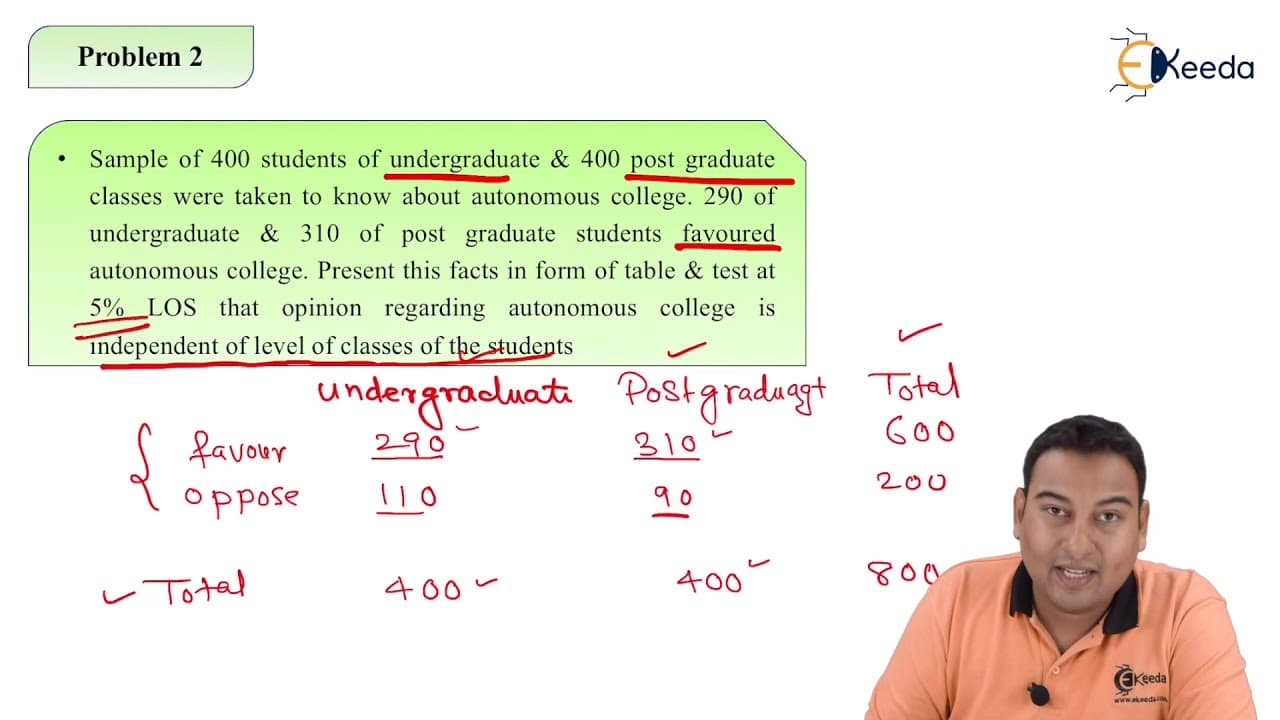
The problem involves 400 undergraduate and 400 postgraduate students and their opinions on whether a college should be autonomous.
-
A table is created to represent the data, with 290 undergraduate and 310 postgraduate students favoring autonomy.
-
The chi-square test is conducted at a 5% level of significance to determine if there is a relationship between student class and opinion.
Read in Other Languages (beta)
Share This Summary 📚
Summarize YouTube Videos and Get Video Transcripts with 1-Click
Try YouTube Summary with ChatGPT & Claude or YouTube Transcript Generator
Explore More Summaries from Ekeeda 📚






Summarize YouTube Videos and Get Video Transcripts with 1-Click
Try YouTube Summary with ChatGPT & Claude or YouTube Transcript Generator