Line Graph | Quantity Sold | DI | Reasoning | Part - 23 | Bharath Kumar
TL;DR
Understanding line graphs for pricing and quantity analysis.
Transcript
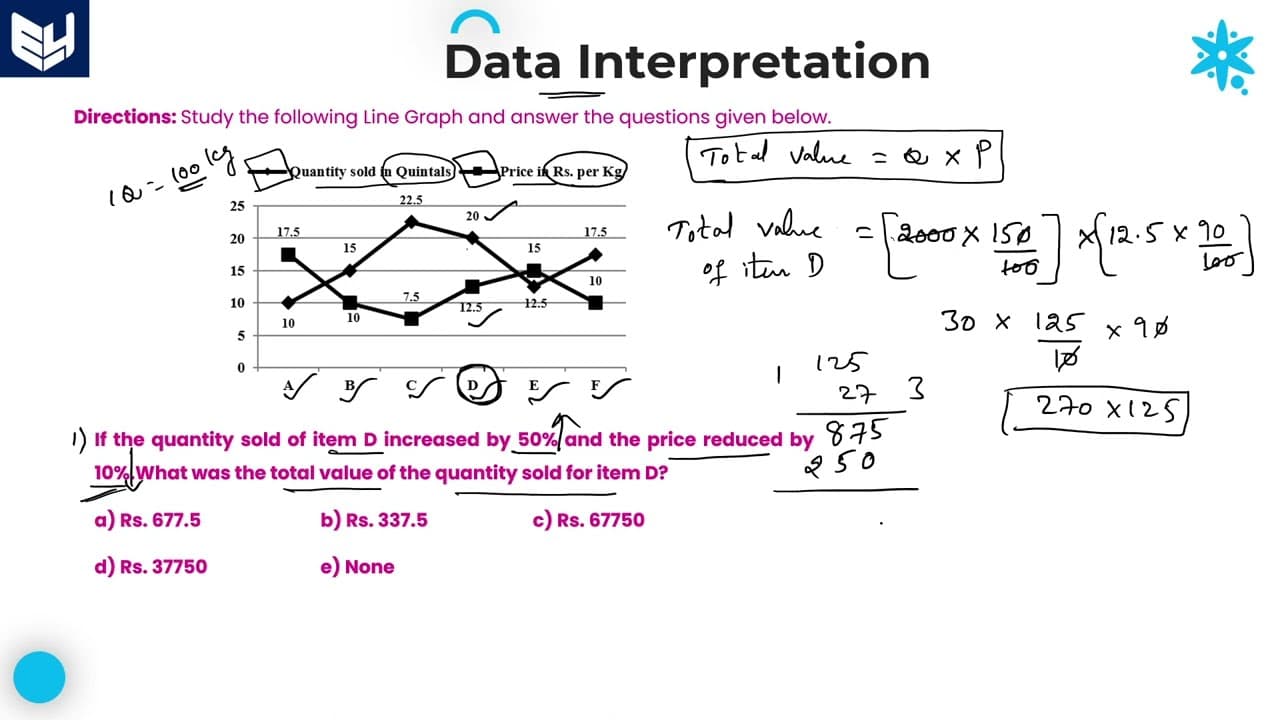
hi everyone welcome to the session in this session I am continuing line graph data interpretation first of all we need to read the information carefully and then based on that information we need to solve the question sir once look at this line graph what is the given information here one line is saying showing that quantity sold in quintus one lin... Read More
Key Insights
- 🫥 Understanding the basic units of measure is vital when interpreting line graphs, especially when converting quintas to kilograms to align with pricing structures.
- 🌍 The application of percentage increases and decreases to quantities sold and prices assists in evaluating real-world economic scenarios and sales projections.
- 🥺 Averaging prices involves clear mathematical procedures which, if inaccurately executed, can lead to gross misestimation of costs in business frameworks.
- 🥳 Ratios serve as a powerful tool for comparing data points and understanding how different items perform relative to each other economically.
- 📈 Mastering graph interpretation equips individuals with analytical skills that can be applied across various quantitative data representations.
- 🖐️ Accurate mathematical calculations play a fundamental role in deriving meaningful insights from sales and pricing data.
- 🪡 Recognizing that specific options may not be available emphasizes the need for comprehensive calculation rather than reliance on preset choices.
Install to Summarize YouTube Videos and Get Transcripts
Explore YouTube Video Summarizer or Get YouTube Transcript Extractor
Questions & Answers
Q: What is the significance of converting quintas to kilograms in this analysis?
Converting quintas to kilograms is crucial because all the pricing information is specified in rupees per kilogram. This ensures that calculations involving total value, average price, and percentage changes accurately reflect real-world pricing and quantities. Failing to perform this conversion could lead to serious errors in data interpretation and decision-making.
Q: How do you calculate the total value of item D after adjustments in quantity and price?
The total value for item D is found by first converting the quantity sold from quintas to kilograms. After determining the new quantity after a 50% increase, you multiply this adjusted quantity by the new price, which is calculated after applying a 10% decrease. The total value formula is Quantity x Price, which gives a clear economic measure of sales performance.
Q: What is the procedure for finding the average price per kg of items A, B, and C?
To find the approximate average price per kg of items A, B, and C, sum the individual prices per kg of these items and divide by the number of items. For example, with prices of 17.5, 10, and 7.5 rupees per kg, the average is calculated as (17.5 + 10 + 7.5) / 3, resulting in roughly 11.67 rupees per kg.
Q: How do you determine the ratio of total values between items E and F?
To find the ratio, calculate the total values for both items E and F using the quantity multiplied by the price after converting units to kilograms. For example, for item E the total value is derived from 12.5 quintas at 15 rupees and for item F from 17.5 quintas at 10 rupees. The ratio of these total values can then be simplified to express a comparative measure in an easily understood format.
Summary & Key Takeaways
-
The session focuses on interpreting line graphs that represent quantities sold and prices in rupees per kg, primarily for six items labeled A through F.
-
Participants are taught to convert quantities from quintas to kilograms for accurate price calculations since prices are given per kg, ensuring clarity in numerical data analysis.
-
Key quantitative analysis concepts are demonstrated, including calculating total values after percentage changes in price and quantity, and determining average prices across different items.
Read in Other Languages (beta)
Share This Summary 📚
Summarize YouTube Videos and Get Video Transcripts with 1-Click
Try YouTube Summary with ChatGPT & Claude or YouTube Transcript Generator