Floating point representation | IEEE 754 | COA | Lec-06 | Bhanu Priya
TL;DR
Floating point representation is crucial for representing very small or large numbers in computing.
Transcript
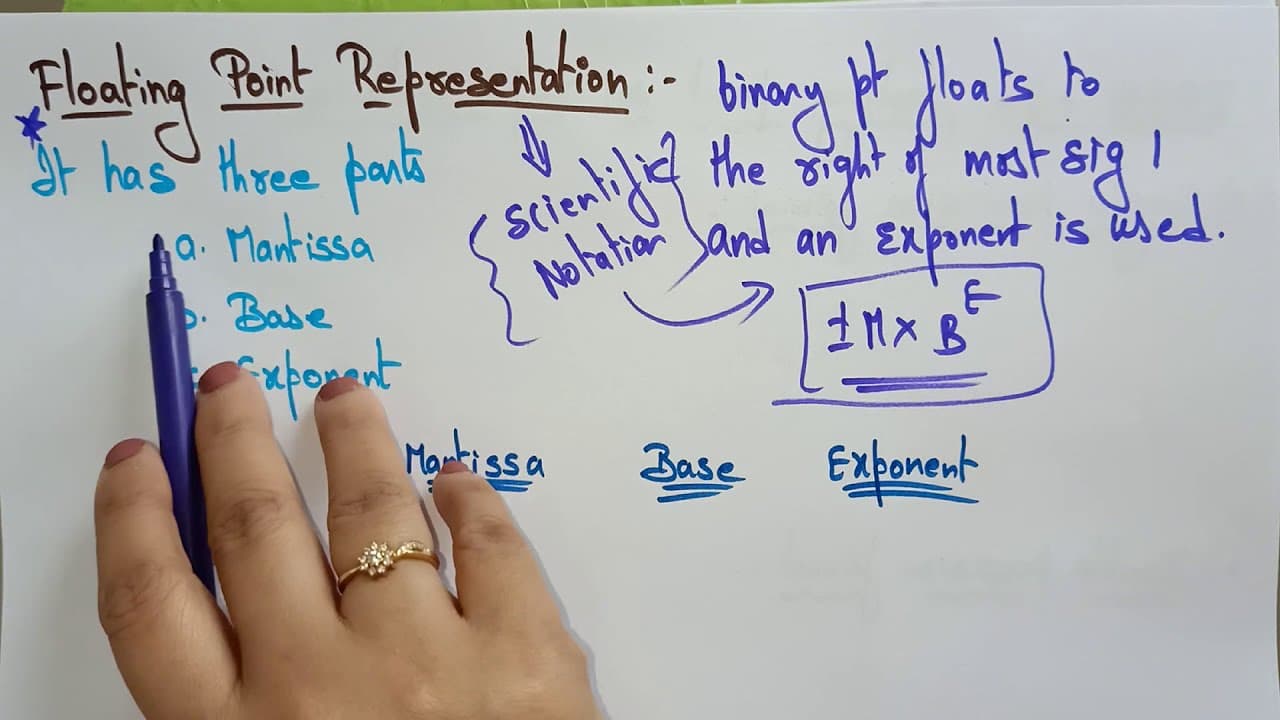
hi students welcome back coming to the next point and the most important concept is the floating point representation in the previous video i explained about the fixed point representation where the binary number is fixed in fix to point representation but whereas in the floating point representation the binary point floats to the right of most sig... Read More
Key Insights
- 🔺 Floating point representation is vital in computing for efficiently managing very small and very large numbers.
- 🚫 The structure of floating point numbers includes a sign bit, exponent, and mantissa, ensuring a comprehensive numeric range.
- 😥 IEEE 754 is the standard governing floating point representation, facilitating consistency across computing systems.
- 🫦 Single precision refers to 32-bit representation, while double precision refers to 64-bit, impacting the range and accuracy of data representation.
- 🫦 The mantissa can vary in size, and additional bits can be added when moving between single and double precision formats.
- 😥 Understanding how to manipulate the binary point is essential for computing, impacting both precision and data range.
- 😥 Applications of floating point representation are found across scientific calculations, simulations, and technologies reliant on precise numeric data.
Install to Summarize YouTube Videos and Get Transcripts
Explore YouTube Video Summarizer or Get YouTube Transcript Extractor
Questions & Answers
Q: What is the primary advantage of floating point representation over fixed point representation?
The primary advantage of floating point representation is its ability to scale. Unlike fixed point representation, where the decimal point is static, floating point representation allows for dynamic placement of the binary point, enabling the representation of a much wider range of values, including very small and very large numbers. This is critical in various technological applications, such as scientific calculations where precision is essential.
Q: Can you explain the structure of a floating point number as per the IEEE 754 standard?
The IEEE 754 standard defines two main formats for floating point representation: single and double precision. In single precision (32 bits), there is 1 bit for the sign, 8 bits for the exponent, and 23 bits for the mantissa. In double precision (64 bits), there is still 1 bit for the sign, but the exponent is represented with 11 bits, and the mantissa extends to 52 bits, allowing for greater precision and range in representation.
Q: How is the scientific notation applied in floating point representation?
In floating point representation, numbers are expressed in scientific notation as "±m × b^e," where "m" is the mantissa, "b" is the base (typically 2 or 10), and "e" is the exponent. This format allows both very small and large values to be represented efficiently. For example, "9 × 10^8" is represented as a mantissa of 9, base of 10, and an exponent of 8.
Q: What are the implications of the sign bit in floating point representation?
The sign bit plays a crucial role in determining the nature of the number represented in floating point format. If the sign bit is 0, the number is positive; if it is 1, the number is negative. This allows for a balanced representation of both positive and negative values within the same system, essential for mathematical computations in programming and scientific calculations.
Q: How is the exponent determined when representing a number in floating point?
The exponent in floating point representation is determined by the position of the binary point in relation to the most significant digit of the mantissa. For instance, shifting the decimal or binary point to normalize the number results in the exponent taking on a value that reflects this shift. This allows the representation of numbers as closely as possible to their actual values while maintaining a consistent format.
Summary & Key Takeaways
-
Floating point representation allows binary numbers to have a dynamic binary point that moves based on the number's significance, unlike fixed point representation.
-
This method uses three components: mantissa, base, and exponent, making it possible to represent vast ranges of values, from very small to extremely large.
-
The IEEE 754 standard defines how floating point numbers are stored in computer systems, detailing formats for single precision (32 bits) and double precision (64 bits).
Read in Other Languages (beta)
Share This Summary 📚
Summarize YouTube Videos and Get Video Transcripts with 1-Click
Try YouTube Summary with ChatGPT & Claude or YouTube Transcript Generator