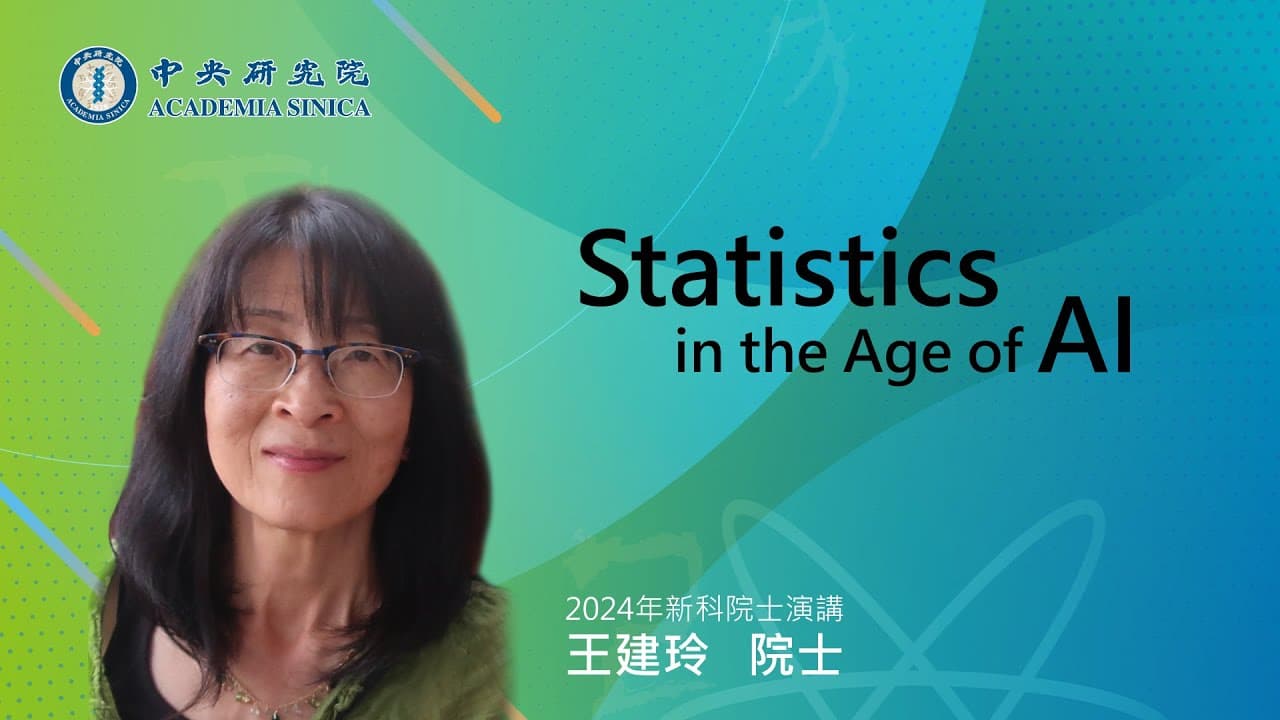
2024年新科院士-王建玲院士/Statistics in the Age of AI
TL;DR
Explores statistics' role and challenges in AI's evolution.
Transcript
finally uh let's uh warly welcome Professor Jenny Wang with Applause for her future talk uh thank you Shino and thank you everybody good afternoon uh welcom here uh it's a real honor to give this talk here but I have to make clear I am we should congratulate Thailand professor taling on the first row he was elected yesterday as so I... Read More
Key Insights
- Professor Jenny Wang discusses the evolving role of statistics in the age of AI, emphasizing the importance of integrating statistical methods with AI technologies.
- The talk highlights the need for statisticians to adapt to AI advancements to avoid being left behind, suggesting a focus on estimation and inference.
- Deep learning's ability to learn lower-dimensional structures from data is seen as a significant advantage over traditional nonparametric methods.
- Functional data analysis is explored, with an emphasis on adaptive functional neural networks that learn optimal basis representations for data.
- Survival data analysis is addressed, particularly the challenges of handling incomplete data and the use of partial likelihood in Cox models.
- The importance of scalability in AI research is underscored, with a need for large data sets and powerful computing resources to effectively utilize deep learning.
- The talk suggests that while AI poses challenges, it also reestablishes statistics' link to its roots, offering opportunities for innovation.
- Interpretability in AI models is a key concern, with a call for methods that allow for more transparent understanding of model outputs.
Install to Summarize YouTube Videos and Get Transcripts
Explore YouTube Video Summarizer or Get YouTube Transcript Extractor
Questions & Answers
Q: What is the main challenge for statisticians in the age of AI?
The main challenge for statisticians in the age of AI is to adapt their methods and skills to integrate with AI technologies effectively. This involves focusing on estimation, inference, and interpretability to ensure that statistical methods remain relevant and valuable in the context of AI advancements.
Q: How does deep learning differ from traditional statistical methods?
Deep learning differs from traditional statistical methods in its ability to learn lower-dimensional structures from data, which allows for faster convergence rates. Unlike traditional methods that often require pre-defined models, deep learning can automatically extract features and learn representations directly from raw data, making it highly effective for complex data analysis.
Q: What role does scalability play in AI research?
Scalability is crucial in AI research as it determines the ability to handle large data sets and perform complex computations efficiently. The success of AI models, particularly deep learning, often depends on having access to vast amounts of data and powerful computing resources, such as GPUs, to ensure effective learning and performance.
Q: Why is interpretability important in AI models?
Interpretability is important in AI models because it allows for a transparent understanding of how models make predictions or decisions. This transparency is essential for gaining trust in AI systems, particularly in fields like healthcare or finance, where decisions can have significant consequences. Interpretability helps ensure that models are not only accurate but also understandable and explainable.
Q: What are the implications of AI advancements for statistical education?
AI advancements imply that statistical education must evolve to include training in AI and machine learning techniques. Statisticians need to be equipped with skills in computational methods, data science, and AI to remain competitive and contribute effectively to interdisciplinary research. This shift in education will prepare future statisticians to meet the demands of the evolving data landscape.
Q: How can statisticians contribute to AI research?
Statisticians can contribute to AI research by focusing on areas like estimation, inference, and uncertainty quantification. They can also work on developing methods that enhance the interpretability and transparency of AI models. By integrating statistical rigor with AI technologies, statisticians can help improve model accuracy and reliability, thereby advancing the field of AI.
Q: What opportunities does AI present for statisticians?
AI presents opportunities for statisticians to innovate and expand their methodologies to address new challenges in data analysis. The integration of AI with statistics can lead to the development of novel approaches that improve data-driven decision-making across various fields. This collaboration can also reestablish statistics' foundational role in data science and AI research.
Q: What is the significance of the partial likelihood in survival analysis?
The partial likelihood is significant in survival analysis as it allows for the estimation of model parameters without directly modeling the entire likelihood function, which is often complicated by censored data. It provides a way to estimate the effects of covariates on survival times while handling incomplete data, making it a powerful tool for analyzing survival data in the presence of censoring.
Summary & Key Takeaways
-
Professor Jenny Wang's talk at the 2024 Symposium of Newly Elected Academicians focuses on the integration of statistics within the rapidly evolving field of AI. She emphasizes the need for statisticians to adapt and participate in AI research to avoid obsolescence.
-
The presentation covers the advantages of deep learning, particularly its ability to learn lower-dimensional structures, which provides faster convergence rates compared to traditional methods. Functional and survival data analyses are used to illustrate these concepts.
-
Wang highlights the importance of scalability in AI research and the need for statisticians to focus on estimation, inference, and interpretability to contribute effectively to AI advancements. The talk concludes with a call for statisticians to embrace these challenges as opportunities for growth.
Read in Other Languages (beta)
Share This Summary 📚
Summarize YouTube Videos and Get Video Transcripts with 1-Click
Try YouTube Summary with ChatGPT & Claude or YouTube Transcript Generator