Area of an Equilateral Triangle (GMAT/GRE/CAT/Bank PO/SSC CGL) | Don't Memorise
TL;DR
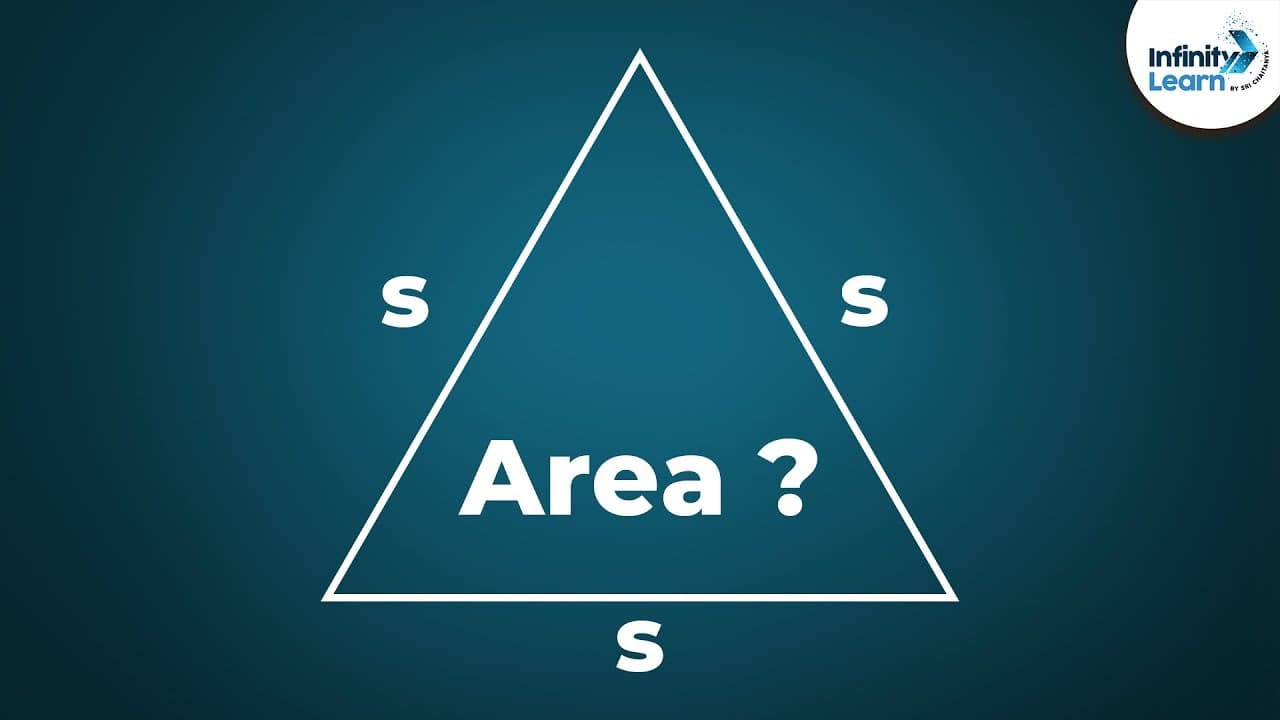
The area of an equilateral triangle can be found using the formula √3/4 * s^2, where s represents the length of one of its sides.
Transcript
what's so special about the area of an equilateral triangle to get to its area we need to understand a few Concepts first all sides of the equilateral triangle are equal to each other and so are the angles all sides equal and all angles equal so if we assume each angle to be X De then 3x would equal 180° as the sum of angles of a triangle is always... Read More
Key Insights
- 🔺 All sides and angles of an equilateral triangle are equal.
- 🥳 Dropping a perpendicular from a vertex to the opposite side divides it into two equal parts.
- 🔺 The area of an equilateral triangle can be calculated using the formula √3/4 * s^2.
- 🔺 Pythagoras' Theorem can be used to derive the formula for the area of an equilateral triangle.
- 🙃 The formula allows us to find the area of an equilateral triangle using the length of one of its sides.
- 😑 The area of an equilateral triangle can also be expressed as side length squared times √3/4.
- 🔺 Equilateral triangles have a unique relationship between their sides, angles, and area.
Install to Summarize YouTube Videos and Get Transcripts
Explore YouTube Video Summarizer or Get YouTube Transcript Extractor
Questions & Answers
Q: How can the area of an equilateral triangle be calculated?
The area can be found using the formula √3/4 * s^2, where s represents the length of one of its sides.
Q: What are the properties of an equilateral triangle?
An equilateral triangle has all sides equal to each other and all angles equal to 60°.
Q: What does dropping a perpendicular from a vertex to the opposite side of an equilateral triangle do?
It divides the opposite side into two equal parts.
Q: Can the formula for the area of an equilateral triangle be derived using Pythagoras' Theorem?
Yes, by using Pythagoras' Theorem, we can derive the formula √3/4 * s^2 for the area of an equilateral triangle.
Summary & Key Takeaways
-
An equilateral triangle has all sides and angles equal to each other.
-
By dropping a perpendicular from a vertex to the opposite side, the opposite side is divided into two equal parts.
-
The area of an equilateral triangle can be calculated using the formula √3/4 * s^2.
Read in Other Languages (beta)
Share This Summary 📚
Summarize YouTube Videos and Get Video Transcripts with 1-Click
Try YouTube Summary with ChatGPT & Claude or YouTube Transcript Generator
Explore More Summaries from Infinity Learn NEET 📚

Summarize YouTube Videos and Get Video Transcripts with 1-Click
Try YouTube Summary with ChatGPT & Claude or YouTube Transcript Generator