GPT Explained!
TL;DR
This video details the original GPT model and its fine-tuning strategies.
Transcript
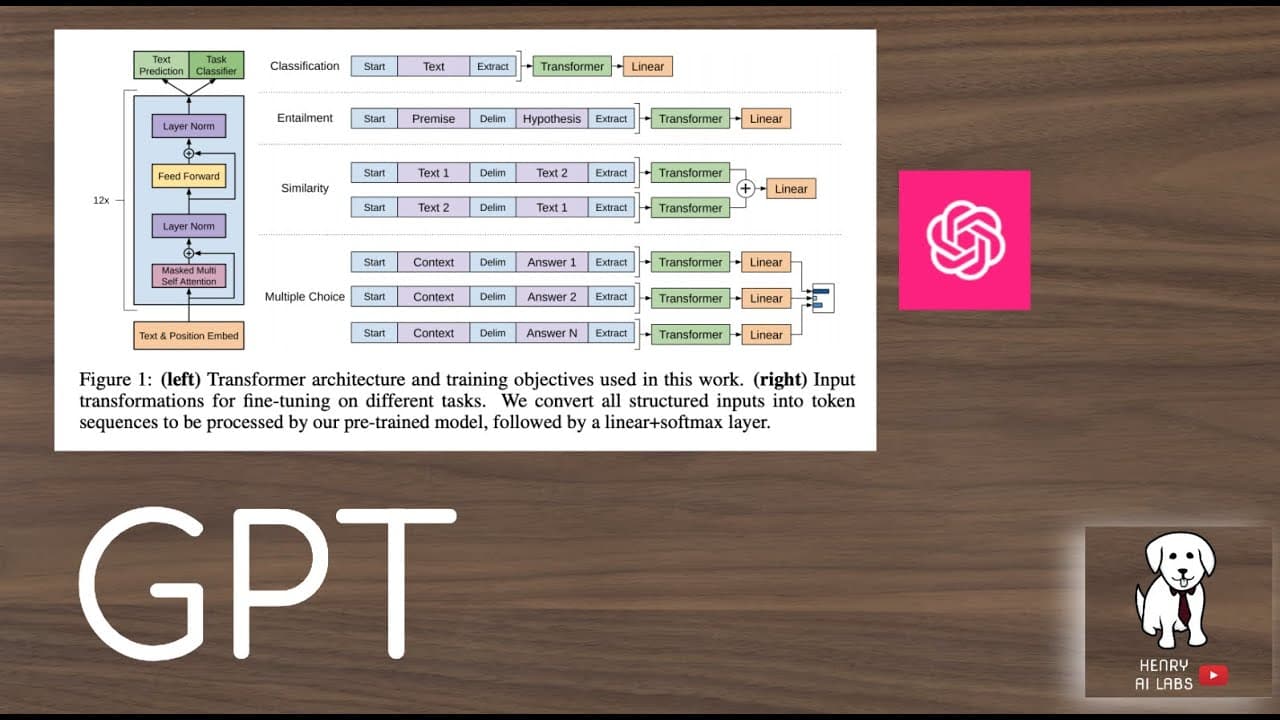
this video will explain the first GPT model developed by open AI GPT is a 12 layer 12 attention head transformer decoder but explores how to take advantage of massive unlabeled text datasets to fine tune them on limited supervised learning datasets some of the interesting contributions of the GPT model are the input transformations for task-specifi... Read More
Key Insights
- ⚾ The original GPT model's architecture is based on a 12-layer transformer decoder, emphasizing flexibility and efficiency in language modeling.
- 🆘 Employing semi-supervised learning helps GPT leverage vast amounts of unlabeled data, enhancing its training without extensive labeling efforts.
- 😑 The model's fine-tuning strategy incorporates task-specific input transformations, ensuring compatibility between pre-training and supervised tasks for better results.
- 👻 An auxiliary language modeling objective during fine-tuning allows GPT to continue predicting text while training on classification problems, thereby improving accuracy.
- 🏆 Evaluating the GPT model involves multiple supervised tasks that test its capabilities in natural language inference, question answering, and more.
- 📙 The books corpus dataset used for pre-training emphasizes long-range contextual understanding, a feature that differentiates it from other datasets.
- ❓ The retention of layers during transfer learning is critical, with more layers improving performance on downstream tasks.
Install to Summarize YouTube Videos and Get Transcripts
Explore YouTube Video Summarizer or Get YouTube Transcript Extractor
Questions & Answers
Q: What are the main architectural features of the GPT model?
The GPT model is structured as a transformer decoder featuring 12 layers and 12 attention heads. This architecture allows for effective processing of input sequences by utilizing a self-attention mechanism, which can focus on different parts of the input text dynamically. This design is crucial for understanding context and facilitating tasks such as language modeling and downstream classification.
Q: How does semi-supervised learning benefit the GPT model?
Semi-supervised learning benefits the GPT model by enabling it to leverage enormous amounts of unlabeled text data alongside smaller labeled datasets, which are labor-intensive to create. By pre-training on vast text resources like Wikipedia or the books corpus, the model captures extensive language patterns, making it more efficient during fine-tuning on specific, supervised tasks.
Q: What role do input transformations play in task-specific fine-tuning for GPT?
Input transformations are essential in task-specific fine-tuning as they allow the model to maintain consistency in input representation, aligning the format used during pre-training language modeling with the different supervised tasks. Special tokens, such as delimiters, are introduced to structure the input efficiently, facilitating smoother transitions between tasks like semantic similarity and question answering.
Q: Can you explain the importance of the auxiliary language modeling objective during fine-tuning?
The auxiliary language modeling objective retains language prediction tasks even during fine-tuning on classification problems. This dual approach allows GPT to improve its performance on supervised learning tasks while still optimizing for text generation. The weighted contributions from both objectives ensure that the model continues to enhance its predictive capabilities.
Q: How is the performance of GPT evaluated across different tasks?
GPT's performance is evaluated using various supervised tasks, including natural language inference, multiple-choice question answering, semantic similarity, and text classification. Each task assesses the model's understanding and generation of language in diverse contexts, helping identify strengths and weaknesses in its language processing abilities.
Q: What distinguishes the books corpus dataset used for pre-training in GPT?
The books corpus dataset is unique as it encompasses 7,000 unpublished texts from many genres, which necessitates longer-range context modeling compared to other datasets like the 1 billion word benchmark. This rich dataset aids GPT in developing a deeper understanding of narrative structures, thematic cues, and language patterns, enhancing its overall performance.
Q: Why is the number of layers retained during transfer learning relevant to the model's accuracy?
Retaining a higher number of transformer layers during transfer learning enhances the model's accuracy on downstream tasks. The more layers that are preserved from the pre-training phase, the better the model can utilize learned representations and features, resulting in improved performance across various language tasks.
Q: How does the transformer architecture compare to earlier models like LSTMs in long-range modeling?
The transformer architecture outperforms LSTMs in long-range language modeling due to its self-attention mechanism, which allows for better contextual understanding over extended sequences. Unlike LSTMs, which often struggle with long dependencies, transformers efficiently capture relationships across different parts of the text, making them more suitable for complex language tasks.
Summary & Key Takeaways
-
The video explains the development of the first GPT model by OpenAI, highlighting its architecture as a transformer decoder with 12 layers and attention heads.
-
It discusses the innovative use of semi-supervised learning through pre-training on massive unlabeled datasets, like the books corpus, to enhance language understanding tasks.
-
Various supervised learning tasks are examined, such as question answering, semantic similarity, and text classification, showcasing GPT’s flexibility across different language processing demands.
Read in Other Languages (beta)
Share This Summary 📚
Summarize YouTube Videos and Get Video Transcripts with 1-Click
Try YouTube Summary with ChatGPT & Claude or YouTube Transcript Generator
Explore More Summaries from Connor Shorten 📚
Summarize YouTube Videos and Get Video Transcripts with 1-Click
Try YouTube Summary with ChatGPT & Claude or YouTube Transcript Generator