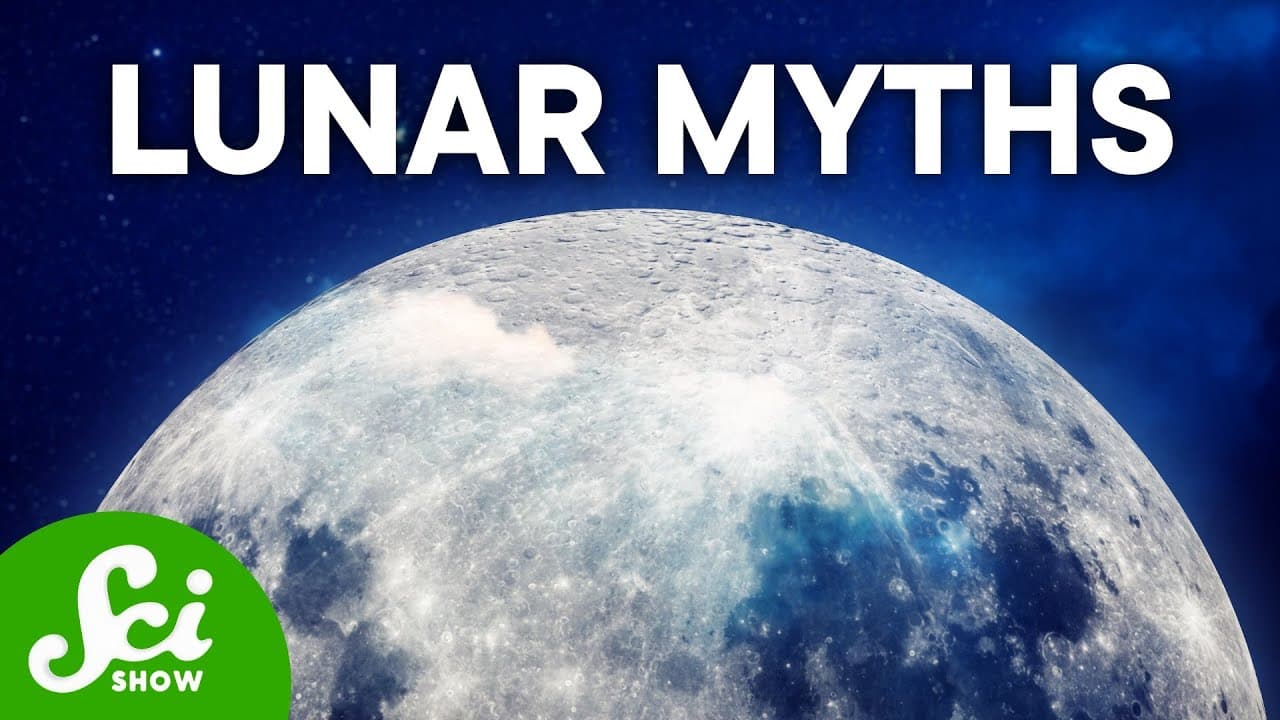
What Actually Happens on the Full Moon? | 8 Full-Moon Myths & Facts
TL;DR
The moon affects sleep, animal behavior, coral spawning, atmospheric tides, menstruation cycles, scorpion glow, seizures, and dung beetle navigation.
Transcript
[♪ INTRO] When you’re having a particularly weird night and strangers are acting stranger than normal, you’ve probably heard someone say, “Must be a full moon!” But here’s the thing: The idea that the moon makes people behave strangely is all a myth. There are no more crimes, deaths, or injuries when the moon is full. But! That doesn’t mean that th... Read More
Key Insights
- 😪 The full moon affects human sleep patterns, with longer sleep onset times and less REM sleep.
- 🧘 Animals, such as nudibranchs, sync their behavior with the moon's phase and position due to the Earth's magnetic field.
- 🪸 Coral spawning is triggered by the right amount of moonlight, which corals detect using photoreceptors.
- 🥺 The moon's gravity creates atmospheric tides, leading to higher air pressure and decreased rainfall.
- 🏍️ There is no scientific evidence supporting a link between the lunar cycle and menstruation cycles.
- 🙂 Scorpions use their ability to detect UV light to gauge moonlight intensity and make decisions about foraging and hiding.
- 🌙 The full moon does not trigger seizures, but epileptic seizures may be influenced by levels of melatonin and the darkness of the night.
Install to Summarize YouTube Videos and Get Transcripts
Explore YouTube Video Summarizer or Get YouTube Transcript Extractor
Questions & Answers
Q: Why do humans experience poorer sleep during a full moon?
Studies suggest that it is not just the light from the moon but also potential circalunar rhythms that affect human sleep patterns during a full moon. This indicates that it may be an evolutionary relic from when humans synchronized their behavior with the moon.
Q: How do coral polyps know when to spawn?
Coral polyps use photoreceptors in their bodies to detect changes in the blue wavelengths of moonlight. The right amount of moonlight signals to the corals that it is time to release their eggs and sperm into the water for fertilization.
Q: How does the moon impact atmospheric tides?
The moon's gravity creates two bulges in the atmosphere—one beneath it and another on the opposite side of the planet. This leads to higher air pressure in the bulge under the moon, resulting in decreased rainfall in areas directly beneath the moon.
Q: Is there a connection between the lunar cycle and menstruation cycles?
Despite the similarity in length between the lunar and menstrual cycles, there is no scientific evidence supporting a correlation between the two. The shared duration is likely a coincidence.
Q: Why do scorpions glow under UV light?
Scorpions use their green glow, which is visible under UV light, to gauge the amount of UV light coming from the moon. This helps them determine how much UV light is present in their environment and whether it is a good time to forage or seek shelter.
Q: Is there a link between the full moon and seizures?
The full moon itself does not trigger seizures. However, there seems to be a connection between lunar cycles and epileptic seizures, with darker nights potentially associated with higher seizure frequencies. Melatonin levels produced in darkness may play a role.
Q: How do dung beetles navigate using moonlight?
Dung beetles utilize the polarization pattern of moonlight to navigate along straight paths. They are the first animals known to use the dimmer polarization of moonlight for navigation, with full moon nights providing the brightest moonlight and strongest polarization.
Summary & Key Takeaways
-
The full moon affects human sleep patterns, causing individuals to take longer to fall asleep and experience less REM sleep.
-
Animals such as nudibranchs synchronize their behavior with the moon's phase and position due to the influence of the Earth's magnetic field.
-
Coral spawning, also known as the "annual sex festival," is triggered a few days after a full moon when the corals detect the right amount of moonlight.
-
The moon's gravity creates atmospheric tides, resulting in higher air pressure and decreased rainfall in areas where the moon is directly overhead.
-
There is no scientific evidence supporting a correlation between the lunar cycle and menstruation cycles.
-
Scorpions use their ability to detect UV light to gauge the amount of moonlight present and make decisions about foraging and hiding.
-
The belief that the full moon triggers seizures is not supported by scientific research, but epileptic seizures may be influenced by levels of melatonin and the darkness of the night.
-
Dung beetles use the polarization pattern of moonlight to navigate and roll dung balls along straight paths.
Read in Other Languages (beta)
Share This Summary 📚
Summarize YouTube Videos and Get Video Transcripts with 1-Click
Try YouTube Summary with ChatGPT & Claude or YouTube Transcript Generator
Explore More Summaries from SciShow 📚


Summarize YouTube Videos and Get Video Transcripts with 1-Click
Try YouTube Summary with ChatGPT & Claude or YouTube Transcript Generator