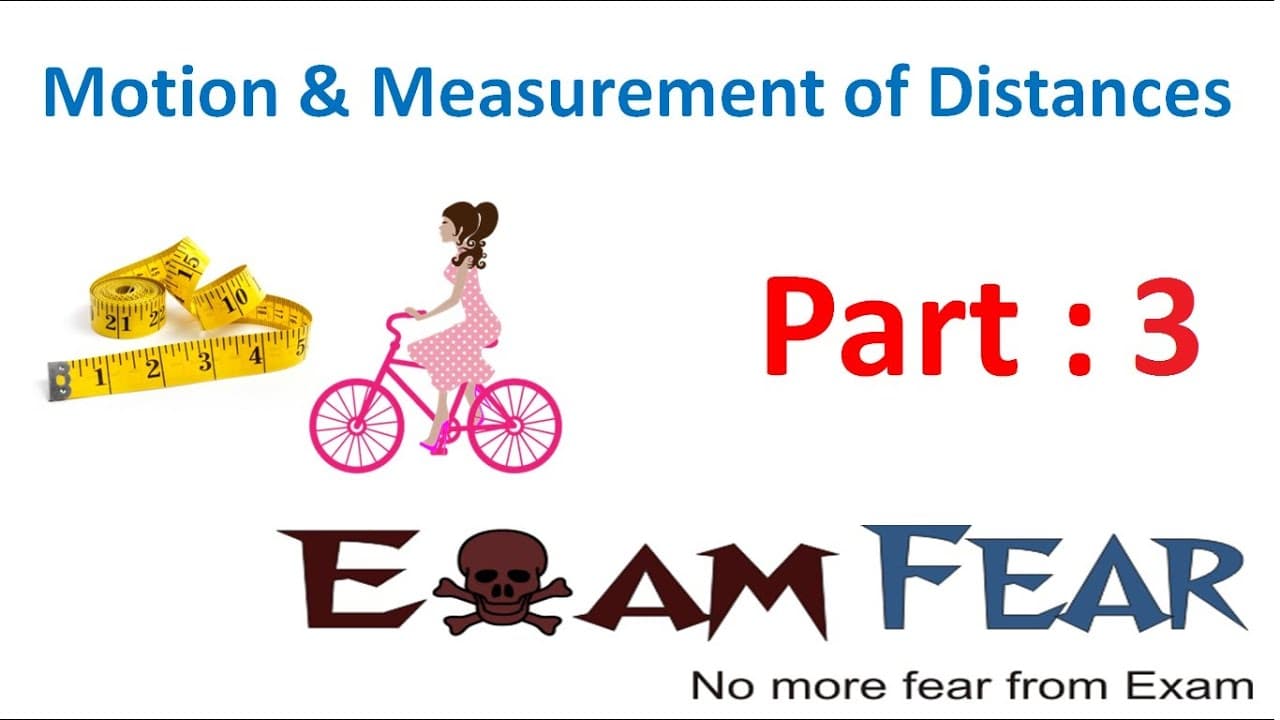
Physics Motion & Measurement of Distance Part 3 (Units to Measure Distance) Class 6 VI
TL;DR
This video explains the different units of length and their use in measuring various distances and objects.
Transcript
hello friends this video on motion and measurement of distance part 3 is brought to you by exam fuel calm no more pure from exam ok so now again let us get back to the measurement of nen now I said that meter is the SI unit for length but besides meter there are many other units also open-end so let us look at the various units of length so they ar... Read More
Key Insights
- 🤒 The video explains the different units of length, including millimeter, centimeter, decimeter, meter, decameter, hectometer, and kilometer.
- 🇦🇪 The sequence of units represents increasing quantities, with millimeter being the smallest unit and kilometer being the largest.
- 🇦🇪 Different units are used based on the distance or object being measured, with larger units used for longer distances and smaller units used for smaller measurements.
- 👻 The variety of units allows for accurate measurement in different situations and contexts.
- 😒 The use of smaller or larger units depends on the scale of the measurement and the object being measured.
- 💦 The video provides examples of when different units would be used, such as measuring the distance between cities or the thickness of a water pipe.
- 🚐 The sequence of units can be remembered using the mnemonic "minis empty dizzy mini simply dressing, taken 2 kilo."
- 🇦🇪 Remembering the sequence of units helps in understanding the relative sizes and quantities they represent and facilitates conversion between different units.
Install to Summarize YouTube Videos and Get Transcripts
Explore YouTube Video Summarizer or Get YouTube Transcript Extractor
Questions & Answers
Q: Why are there so many units to measure length?
The reason for having multiple units is to ensure that different distances or objects can be measured accurately. For larger distances, such as between cities, larger units like kilometers are used. For smaller measurements, such as the thickness of a water pipe, smaller units like millimeters are used.
Q: How do the units of length differ from each other?
The units of length are arranged in a sequence, with millimeter being the smallest and kilometer being the largest. As you move down the sequence, the units represent larger quantities. For example, a centimeter is bigger than a millimeter, and a decameter is bigger than a meter.
Q: When would you use millimeters to measure length?
Millimeters are typically used to measure very small distances or lengths. For example, the thickness of a water pipe or the size of certain objects may be measured in millimeters.
Q: Why is it important to remember the sequence of units?
Remembering the sequence of units is important because it helps in understanding the relative sizes and quantities they represent. It also helps in converting between different units when needed.
Summary & Key Takeaways
-
The video introduces various units of length, including millimeter, centimeter, decimeter, meter, decameter, hectometer, and kilometer.
-
The units are arranged in a sequence to represent increasing quantities, with millimeter being the smallest unit and kilometer being the largest.
-
The use of different units depends on the distance or object being measured, with larger units used for longer distances and smaller units used for smaller measurements.
Read in Other Languages (beta)
Share This Summary 📚
Summarize YouTube Videos and Get Video Transcripts with 1-Click
Try YouTube Summary with ChatGPT & Claude or YouTube Transcript Generator
Explore More Summaries from LearnoHub - Class 11, 12 📚




Summarize YouTube Videos and Get Video Transcripts with 1-Click
Try YouTube Summary with ChatGPT & Claude or YouTube Transcript Generator