My First Computer | James Gosling and Lex Fridman
TL;DR
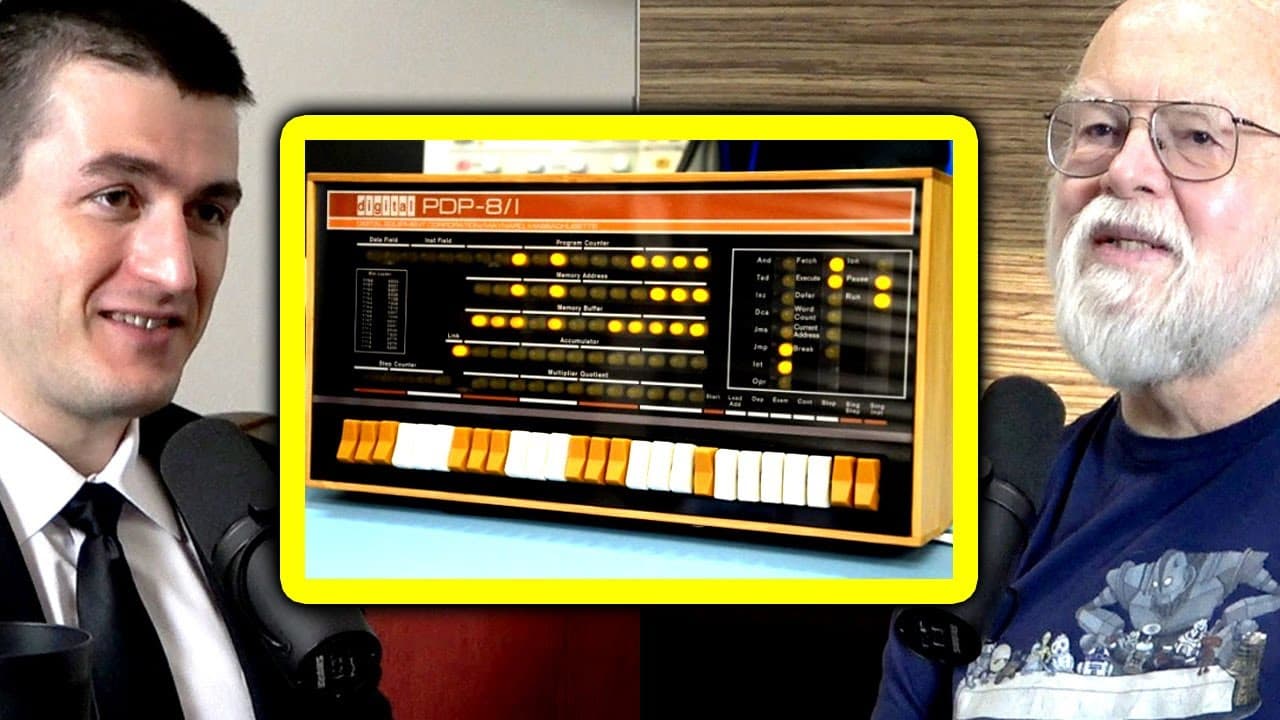
The interviewee discusses their experience programming on a PDP-8 machine, highlighting its limited specs and primitive user interface, but also its accessibility and the excitement of building things without physical materials.
Transcript
what's the first program you've ever written oh i have no idea what the first one was i mean i i know the first machine that i learned that i learned to program on what is it was a a pdp-8 um at the university of calgary do you remember the specs oh yeah so so the thing had 4k of ram nice 12-bit words the clock rate was um it was about a third of a... Read More
Key Insights
- 💽 The PDP-8 was an early mini-computer that universities could afford, but it had limited specs compared to modern computers.
- 👤 Programming on the PDP-8 involved using a model 33 teletype, a primitive user interface without monitors.
- 👻 The accessibility of programming on the PDP-8 allowed individuals with limited resources to build complex things.
- 🤑 The interviewee's experience highlights the excitement of programming and the ability to create without the need for physical materials or money.
- 💖 The limitations of early computers and user interfaces sparked curiosity and resourcefulness in early programmers.
- 🎰 While the PDP-8 was not a widely used machine, it provided a platform for experimentation and learning programming languages.
- 💻 The interviewee's experience with the PDP-8 demonstrates the early stages of computer networking and the potential for future advancements.
Install to Summarize YouTube Videos and Get Transcripts
Explore YouTube Video Summarizer or Get YouTube Transcript Extractor
Questions & Answers
Q: What were the specifications of the PDP-8 machine you learned to program on?
The PDP-8 had 4K of RAM and a clock rate of about a third of a megahertz. It was considered a mini-computer and was affordable for universities.
Q: Did the PDP-8 have time-sharing capabilities?
Yes, there was a time-sharing operating system available for the PDP-8, although it wasn't widely used. The machine I learned on was used for computer networking but was mostly unused.
Q: How did you interact with the PDP-8? Did it have a monitor?
The PDP-8 did not have a monitor. I used a model 33 teletype, which is like a typewriter, and a paper tape reader as the user interface.
Q: Did you realize the potential of exponential improvement and Moore's Law while programming on the PDP-8?
At that time, I didn't see it as anything more than a cool toy. It allowed me to build complex things without needing physical materials or money, but I didn't foresee the massive advancements of technology.
Summary & Key Takeaways
-
The interviewee learned to program on a PDP-8 machine at the University of Calgary, which had 4K of RAM and a clock rate of about a third of a megahertz.
-
The PDP-8 was not considered a supercomputer, but it was one of the first mini-computers that universities could afford to buy.
-
The interviewee initially started programming on the PDP-8 out of curiosity and used a model 33 teletype as the user interface.
Read in Other Languages (beta)
Share This Summary 📚
Summarize YouTube Videos and Get Video Transcripts with 1-Click
Try YouTube Summary with ChatGPT & Claude or YouTube Transcript Generator
Explore More Summaries from Lex Clips 📚


Summarize YouTube Videos and Get Video Transcripts with 1-Click
Try YouTube Summary with ChatGPT & Claude or YouTube Transcript Generator