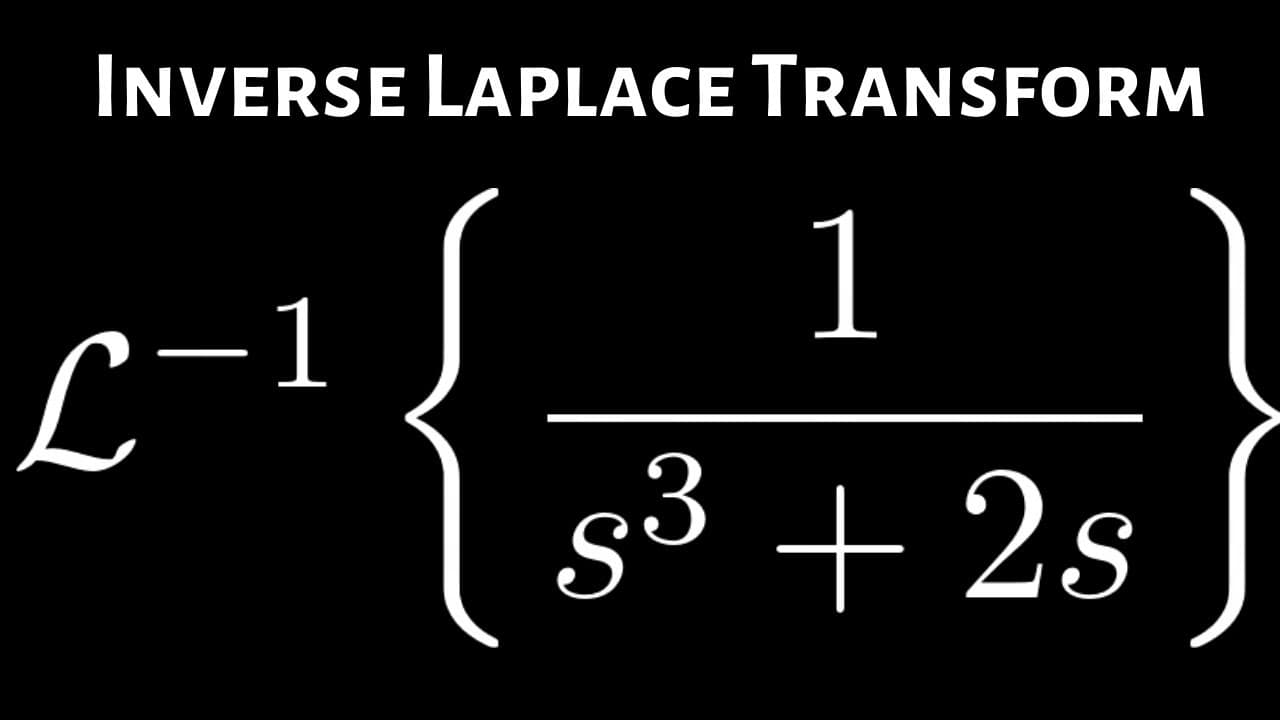
Inverse Laplace Transform of 1/(s^3 + 2s) using Partial Fraction Decomposition
TL;DR
This video explains how to find the inverse Laplace transform using partial fractions.
Transcript
hi everyone in this video we're going to find the inverse Laplace of this expression we're going to do it using partial fractions so let's go through it so first thing you do is you take this expression and you write it down and I believe we can factor out an S here so this will be s parentheses s squared plus 2 yep looks like I did that right so w... Read More
Key Insights
- ❓ Partial fractions are used to simplify the process of finding the inverse Laplace transform.
- 🪈 The order of operations in solving partial fraction problems is crucial for efficiency.
- 🔌 Plugging in values to find coefficients is an important step in the partial fraction method.
- 🍉 Factoring out terms and expressing squared terms as linear pieces is a common practice in partial fractions.
- 🥡 The inverse Laplace transform can be obtained by taking the inverse Laplace of each individual fraction.
- 📔 The cover-up method is not applicable in all situations, and partial fractions are used as an alternative.
- 🙃 Coefficients are determined by comparing terms with the same power of s on both sides of the equation.
Install to Summarize YouTube Videos and Get Transcripts
Explore YouTube Video Summarizer or Get YouTube Transcript Extractor
Questions & Answers
Q: How does the process of finding the inverse Laplace transform using partial fractions work?
The process starts with factoring out the linear term and expressing the squared term as a linear piece. Coefficients are then found by plugging in values, and the inverse Laplace transform is obtained by taking the inverse Laplace of each separate piece.
Q: Why is it important to follow a specific order of operations when solving partial fraction problems?
The order of operations helps to make the process more efficient. It is advised to first plug in values that will make certain terms cancel out before resorting to finding coefficients, as this simplifies the problem and makes it easier to solve.
Q: What is the purpose of using partial fractions in finding the inverse Laplace transform?
Partial fractions help in breaking down complex expressions into simpler fractions, which can then be individually transformed back into the time domain. This makes it easier to calculate the inverse Laplace transform.
Q: How are coefficients found in partial fraction problems?
The coefficients are found by equating the coefficients of terms with the same power of s on both sides of the equation. By comparing coefficients, the values of the unknown variables can be determined.
Summary & Key Takeaways
-
The video discusses the process of finding the inverse Laplace transform using partial fractions.
-
It explains that by factoring out the linear term and expressing the squared term as a linear piece, the expression can be simplified.
-
The video also discusses the order of operations when solving partial fraction problems and emphasizes the importance of plugging in values to find the coefficients.
Read in Other Languages (beta)
Share This Summary 📚
Summarize YouTube Videos and Get Video Transcripts with 1-Click
Try YouTube Summary with ChatGPT & Claude or YouTube Transcript Generator
Explore More Summaries from The Math Sorcerer 📚


Summarize YouTube Videos and Get Video Transcripts with 1-Click
Try YouTube Summary with ChatGPT & Claude or YouTube Transcript Generator