Wave Equation
TL;DR
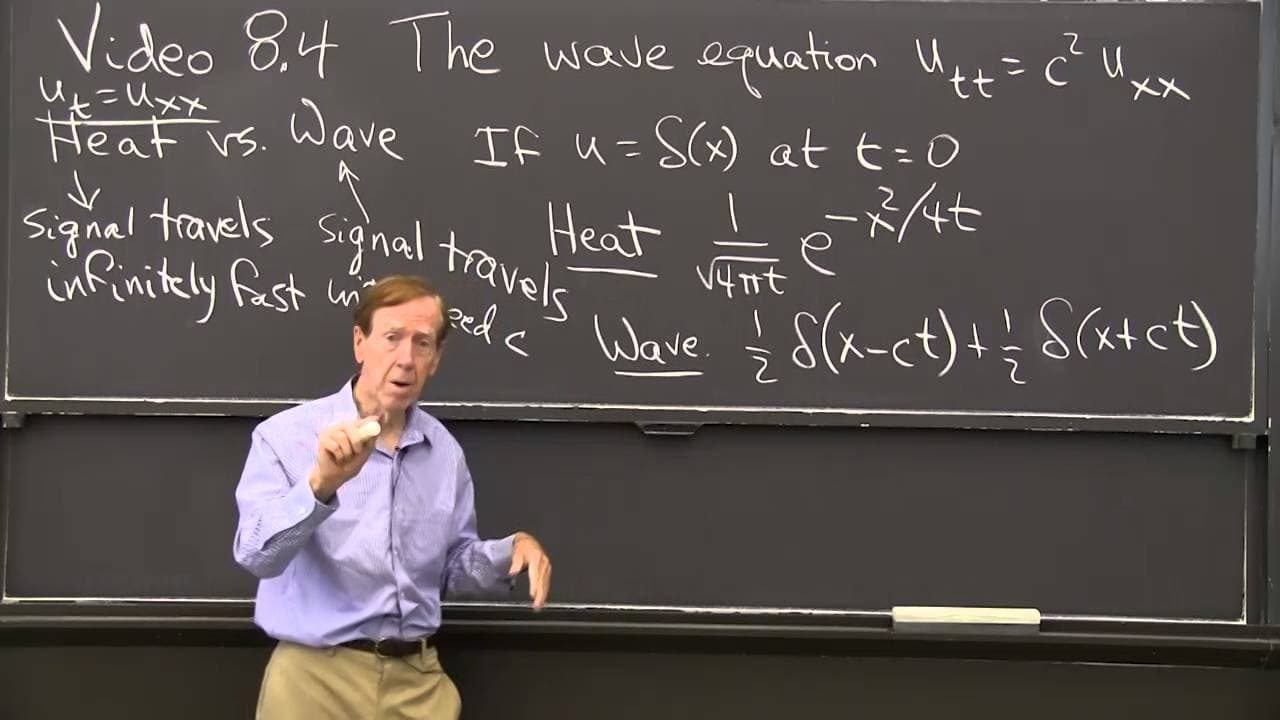
The wave equation is a hyperbolic equation that describes the behavior of waves, while the heat equation is a parabolic equation that describes the diffusion of heat. The wave equation allows for the propagation of signals with finite velocity, while the heat equation allows for instant diffusion.
Transcript
GILBERT STRANG: OK. This video is about the third of the great trio of partial differential equations. Laplace's equation was number one. That's called an elliptic equation. The heat equation was number two. That's called a parabolic equation. Now we reach the wave equation. That's number three, and it's called a hyperbolic equation. So somehow the... Read More
Key Insights
- 🥵 Laplace's equation, the heat equation, and the wave equation are the three main types of partial differential equations.
- 🥵 The wave equation is a hyperbolic equation, while the heat equation is a parabolic equation.
- 👻 The wave equation allows for the finite velocity propagation of signals, while the heat equation allows for instant diffusion.
- ⌛ The wave equation is second-order in both time and space, while the heat equation is first-order in time.
- 👋 For specific initial conditions, such as a delta function, the solutions to the wave equation consist of traveling waves.
- 👋 The wave equation provides important information about tsunamis, including the speed at which the wave propagates.
- 👋 The wave equation can be solved using separation of variables to obtain a series solution.
Install to Summarize YouTube Videos and Get Transcripts
Explore YouTube Video Summarizer or Get YouTube Transcript Extractor
Questions & Answers
Q: What are the main differences between the heat equation and the wave equation?
The heat equation allows for instant diffusion of heat, while the wave equation allows for the finite velocity propagation of signals. Additionally, the heat equation is first-order in time, while the wave equation is second-order in time.
Q: How does a wave propagate according to the wave equation?
According to the wave equation, a wave travels with a finite velocity. For a specific initial condition, such as a delta function, the solution consists of two waves traveling in opposite directions, each represented by half of a delta function.
Q: What is the advantage of using the wave equation to study tsunamis?
The wave equation provides crucial information about tsunamis, such as the speed at which the wave propagates. This information can be used to alert people about an approaching tsunami, which is not possible with the heat equation.
Q: How can the wave equation be solved for different initial conditions?
The wave equation can be solved using separation of variables. By separating the variables of time and space, the solution can be expressed as a sum of separated sine and cosine functions, each multiplied by coefficients determined by the initial conditions.
Summary & Key Takeaways
-
The wave equation is the third of the trio of partial differential equations, along with Laplace's equation (elliptic) and the heat equation (parabolic).
-
The wave equation involves second-order derivatives in time and space, while the heat equation involves first-order derivatives in time.
-
The wave equation allows for the finite velocity propagation of signals, while the heat equation allows for instantaneous diffusion of heat.
Read in Other Languages (beta)
Share This Summary 📚
Summarize YouTube Videos and Get Video Transcripts with 1-Click
Try YouTube Summary with ChatGPT & Claude or YouTube Transcript Generator
Explore More Summaries from MIT OpenCourseWare 📚
Summarize YouTube Videos and Get Video Transcripts with 1-Click
Try YouTube Summary with ChatGPT & Claude or YouTube Transcript Generator