Steering angle | Change of beam width | Radar Systems | Lec-69
TL;DR
This video explains the relationship between beam width and steering angle in phased array antennas.
Transcript
hi everyone in this video I am going to explain you about the relation between beam width and steering angle what do you mean by steering angle and what do you mean by beam width beam width is nothing but half power width so beam width is nothing but beam width is nothing but half power being width half power being with this so in this case we are ... Read More
Key Insights
- 😁 Beam width is the half-power width of the radiation pattern and plays a crucial role in antenna design and performance.
- 📡 Steering angle dictates the directionality of the radiation pattern in phased array antennas, essential for effective communication and signal clarity.
- 😁 There is a quantifiable relationship between beam width and steering angle that can be expressed mathematically.
- 😁 As the steering angle increases, the beam width decreases, affecting the antenna's focusing ability.
- 📡 Understanding these parameters is critical for optimizing phased array antennas in various applications, such as radar and telecommunications.
- 🦻 The mathematical manipulation using trigonometric functions aids in visualizing and predicting antenna behavior under specific operating conditions.
- 📡 The content emphasizes a comprehensive theoretical basis for practical applications in antenna engineering.
Install to Summarize YouTube Videos and Get Transcripts
Explore YouTube Video Summarizer or Get YouTube Transcript Extractor
Questions & Answers
Q: What is beam width, and why is it important in phased array antennas?
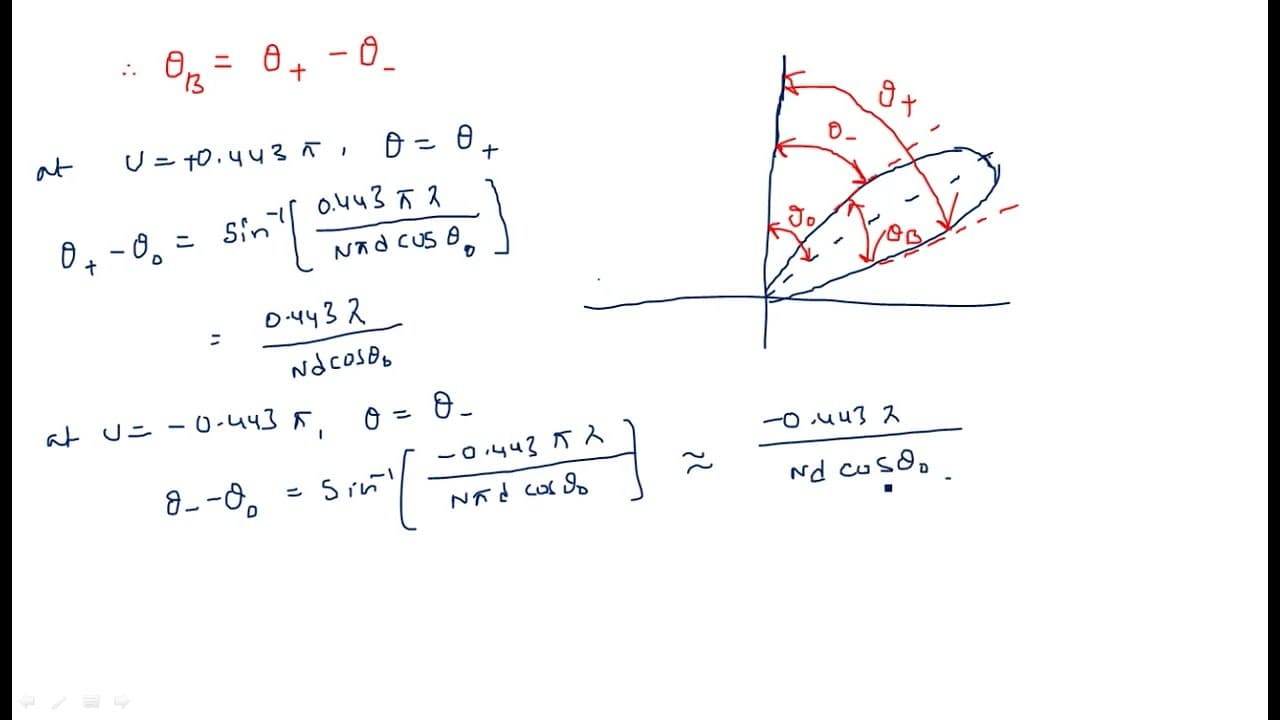
Beam width refers to the half-power width of the antenna's radiation pattern, specifically indicated by Theta B. It is significant because it determines how focused the antenna's energy is, directly impacting the antenna's performance in targeted radiation and reception over specific directions.
Q: How is steering angle defined in the context of this video?
The steering angle, denoted as Theta naught, is defined as the angle at which the radiation pattern is transmitted or received. Understanding this angle is crucial for optimizing the directionality of phased array antennas during operation and signal processing.
Q: Can you explain the mathematical relationship derived between beam width and steering angle?
The relationship shows that beam width (Theta B) is inversely proportional to the steering angle (Theta naught). As the steering angle increases, the beam width decreases, indicating more focused attenuation of the beam, which is critical in enhancing performance during directional signal transmission.
Q: What role does the expression involving sine functions play in the video?
The sine function expression is vital in illustrating the behavior of the radiation pattern in terms of steering angle and beam width. By manipulating these functions, the presenter can derive relationships that help in understanding how beam width changes with variations in the steering angle.
Summary & Key Takeaways
-
The video discusses the concepts of beam width and steering angle, defining beam width as the half-power width, indicated by Theta B, and the steering angle, Theta naught, as the angle of radiation transmission.
-
A mathematical relationship between beam width (Theta B) and steering angle (Theta naught) is explored, showing how these parameters interact under specific conditions in phased array antennas.
-
The presenter derives an expression demonstrating that beam width is inversely proportional to the steering angle, indicating that as the steering angle increases, the beam width decreases.
Read in Other Languages (beta)
Share This Summary 📚
Summarize YouTube Videos and Get Video Transcripts with 1-Click
Try YouTube Summary with ChatGPT & Claude or YouTube Transcript Generator