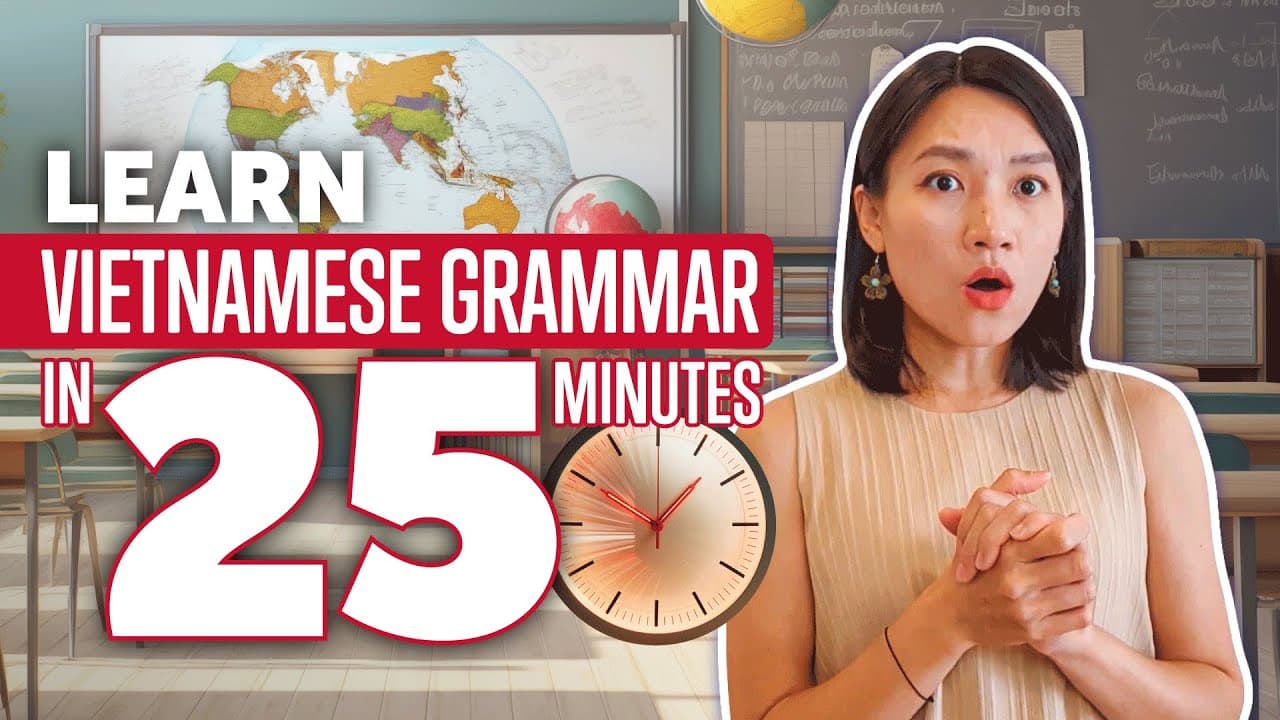
Learn Vietnamese Grammar in 25 Minutes: Master Vietnamese Course
TL;DR
Learn Vietnamese basics, including greetings and grammar tips.
Transcript
expand your vocabulary with our core 2000w ebook it's free and packed with essential Expressions that you'll use on a daily basis start building your vocabulary today click the link in the description below to download your free Vietnamese ebook before it's gone welcome to Vietnamese part 101.com B the fastest easiest and most fun way to learn vame... Read More
Key Insights
- The video offers a free 2000-word Vietnamese ebook to help expand vocabulary with essential daily expressions.
- Basic Vietnamese introductions are simple, requiring only two sentences, suitable for both formal and informal settings.
- Vietnamese people tend to prefer closer relationships, often saying 'I'm happy to get to know you' rather than just 'nice to meet you.'
- There is a more formal way to introduce oneself in Vietnamese, which includes saying 'my name is' instead of 'I am.'
- Vietnamese greetings are simple and do not change with the time of day, unlike in English.
- The video provides practical tips for mastering Vietnamese grammar through listening, reading, and engaging with lessons.
- Using questions is a key strategy to keep conversations going, especially for beginners.
- Exposure to real conversations and examples is crucial for mastering Vietnamese grammar and vocabulary.
Install to Summarize YouTube Videos and Get Transcripts
Explore YouTube Video Summarizer or Get YouTube Transcript Extractor
Questions & Answers
Q: What are the basic Vietnamese greetings mentioned in the video?
The video explains that the basic Vietnamese greeting is 'sin chào,' which means 'hi' or 'hello.' It is used in both formal and informal situations and can be used at any time of the day. The farewell 'tạm biệt' means 'goodbye,' and 'hẹn gặp lại' means 'see you soon.'
Q: How does the video suggest mastering Vietnamese grammar?
The video suggests mastering Vietnamese grammar by listening to lesson conversations and explanations, reading bonus explanations and tutorials, and leaving comments for practice. It also recommends unlocking more grammar lessons through the lesson library and engaging with real conversations to understand grammar in context.
Q: What is the importance of asking questions in a conversation according to the video?
According to the video, asking questions is crucial for keeping a conversation going, especially for beginners. It helps avoid awkward silences and allows learners to engage with native speakers even with limited vocabulary. Memorizing key questions and knowing when to use them can significantly improve conversational skills.
Q: What resources does the video offer to help learn Vietnamese?
The video offers a free 2000-word ebook to help expand vocabulary with essential expressions. It also provides access to over 2,500 video and audio lessons, a grammar bank for detailed explanations, and a structured learning program for mastering Vietnamese quickly and efficiently.
Q: What is the recommended way to introduce oneself in Vietnamese?
The recommended way to introduce oneself in Vietnamese is by saying 'sin chào, tôi là [name], rất vui được gặp bạn,' which translates to 'Hi, I am [name], nice to meet you.' This introduction is neutral and suitable for both formal and informal situations. A more formal version involves saying 'tên tôi là [name],' meaning 'my name is [name].'
Q: How are gratitude and politeness expressed in Vietnamese?
Gratitude in Vietnamese is expressed by saying 'cảm ơn,' meaning 'thank you.' To say 'thank you very much,' one can say 'cảm ơn nhiều.' For a more formal expression, 'xin cảm ơn' is used. Responses to gratitude include 'không có gì,' meaning 'it's nothing,' or 'không sao,' meaning 'no problem.'
Q: What does the video say about the use of pronouns in Vietnamese?
The video notes that Vietnamese uses a complex system of pronouns based on gender, age, and relationship closeness. The pronoun 'bạn' is generally used for someone younger, about the same age, or a few years older. For older individuals, adding 'ạ' at the end of a question shows respect.
Q: How does the video encourage learners to practice Vietnamese?
The video encourages learners to practice Vietnamese by engaging with lesson content, leaving comments for feedback, and using the grammar bank for additional study. It emphasizes the importance of exposure to real conversations and suggests using video and audio lessons repeatedly to reinforce learning.
Summary & Key Takeaways
-
The video provides a comprehensive guide to learning basic Vietnamese, including introductions, greetings, and expressions of gratitude. It emphasizes the simplicity of Vietnamese greetings, which do not change with the time of day, and offers a free 2000-word ebook to expand vocabulary.
-
Viewers are encouraged to engage with the content by listening to conversations, reading bonus explanations, and leaving comments for feedback. The video highlights the importance of asking questions to maintain conversations and suggests memorizing core vocabulary for better communication.
-
The video stresses the significance of real-life exposure to Vietnamese through audio and video lessons. It promotes using the grammar bank for in-depth learning and advises learners to practice regularly to achieve fluency. The content is designed to be the fastest and most enjoyable way to learn Vietnamese.
Read in Other Languages (beta)
Share This Summary 📚
Summarize YouTube Videos and Get Video Transcripts with 1-Click
Try YouTube Summary with ChatGPT & Claude or YouTube Transcript Generator
Explore More Summaries from Learn Vietnamese with VietnamesePod101.com 📚



Summarize YouTube Videos and Get Video Transcripts with 1-Click
Try YouTube Summary with ChatGPT & Claude or YouTube Transcript Generator