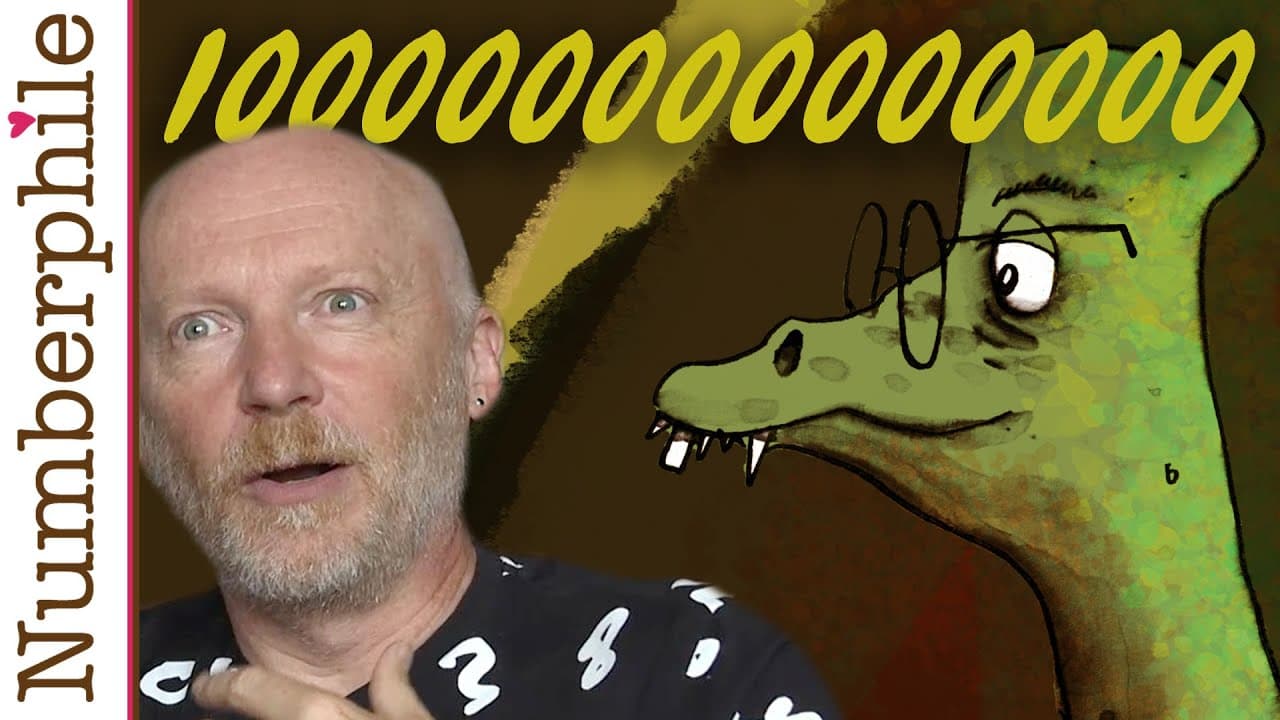
How to write 100,000,000,000,000 poems - Numberphile
TL;DR
The OuLiPo movement uses mathematics to generate literature and explore new artistic ideas, such as Queneau's sonnets and Perec's use of Latin-Graeco squares in his novel.
Transcript
People probably have heard of Bourbaki, this group of mathematicians that came together in France to kind of rewrite the foundations of mathematics. I remember being rather blown away when I went into the library and seeing all of these books by this one mathematician, Bourbaki, kind of freaked me out and I was quite pleased to discover oh... Read More
Key Insights
- 🥰 The OuLiPo movement used mathematics to push the boundaries of creativity in literature and art.
- #️⃣ Queneau's method of writing sonnets demonstrated how mathematics can be used to generate a vast number of unique compositions.
- ✍️ Perec's novel showcased how mathematics could provide a structure and constraint that inspires inventive writing.
- 🥰 Art and literature can inspire mathematicians to explore new mathematical concepts and structures.
- 💭 Using mathematics in creative endeavors can be both fun and thought-provoking, even if not every output is meaningful.
- 💦 Calvino and Borges are examples of authors who incorporated mathematical ideas into their works, producing literature that reflects mathematical structures.
- 🥰 Constraints and mathematical rules in art and literature can lead to unexpected and innovative outcomes.
Install to Summarize YouTube Videos and Get Transcripts
Explore YouTube Video Summarizer or Get YouTube Transcript Extractor
Questions & Answers
Q: What is the OuLiPo movement and how does it use mathematics in literature?
The OuLiPo movement was a group of mathematicians and writers in France who used mathematics as a tool to generate literature and explore new ideas. They applied mathematical principles, such as permutations and constraints, to the creative process.
Q: How did Queneau write a hundred thousand billion sonnets using mathematics?
Queneau used a mathematical shortcut to generate a massive number of sonnets. He wrote 10 lines for each of the 14 lines in a sonnet, giving him 10 choices for each line. By randomly choosing these lines, he could create a vast number of unique sonnets.
Q: How did Perec use mathematics as a structure for his novel?
Perec used a 10x10 Latin-Graeco square, a mathematical concept similar to a sudoku, as the structure for his novel, "Life, a User's Manual." Each square represented a chapter, and Perec filled each square with different ideas that followed specific rules to avoid repetitions. This structure compelled him to write chapters involving the ideas in each square.
Q: Can mathematics benefit from art and literature?
Yes, art and literature can inspire mathematical exploration. The Fibonacci numbers, for example, were initially discovered by poets and musicians as they counted the number of rhythms possible with long and short beats. Artists' unique perspectives can lead mathematicians to discover new mathematical structures and ideas.
Summary & Key Takeaways
-
The OuLiPo movement, inspired by the Bourbaki group, used mathematics to generate literature and push the boundaries of creativity.
-
Queneau devised a method to write a hundred thousand billion sonnets by exploiting the mathematical principle of permutations.
-
Perec used a 10x10 Latin-Graeco square as the structure for his novel, "Life, a User's Manual," using mathematics as a constraint to inspire inventive writing.
Read in Other Languages (beta)
Share This Summary 📚
Summarize YouTube Videos and Get Video Transcripts with 1-Click
Try YouTube Summary with ChatGPT & Claude or YouTube Transcript Generator
Explore More Summaries from Numberphile 📚
Summarize YouTube Videos and Get Video Transcripts with 1-Click
Try YouTube Summary with ChatGPT & Claude or YouTube Transcript Generator