Products
Features
YouTube Video Summarizer
Summarize YouTube videos
Web & PDF Highlighter
Highlight web pages & PDFs
Chat with PDF
Ask any PDF questions with AI
Ask AI Clone
Chat with your highlights & memories
Audio Transcriber
Transcribe audio files to text
Glasp Reader
Read and highlight articles
Kindle Highlight Export
Export your Kindle highlights
Idea Hatch
Hatch ideas from your highlights
Integrations
Obsidian Plugin
Notion Integration
Pocket Integration
Instapaper Integration
Medium Integration
Readwise Integration
Snipd Integration
Hypothesis Integration
Apps & Extensions
Chrome Extension
Safari Extension
Edge Add-ons
Firefox Add-ons
iOS App
Android App
Discover
Discover
Ideas
Discover new ideas and insights
Articles
Curated articles and insights
Books
Book recommendations by great minds
Posts
Essays and notes from readers
Quotes
Inspiring quotes collection
Videos
Curated videos and summaries
Explore Glasp
Glasp Newsletter
Weekly insights and updates
Glasp Talk
Interview series with great minds
Glasp Blog
Latest news and articles
Glasp Use Cases
Learn how others use Glasp
Build & Support
Glasp API
Access Glasp's API for developers
MCP Connector
Connect Glasp to Claude & ChatGPT
Community
Glasp Reddit Community
Students
Student discount and benefits
FAQs
Frequently Asked Questions
AboutPricing
DashboardLog inSign up

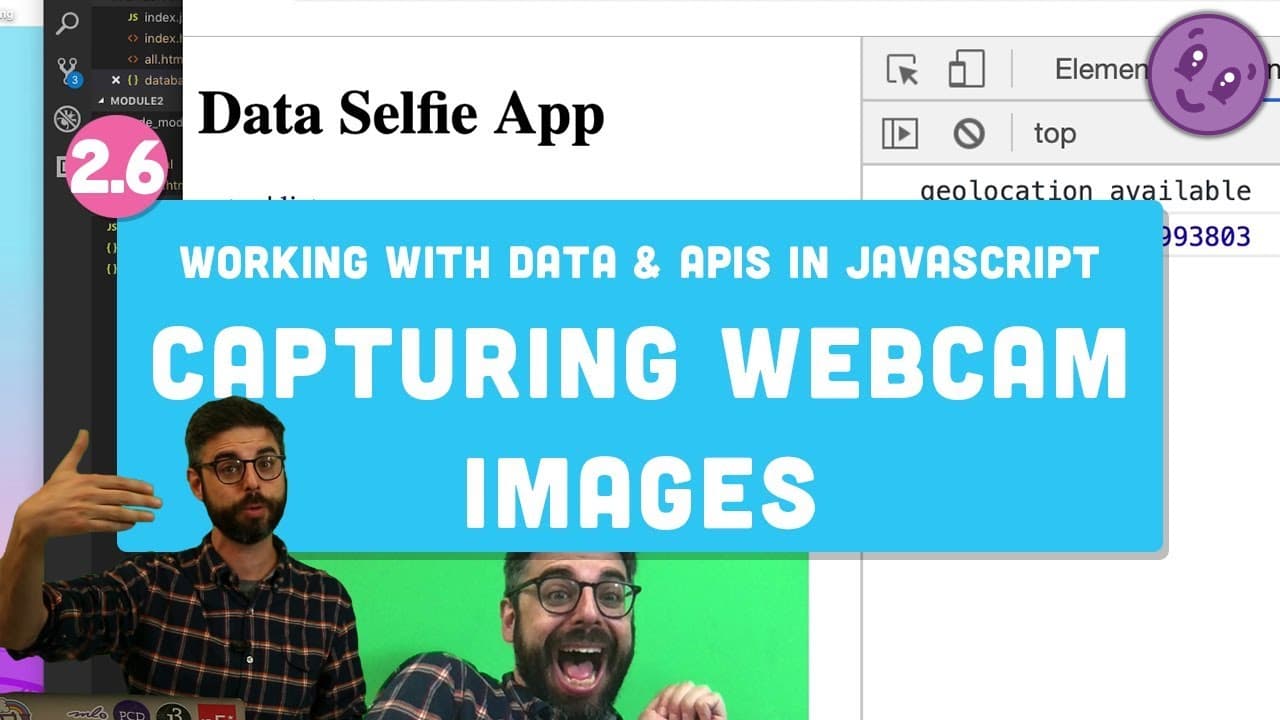
2.6 Saving Images and Base64 Encoding - Working with Data and APIs in JavaScript
95.5K views
•
June 6, 2019
by
The Coding Train
YouTube video player
2.6 Saving Images and Base64 Encoding - Working with Data and APIs in JavaScript

TL;DR

This tutorial demonstrates how to use the p5.js library to add a webcam image to a database in a data selfie app.

Transcript

I am back to finish off the data selfie app with one more feature, and that feature is adding something else to the database-- namely, an image from the webcam. So this is the perfect opportunity, I'm very excited about this, to use the p5.js library in this project. So actually it's kind of strange this particular course, this playlist of videos, ... Read More

Key Insights

  • 😀 The p5.js library is used to integrate webcam functionality into a data selfie app.
  • 💨 Base64 encoding is a convenient way to store and transmit image data as a string.
  • 😀 The p5.js setup function plays a crucial role in initializing the app and connecting to the webcam.
  • 📟 The image can be added to the HTML page dynamically using JavaScript and the base64 encoded data.

Install to Summarize YouTube Videos and Get Transcripts

Explore YouTube Video Summarizer or Get YouTube Transcript Extractor

Questions & Answers

Q: What is the purpose of using the p5.js library in this project?

The p5.js library is used to connect to the webcam, display the image on a canvas, and convert the image to base64 encoding for storage in the database.

Q: Why is base64 encoding used for storing the image in the database?

Base64 encoding allows the image data to be easily converted to a string and passed in the HTTP request body. It provides a convenient way to transmit the image data.

Q: What is the role of the setup function in p5.js?

The setup function in p5.js is equivalent to the window.onload or jQuery's ready function. It is executed when the webpage is loaded and everything is ready to go.

Q: How can the image be displayed on the list page of the app?

By creating an image element using document.createElement() and setting the source attribute to the base64 encoded image data, the image can be dynamically added to the page.

Summary & Key Takeaways

  • The p5.js library is used to connect to the webcam and display the image on a canvas.

  • The image is then converted to base64 encoding and stored in the database.

  • The code is structured using the p5.js setup function and the video.canvas.toDataURL() function.

  • The app allows users to submit their mood and capture and store an image from their webcam.


Read in Other Languages (beta)

English

Share This Summary 📚

Summarize YouTube Videos and Get Video Transcripts with 1-Click

Download browser extensions on:

Try YouTube Summary with ChatGPT & Claude or YouTube Transcript Generator

Explore More Summaries from The Coding Train 📚
Coding Challenge #126: Toothpicks thumbnail
Coding Challenge #126: Toothpicks
The Coding Train
Coding Challenge #116: Lissajous Curve Table thumbnail
Coding Challenge #116: Lissajous Curve Table
The Coding Train
9.4: Genetic Algorithm: Looking at Code - The Nature of Code thumbnail
9.4: Genetic Algorithm: Looking at Code - The Nature of Code
The Coding Train
Text Generation using Spell with Nabil Hassein thumbnail
Text Generation using Spell with Nabil Hassein
The Coding Train
Classifying Poses with ml5.js Part 2 thumbnail
Classifying Poses with ml5.js Part 2
The Coding Train
8.1: Fractals - The Nature of Code thumbnail
8.1: Fractals - The Nature of Code
The Coding Train

Summarize YouTube Videos and Get Video Transcripts with 1-Click

Download browser extensions on:

Try YouTube Summary with ChatGPT & Claude or YouTube Transcript Generator

Apps & Extensions

  • Chrome Extension
  • Safari Extension
  • Edge Add-ons
  • Firefox Add-ons
  • iOS App
  • Android App

Key Features

  • YouTube Video Summarizer
  • Web & PDF Summarizer
  • Web & PDF Highlighter
  • Chat with PDF
  • Ask AI Clone
  • Audio Transcriber
  • Glasp Reader
  • Kindle Highlight Export
  • Idea Hatch

Integrations

  • Obsidian Plugin
  • Notion Integration
  • Pocket Integration
  • Instapaper Integration
  • Medium Integration
  • Readwise Integration
  • Snipd Integration
  • Hypothesis Integration

More Features

  • APIs
  • MCP Connector
  • Blog & Post
  • Embed Links
  • Image Highlight
  • Personality Test
  • Quote Shots

Company

  • About us
  • Blog
  • Community
  • FAQs
  • Job Board
  • Newsletter
  • Pricing
Terms

•

Privacy

•

Guidelines

© 2026 Glasp Inc. All rights reserved.