Ron Vale (UCSF, HHMI) 1: Molecular Motor Proteins
TL;DR
This talk introduces molecular motor proteins, their functions in cells, their ability to convert chemical energy into motion, and their implications in human health and disease.
Transcript
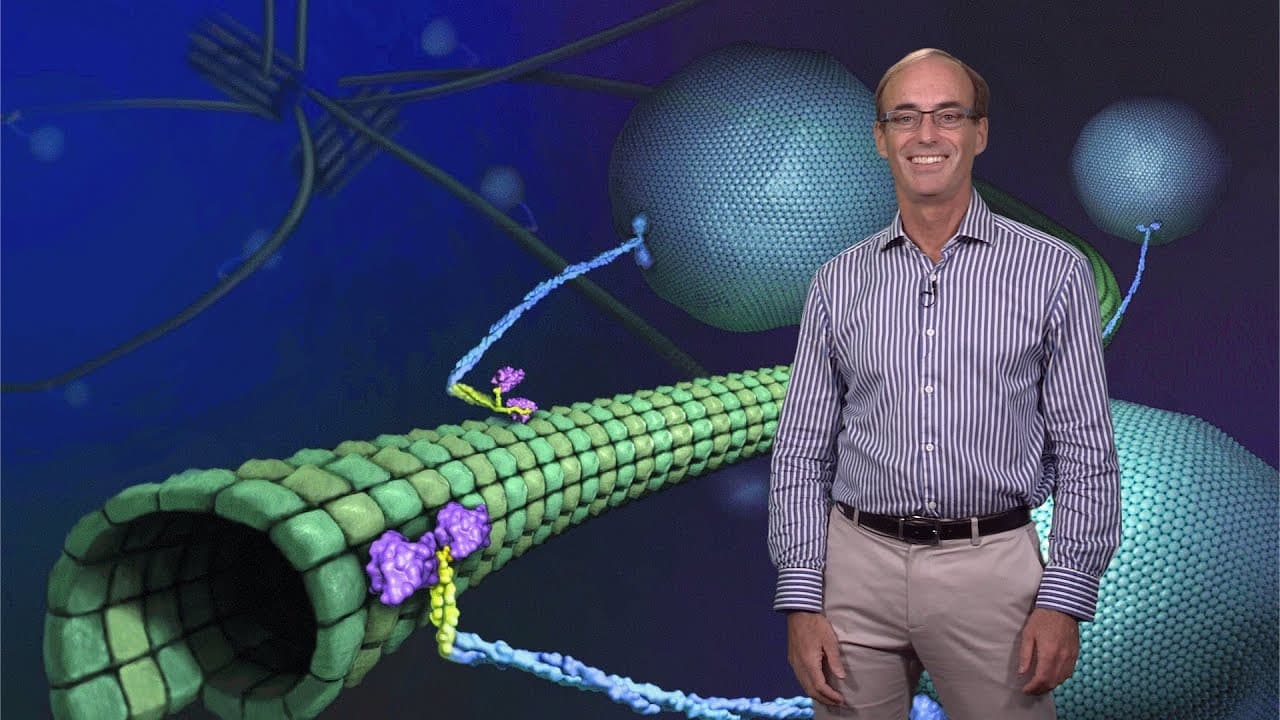
Hello. I'm Ron Vale, and in this talk I'd like to introduce you to molecular motor proteins, which are these fascinating protein machines that are featured in this animated video here. And these proteins are able to walk along a cytoskeletal track and transport a variety of different types of cargos inside of cells. What I'd like to do today is, f... Read More
Key Insights
- 🧬 Molecular motor proteins are fascinating protein machines that can walk along a cytoskeletal track and transport various types of cargos inside cells.
- 🧲 Biological motion is a fundamental attribute of all living organisms and can be observed through muscle contractions and movements of cells and material inside cells.
- 🔬 Microscopy has played a major role in understanding biological motility, allowing scientists to observe the dynamics of living cells and the movements of different types of organelles and molecules.
- ♂️ Molecular motor proteins interact with cytoskeletal tracks, such as microtubules and actin filaments, to carry out their functions.
- 📺 In vitro motility assays and single molecule studies have provided insights into the mechanisms of these motor proteins, including their ability to generate forces and take steps along the cytoskeletal tracks.
- ⚙️ Motor proteins have similar enzymatic and structural characteristics, suggesting a common evolutionary origin, but they have evolved different mechanical elements to perform specific types of motility.
- 💊 Mutations in motor proteins and associated proteins can lead to various diseases, but they can also be targeted for therapeutic modulation to improve motor protein function and treat conditions such as heart failure.
- ❓ Many questions and challenges remain in understanding how motor proteins interact with their cargos, how their biophysical properties are tuned by evolution, and how they can be further manipulated for medical applications.
Install to Summarize YouTube Videos and Get Transcripts
Explore YouTube Video Summarizer or Get YouTube Transcript Extractor
Questions & Answers
Q: How do molecular motor proteins convert chemical energy into motion?
Molecular motor proteins convert chemical energy into motion through ATP hydrolysis. By binding ATP, hydrolyzing it, and releasing the products in a sequential manner, the motor proteins undergo structural changes that allow them to take steps along the cytoskeletal tracks.
Q: What are the two major types of cytoskeletal tracks that motor proteins interact with?
Motor proteins interact with microtubules and actin filaments, which serve as the cytoskeletal tracks for their movement.
Q: How do kinesin and dynein differ in terms of their directionality along microtubules?
Kinesin moves towards the plus end of microtubules, delivering cargos from the interior to the periphery of the cell. Dynein moves towards the minus end, delivering cargos from the periphery to the interior.
Q: What are some examples of cargos transported by motor proteins?
Motor proteins transport a variety of cargos, including membrane organelles, large organelles like the nucleus, viruses, and mRNA molecules. The specific cargos and destinations depend on the type of motor protein and its associated regulatory mechanisms.
Q: How do motor proteins contribute to muscle contraction?
Motor proteins, specifically myosin, interact with actin filaments within sarcomeres to generate muscle contraction. The myosin heads bind to actin, undergo conformational changes during ATP hydrolysis, and produce the sliding motion between actin filaments, leading to sarcomere shortening and muscle contraction.
Q: What are some diseases associated with mutations in molecular motor proteins?
Mutations in motor proteins, such as cardiac myosin, dynein, and kinesin, are associated with various diseases. For example, familial hypertrophic cardiomyopathy is caused by mutations in cardiac myosin, while mutations in dynein can lead to ciliary dyskinesias. Neurodegenerative diseases can be associated with mutations in kinesin motors.
Q: How can motor protein function be modulated for therapeutic purposes?
Modulating motor protein function can have therapeutic implications. For instance, a small molecule drug, Omecamtiv mercarbil, has been developed to activate cardiac myosin and improve heart contractility in heart failure patients. This example highlights the potential for targeted modulation of motor proteins to treat specific diseases.
Summary & Key Takeaways
-
Biological motion is a fundamental aspect of living organisms, and molecular motor proteins play a crucial role in various cellular functions.
-
Motor proteins interact with cytoskeletal tracks, such as microtubules and actin filaments, and transport cargos within cells.
-
Different motor proteins have evolved to perform specific functions, and understanding their mechanisms can lead to new insights into human diseases and potential therapeutic strategies.
Read in Other Languages (beta)
Share This Summary 📚
Summarize YouTube Videos and Get Video Transcripts with 1-Click
Try YouTube Summary with ChatGPT & Claude or YouTube Transcript Generator
Explore More Summaries from Science Communication Lab 📚
Summarize YouTube Videos and Get Video Transcripts with 1-Click
Try YouTube Summary with ChatGPT & Claude or YouTube Transcript Generator