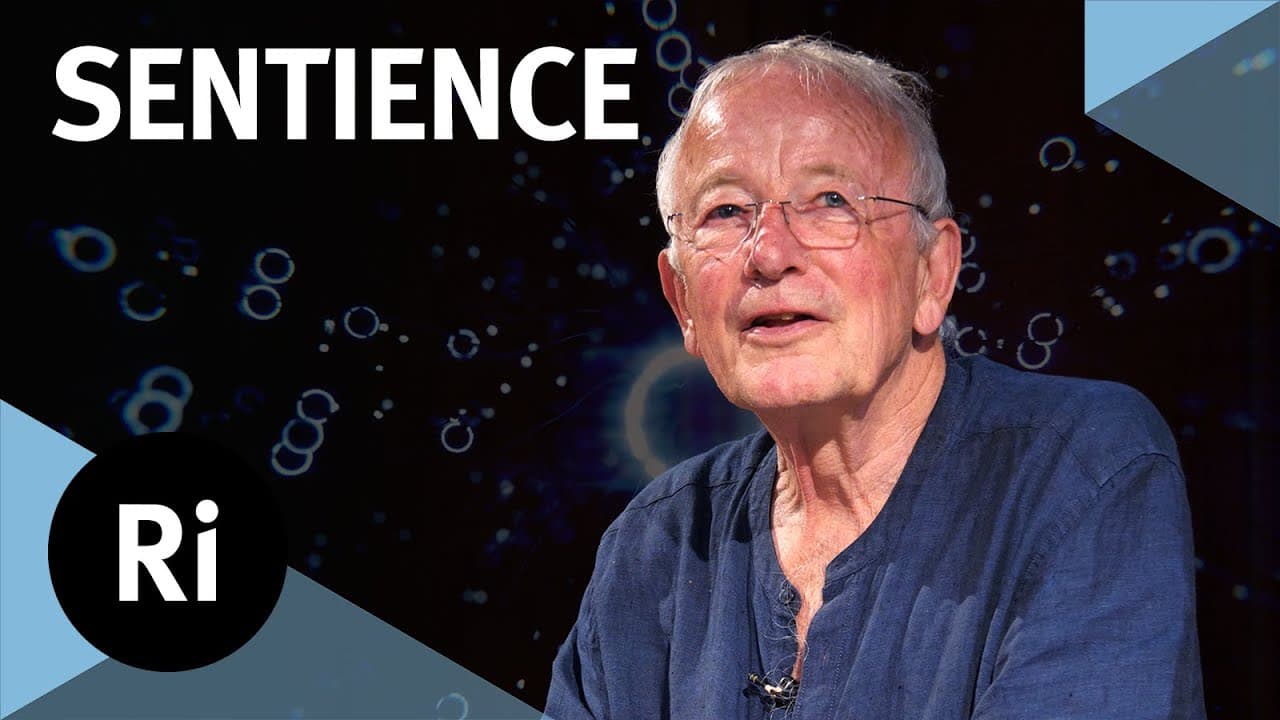
How did consciousness evolve? - with Nicholas Humphrey
TL;DR
This talk explores the evolution of sentience, from blindsight to phenomenal consciousness, and suggests that it may have originated in warm-blooded mammals and birds.
Transcript
(funky bright whooshing) (crowd clapping) - I was hoping Daniel wouldn't mention that, 'cause you may think you're getting kind of secondhand goods, but I have been writing a lot of books over the last few years, and every time I think I've nailed it and then either I or someone else points out that, no, you haven't quite got there yet. Well, this ... Read More
Key Insights
- 🧠 The brain is seen as a living machinery that generates conscious feeling, in contrast to the view of the brain as a biophysical engine for mechanical work.
- 🔄 Paradoxes and logical conundrums have long fascinated thinkers and have led to deep exploration into the nature of consciousness and self-awareness.
- 🔍 Blindsight, a phenomenon in which individuals have no conscious awareness of visual stimuli but can still accurately perceive and interact with the environment, challenges traditional notions of consciousness and perception.
- 🌟 Sensations and perceptions are distinct mental representations, with sensations being personal evaluations of sensory stimuli and perceptions being about the external world.
- 🔑 Sentience, or phenomenal consciousness, may have evolved as an active behavioral response to stimuli, allowing for an evaluation of the stimulus and the creation of mental representations.
- 🐦 Warm-blooded animals may be more likely to possess sentience due to the physiological and neural changes associated with their evolution.
- 🤖 While current machines may possess sensory capabilities, they likely lack the necessary self-awareness and sense of self to experience sentience.
- 🌍 The distribution of sentience across the animal kingdom is likely limited to mammals and birds, with other animals lacking the necessary brain structures and lifestyle conditions.
Install to Summarize YouTube Videos and Get Transcripts
Explore YouTube Video Summarizer or Get YouTube Transcript Extractor
Questions & Answers
Q: How did blindsight studies with Helen the monkey and DB the human patient contribute to our understanding of consciousness?
Blindsight studies with Helen and DB provided valuable insights into the dissociation between sensory perception and conscious experience. Despite lacking visual awareness, both individuals demonstrated the ability to respond to visual stimuli, suggesting that consciousness and perception are separate processes.
Q: What is the role of phenomenal consciousness and selfhood in animal behavior?
Phenomenal consciousness and selfhood play a crucial role in animal behavior by enhancing survival and facilitating social interactions. Animals with a robust sense of self and a capacity for empathy are better equipped to navigate their environment, form social bonds, and understand the experiences of others.
Q: How does the speaker argue against the idea that consciousness is identical to brain states?
The speaker argues that consciousness is not identical to brain states, but rather a product of the brain's representation of sensory stimuli and the subjective evaluation of those stimuli. Instead of searching for neurophysiological correlates of consciousness, he emphasizes the importance of understanding how the brain creates and interprets phenomenal experiences.
Q: Why does the speaker suggest that octopuses are unlikely to be sentient?
The speaker suggests that octopuses, despite their high intelligence, do not exhibit behaviors associated with sentience. They do not engage in sensation-seeking activities, show a strong sense of self, or display empathy towards others. Therefore, it is unlikely that octopuses possess phenomenal consciousness.
Q: How does the speaker propose that humans could preserve phenomenal consciousness in the face of extinction?
The speaker proposes that, in the future, humans may create sentient robots and send them into space to ensure the continuation of phenomenal consciousness. This act of cosmic generosity would serve as a preventive measure against the extinction of sentience in the universe.
Summary & Key Takeaways
-
The speaker discusses the journey of understanding consciousness, starting with the concept of blindsight in both humans and non-human animals.
-
He proposes a two-stage process of representation in the brain, involving physical vehicles and cognitive interpretation, to explain the creation of sensations and phenomenal experience.
-
The evolution of sentience is speculated to have occurred in warm-blooded mammals and birds, and the behavioral evidence is presented to support this hypothesis.
Read in Other Languages (beta)
Share This Summary 📚
Summarize YouTube Videos and Get Video Transcripts with 1-Click
Try YouTube Summary with ChatGPT & Claude or YouTube Transcript Generator
Explore More Summaries from The Royal Institution 📚
Summarize YouTube Videos and Get Video Transcripts with 1-Click
Try YouTube Summary with ChatGPT & Claude or YouTube Transcript Generator