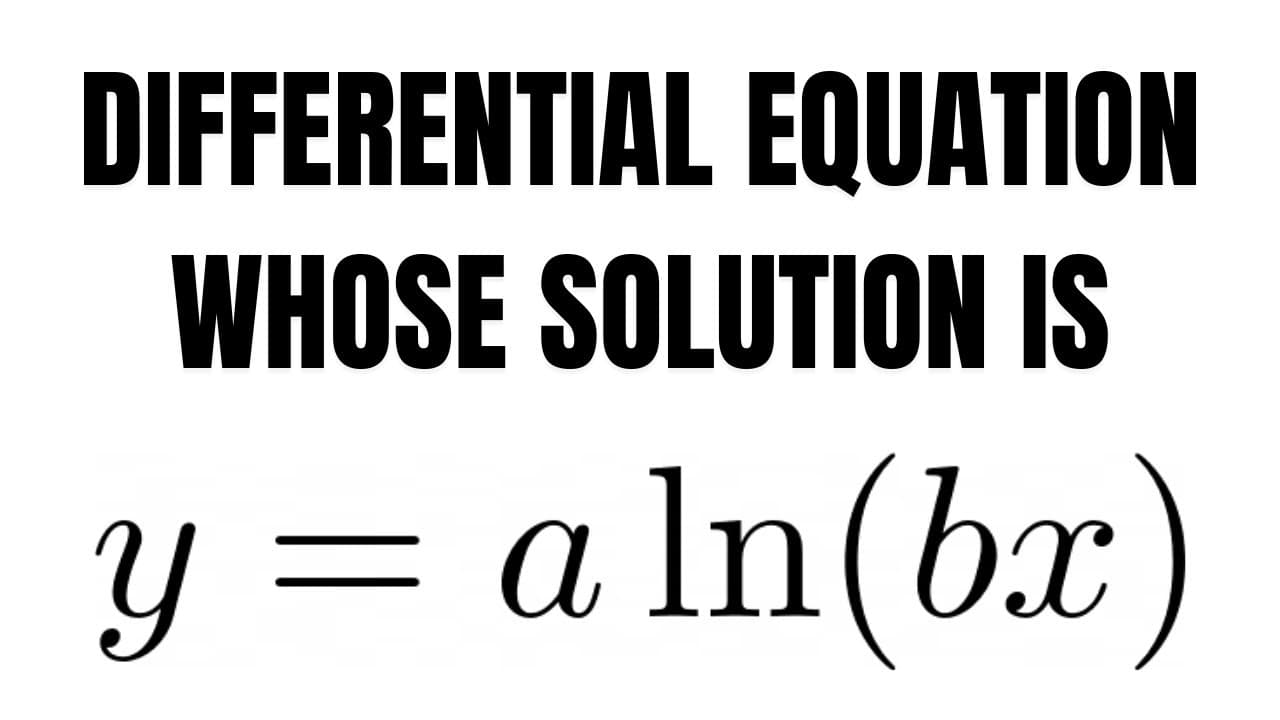
Find a Differential Equation whose Solution is y = a*ln(bx)
TL;DR
This video demonstrates how to find a differential equation using the solution y=a ln(bx) and introduces the concept of a Cauchy Euler differential equation.
Transcript
hi in this problem we're going to find a differential equation whose solution is y equals a times the natural log of bx let's try to work through this so in problems like this uh the way i usually try to do it is by just taking derivatives and then try to eliminate all the a's and b's by maybe adding or subtracting um some linear combination or som... Read More
Key Insights
- 🥡 The process of finding a differential equation involves taking derivatives and manipulating them to eliminate constants.
- ❣️ The first derivative of the given solution is y' = a/x, obtained by applying the chain rule.
- 😀 The second derivative is y'' = -a/x^2, derived by applying the differentiation process.
- ✖️ By multiplying the second derivative by x and adding it to the first derivative, the differential equation x y'' + y' = 0 is obtained.
Install to Summarize YouTube Videos and Get Transcripts
Explore YouTube Video Summarizer or Get YouTube Transcript Extractor
Questions & Answers
Q: How can we find a differential equation given a specific solution?
To find a differential equation, we can take derivatives of the given solution and manipulate them to eliminate constants. By adding or subtracting combinations of the derivatives, we can eliminate the constants and find the desired equation.
Q: What is the first derivative of y=a ln(bx) and how is it derived?
The first derivative is y' = a/x. To derive it, we use the chain rule, taking the derivative of the natural logarithm of bx (which is 1/bx) and multiplying it by the derivative of bx, which is b.
Q: How is the second derivative of y=a ln(bx) obtained?
The second derivative is y'' = -a/x^2. We can derive it by applying the differentiation process to the expression a/x. The negative sign arises from the exponent being negative in the derivative.
Q: What is a Cauchy Euler differential equation?
A Cauchy Euler differential equation is one where the exponent of the independent variable (in this case, x) matches the order of the derivative. In the video, the obtained equation, x y'' + y' = 0, is an example of a Cauchy Euler differential equation.
Summary & Key Takeaways
-
The video explains the process of finding a differential equation by taking the derivatives and manipulating them to eliminate constants.
-
It shows that the first derivative of y=a ln(bx) is y' = a/x, and the second derivative is y'' = -a/x^2.
-
By multiplying the second derivative by x and adding it to the first derivative, the equation x y'' + y' = 0 is obtained, which represents the differential equation for y=a ln(bx).
Read in Other Languages (beta)
Share This Summary 📚
Summarize YouTube Videos and Get Video Transcripts with 1-Click
Try YouTube Summary with ChatGPT & Claude or YouTube Transcript Generator
Explore More Summaries from The Math Sorcerer 📚



Summarize YouTube Videos and Get Video Transcripts with 1-Click
Try YouTube Summary with ChatGPT & Claude or YouTube Transcript Generator