S01.7 About the Order of Summation in Series with Multiple Indices
TL;DR
An explanation of how to sum double sequences, considering different orders of addition and limited ranges of indices.
Transcript
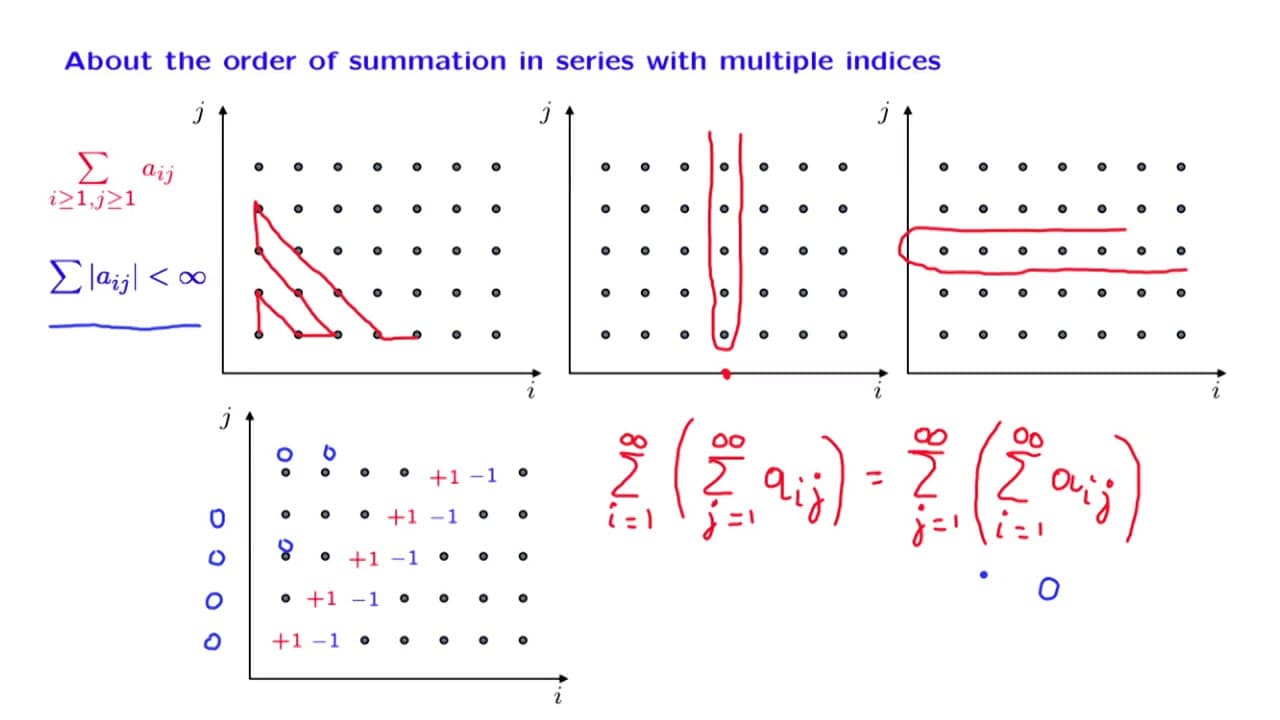
We now continue our discussion of infinite series. Sometimes we have to deal with series where the terms being added are indexed by multiple indices, as in this example here. We're given numbers, aij, and i ranges over all the positive integers. j also ranges over all the positive integers. So what does this sum represent? We can think of it as fol... Read More
Key Insights
- 🫰 Double series can be represented by a two-dimensional grid of indices.
- 🍉 The order of terms' addition can affect the result if the sum of absolute values is infinite.
- 🎃 Fixing a value of i or j allows for specific ways of carrying out the summation for double sequences.
- 🍹 If the sum of absolute values is finite, the two ways of summing yield the same result.
- 😃 When adding terms, the range of i and j can be limited to specific conditions.
- 😃 Different choices of i or j can result in different sums.
- 🍹 The order of summation matters if the sum of absolute values is infinite.
Install to Summarize YouTube Videos and Get Transcripts
Explore YouTube Video Summarizer or Get YouTube Transcript Extractor
Questions & Answers
Q: What does the sum of a double series represent?
The sum of a double series represents the sum of all terms associated with the two-dimensional grid formed by the indices i and j. As long as the sum converges to a finite value, the double series is considered well-defined.
Q: Can the order in which terms are added to a double series affect the result?
Yes, adding terms in different orders can lead to different results. However, if the sum of the absolute values of all the terms is finite, the particular order becomes irrelevant and will yield the same result.
Q: How can a double summation be carried out by fixing a particular choice of i?
By fixing a value of i, we can add all the terms associated with that choice of i as j ranges from 1 to infinity. This process is repeated for every possible value of i, and the obtained numbers are then summed together.
Q: Can the order of summation matter in some cases?
Yes, the order of summation can matter if the sum of the absolute values of all the terms is infinite. In such cases, different orders of summation can yield different results, as demonstrated in an example where changing the order resulted in different sums (0 and 1).
Summary & Key Takeaways
-
The content discusses series of terms indexed by multiple indices.
-
It explains how double series can be represented as a two-dimensional grid and how adding terms in different orders can yield different results.
-
It introduces two different ways of summing double sequences, either by fixing a value of i and summing over different choices of j, or fixing a value of j and summing over different choices of i.
Read in Other Languages (beta)
Share This Summary 📚
Summarize YouTube Videos and Get Video Transcripts with 1-Click
Try YouTube Summary with ChatGPT & Claude or YouTube Transcript Generator
Explore More Summaries from MIT OpenCourseWare 📚



Summarize YouTube Videos and Get Video Transcripts with 1-Click
Try YouTube Summary with ChatGPT & Claude or YouTube Transcript Generator