What is VLSI | Introduction & Design flow | VLSI | Lec-01
TL;DR
VLSI integrates millions of transistors in circuits for advanced electronic devices.
Transcript
hi everyone in this video I am going to start a new subject that is vlsc so vlse stands for very large scale integration v l yes I stands for very large scale integration okay so this subject curve for for btech students either in 31 or in three two that depends upon the University so vlse stands for very large scale integration what you are going ... Read More
Key Insights
- ❓ VLSI significantly enhances performance and efficiency in electronic devices through integration of millions of transistors.
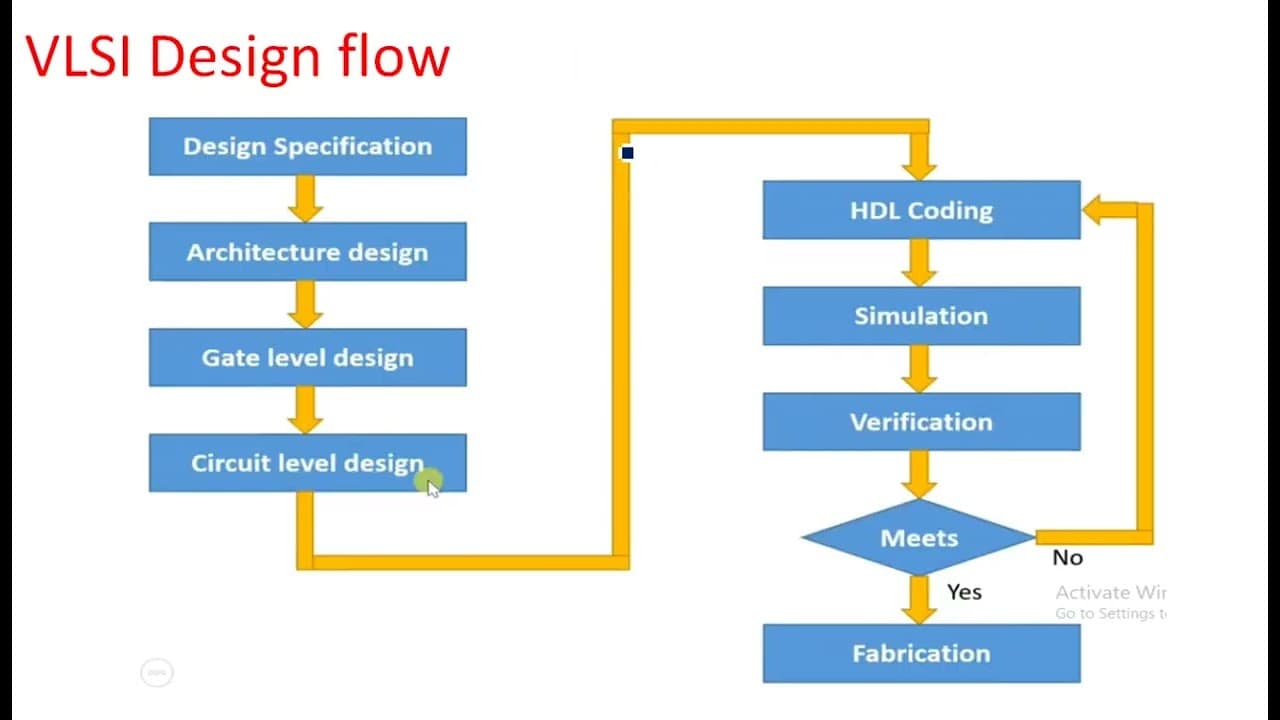
- 💐 The design flow process is iterative, emphasizing continuous refinement based on market specifications and circuit requirements.
- 😘 CMOS technology's advantages include lower power consumption and higher packing density, essential for modern portable devices.
- 🐿️ Integrated circuits are the backbone of today's technology, transforming how devices operate by performing multiple functions on a single chip.
- 🎨 The evolution of integration technologies from SSI to VLSI showcases advancements in semiconductor manufacturing and design methodologies.
- 💐 Challenges in the VLSI design flow include achieving precise specifications and efficient debugging during simulation phases.
- 😒 The use of HDLs in VLSI design enables more precise modeling, which is critical for producing reliable electronics.
Install to Summarize YouTube Videos and Get Transcripts
Explore YouTube Video Summarizer or Get YouTube Transcript Extractor
Questions & Answers
Q: What does VLSI stand for and what is its significance?
VLSI stands for Very Large Scale Integration, which is a crucial subject for BTech students in electronics. It focuses on the design and fabrication of integrated circuits, which are fundamental for modern electronic devices, enabling them to perform complex tasks efficiently using a single chip with millions of transistors.
Q: How does VLSI technology differ from earlier integration technologies?
VLSI technology differs from earlier methods like Small Scale Integration (SSI) and Medium Scale Integration (MSI) by allowing millions of transistors to be integrated into a single chip. This advancement results in higher performance, reduced size, and lower power consumption, leading to the development of sophisticated electronic devices.
Q: What are some applications of VLSI integrated circuits?
VLSI integrated circuits are used in a wide array of devices such as smartphones, smartwatches, televisions, and various consumer electronics. These circuits enable devices to perform multiple functions, making them more efficient and compact, significantly impacting daily technology use.
Q: Can you explain the VLSI design flow process?
The VLSI design flow encompasses several steps, starting from design specification, where market requirements are assessed, to architecture design and gate-level design. It includes circuit-level design using Hardware Description Languages (HDLs) like Verilog and VHDL, followed by simulation to verify output, and fabrication of the final product, ensuring it meets specified requirements.
Q: Why is CMOS technology preferred in VLSI fabrication?
CMOS, or Complementary Metal Oxide Semiconductor, is preferred for VLSI fabrication due to its high packing density and low power consumption. This technology allows for efficient operation of devices, like smartwatches that can last days on a single charge, unlike older television technologies which required higher power levels.
Q: What challenges are associated with the VLSI design flow?
Challenges in the VLSI design flow include ensuring that the design specification meets market needs, achieving accurate simulation results, and iterating code adjustments based on verification feedback. If the design fails to meet requirements during verification, the process must loop back, causing potential delays in product development.
Q: What role do Hardware Description Languages play in VLSI design?
Hardware Description Languages (HDLs) such as Verilog and VHDL are crucial for modeling the behavior of circuits during the design phase of VLSI. They enable engineers to write code that accurately describes the intended function of the hardware, facilitating simulation and verification steps to ensure that the design meets specifications.
Summary & Key Takeaways
-
VLSI stands for Very Large Scale Integration, vital for BTech students in electronics, detailing integrated circuit fabrication.
-
Integrated circuits, found in various electronic devices, utilize billions of transistors to perform multiple functions efficiently.
-
The VLSI design flow involves iterative steps from market specification to circuit fabrication, ensuring circuit design meets current technology trends.
Read in Other Languages (beta)
Share This Summary 📚
Summarize YouTube Videos and Get Video Transcripts with 1-Click
Try YouTube Summary with ChatGPT & Claude or YouTube Transcript Generator