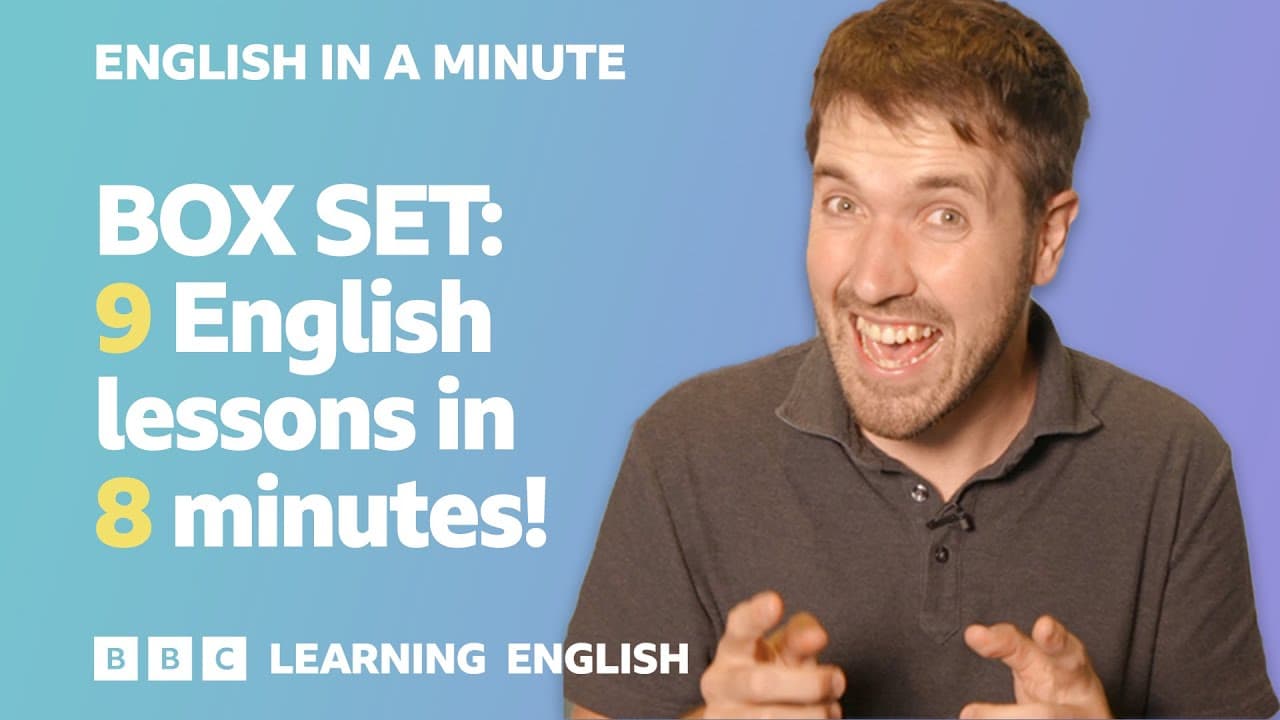
BOX SET: English In A Minute 4 – NINE English lessons in 8 minutes!
TL;DR
Eight English lessons covering vocabulary and grammar in eight minutes.
Transcript
difference between 'to steal' and 'to rob'. Both 'to steal' and 'to rob' mean to take something without permission. 'To steal' focuses on the object or the thing which is taken, for example: Hey! Somebody just stole my phone. 'Rob' focuses on the victim of the crime, for example: The men robbed a bank last night. I wouldn't say someone robbed m... Read More
Key Insights
- The lesson differentiates between 'steal' and 'rob', emphasizing that 'steal' focuses on the object taken, while 'rob' focuses on the victim.
- The use of 'no', 'not any', and 'none' is clarified, with examples showing how each can indicate the absence of something.
- The distinction between 'lay' and 'lie' is explained, noting that 'lay' requires an object while 'lie' does not.
- Differences between 'don't mind' and 'doesn't matter' are discussed, highlighting their use in expressing preference or importance.
- The article 'the' is used for specific references, while its absence denotes generality or non-specificity.
- The terms 'next', 'the next', and 'nearest' are distinguished, with 'next' indicating immediacy, 'the next' referring to a period, and 'nearest' denoting proximity.
- Verbs 'peep', 'peer', and 'glimpse' are explored, each describing different ways of looking at something.
- The use of 'still', 'already', and 'yet' is explained, indicating the status of events in relation to the present.
Install to Summarize YouTube Videos and Get Transcripts
Explore YouTube Video Summarizer or Get YouTube Transcript Extractor
Questions & Answers
Q: What is the difference between 'steal' and 'rob'?
The difference between 'steal' and 'rob' lies in their focus. 'Steal' emphasizes the object taken without permission, such as 'stealing a phone'. 'Rob' focuses on the victim of the crime, like 'robbing a bank', highlighting the person or place affected by the theft.
Q: How can 'no', 'not any', and 'none' be used to express zero quantity?
To express zero quantity, 'no' is used with a noun, like 'I have no change'. 'Not any' is used in negative constructions, such as 'I don't have any change'. 'None' is used independently without a noun or verb, providing a short answer like 'None at all'.
Q: What is the key difference between 'lay' and 'lie'?
'Lay' requires an object and means to put something down, as in 'lay a cloth on the table'. 'Lie' does not take an object and refers to being in a flat position, like 'lie on the sofa'. The past tense of 'lay' is 'laid', while 'lie' is 'lay'.
Q: How do 'don't mind' and 'doesn't matter' differ in usage?
'Don't mind' is used to express no preference or objection, often in response to a request, like 'Do you mind opening the window? No, I don't mind.' 'Doesn't matter' indicates that something is not important, such as 'It doesn't matter if we have tea or coffee.'
Q: When should 'the' be used in English?
'The' is used when referring to a specific item known to both the speaker and listener, such as 'Please pass me the milk.' It is omitted when speaking generally, like 'I love chocolate', or when the item is non-specific, using 'a' or 'an', as in 'Give me a cup of tea.'
Q: What is the difference between 'next', 'the next', and 'nearest'?
'Next' refers to the immediate following instance, like 'next Tuesday'. 'The next' indicates a period starting from now, such as 'the next two weeks'. 'Nearest' describes proximity in distance, as in 'the nearest bus stop'. Each term has a distinct temporal or spatial context.
Q: What are the differences between 'peep', 'peer', and 'glimpse'?
'Peep' means to look quickly and secretively, as in 'peeped at answers'. 'Peer' involves looking intently or with difficulty, like 'peered at the document'. 'Glimpse' denotes seeing something briefly or partially, often used with 'catch', such as 'caught a glimpse of sunlight'.
Q: How are 'still', 'already', and 'yet' used in relation to time?
'Still' refers to actions that haven't finished, like 'Are you still studying?'. 'Already' indicates completed actions, often unexpectedly early, such as 'She's already finished work'. 'Yet' is used in questions and negatives for actions expected to happen, like 'Haven't you left yet?'
Summary & Key Takeaways
-
This video provides concise English lessons on various topics, helping viewers understand differences in vocabulary and grammar. Key lessons include the use of 'steal' versus 'rob', 'no' versus 'not any' versus 'none', and 'lay' versus 'lie'.
-
Viewers learn about the nuances of English articles, specifically the use of 'the', and distinctions between phrases like 'don't mind' versus 'doesn't matter'. The lesson also covers terms related to time and proximity, such as 'next', 'the next', and 'nearest'.
-
The video concludes with explanations of verbs related to sight, including 'peep', 'peer', and 'glimpse', and temporal adverbs 'still', 'already', and 'yet', providing a comprehensive overview of their meanings and applications.
Read in Other Languages (beta)
Share This Summary 📚
Summarize YouTube Videos and Get Video Transcripts with 1-Click
Try YouTube Summary with ChatGPT & Claude or YouTube Transcript Generator
Explore More Summaries from BBC Learning English 📚

Summarize YouTube Videos and Get Video Transcripts with 1-Click
Try YouTube Summary with ChatGPT & Claude or YouTube Transcript Generator