How to Prove Limits at Infinity Using Epsilon-N
TL;DR
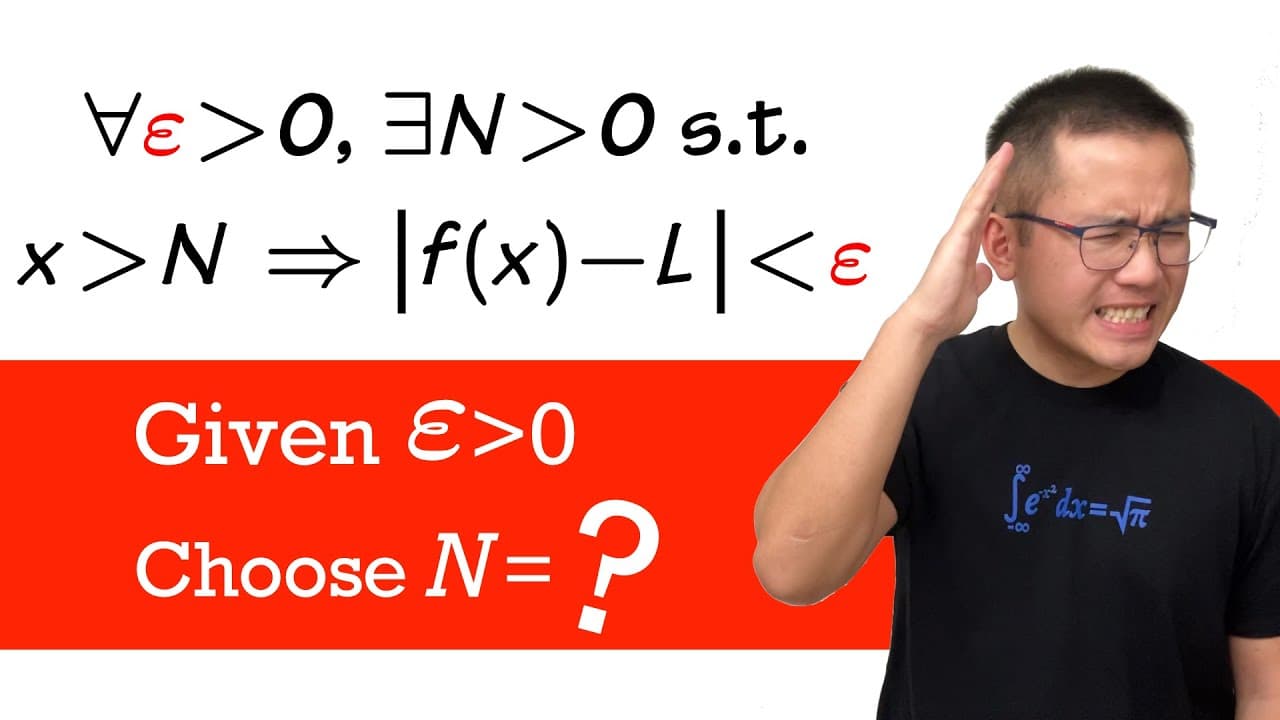
To prove the limit of a function as X approaches infinity equals a finite value (like 2/3), use the epsilon-N definition, which states that for every epsilon greater than zero, there exists an N such that for all X greater than N, the distance between the function and the limit is less than epsilon. This method allows for rigorous validation of limits at infinity.
Transcript
today I'm going to help you to understand how to prove the limit as X approaching Infinity of this thing is equal to 2/3. yes we are talking about proving a limit rigorously (must know for college calculus and real analysis) but this time we'll actually be using the epsilon-N definition because we have X is approaching Infinity so let me j... Read More
Key Insights
- ☺️ There are different versions of proving limits depending on whether X approaches a finite number or infinity.
- ⛔ The epsilon-N definition is used when proving the limit as X approaches infinity of a function with a finite limit.
- 😚 The choice of specific Epsilon allows for a more concrete understanding of how close the function is to the limit.
- 🙅 When choosing N, it is important to consider the conditions of the proof, such as avoiding negative values.
- 🤩 Algebraic manipulation is a key step in the proof process, allowing for the simplification of expressions.
- 👍 Understanding the relationship between variables, such as the connection between numerator and denominator, aids in proving limits.
- ⛔ The epsilon-N definition provides a rigorous framework for proving limits and can be applied to various functions and limits.
Install to Summarize YouTube Videos and Get Transcripts
Explore YouTube Video Summarizer or Get YouTube Transcript Extractor
Questions & Answers
Q: What are the four main versions of proving limits discussed in the video?
The four main versions are: 1) X approaching a finite number with a finite limit (use Epsilon-Delta definition), 2) X approaching a finite number with an infinite limit (use Delta definition), 3) X approaching infinity with a finite limit (use Epsilon-N definition), and 4) X approaching infinity with an infinite limit (use N definition).
Q: What is the specific focus of this video?
The video focuses on proving the limit as X approaches infinity of a function is equal to a finite number.
Q: What is the epsilon-N definition?
The epsilon-N definition states that for any Epsilon greater than zero, there exists a number N such that for all X greater than N, the absolute value of the difference between the function and the limit is less than Epsilon.
Q: How is the specific proof done for the limit equal to 2/3?
The proof involves manipulating the function algebraically and choosing a specific value for Epsilon (e.g., 0.02). By solving the inequality, the value of N is determined to be 26.4, which satisfies the condition for the desired limit.
Summary & Key Takeaways
-
The video discusses different versions of proving limits based on whether X approaches a finite number, infinity, or negative infinity.
-
The specific focus is on proving the limit as X approaches infinity of a function is equal to a finite number, such as 2/3.
-
The video explains the epsilon-N definition and demonstrates how to use it to prove the limit.
Read in Other Languages (beta)
Share This Summary 📚
Summarize YouTube Videos and Get Video Transcripts with 1-Click
Try YouTube Summary with ChatGPT & Claude or YouTube Transcript Generator
Explore More Summaries from blackpenredpen 📚
Summarize YouTube Videos and Get Video Transcripts with 1-Click
Try YouTube Summary with ChatGPT & Claude or YouTube Transcript Generator