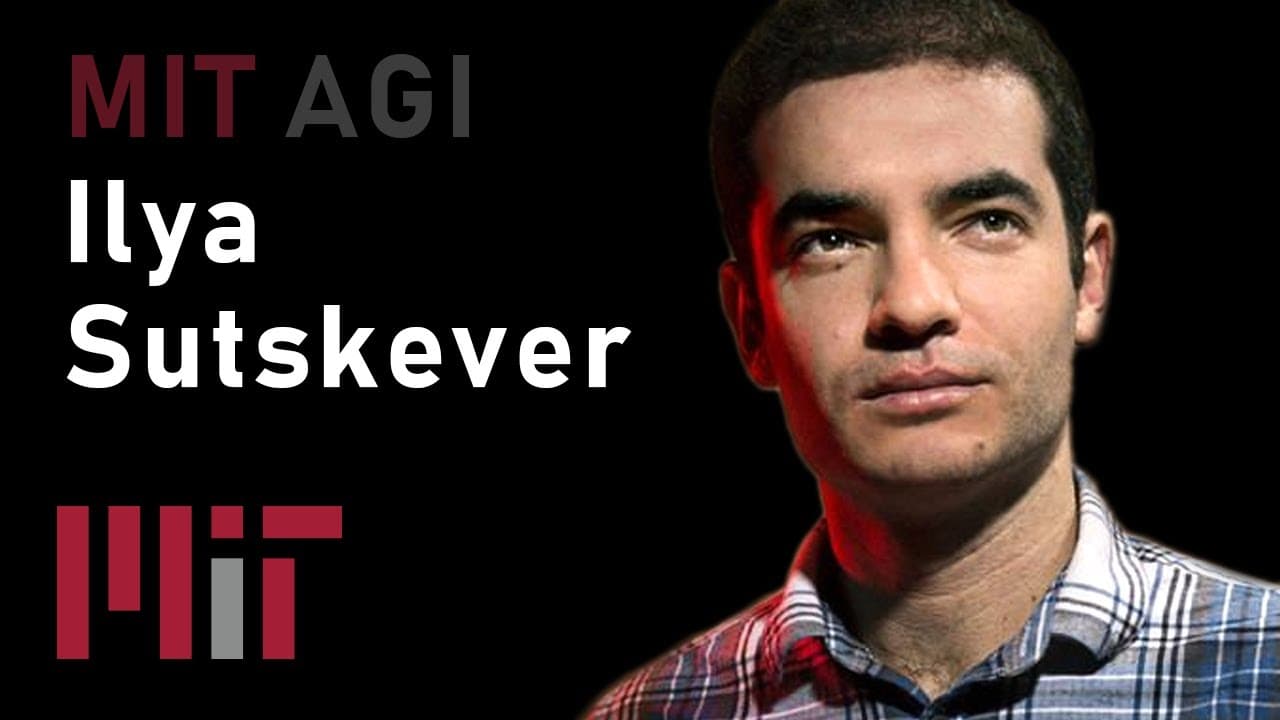
Ilya Sutskever: OpenAI Meta-Learning and Self-Play | MIT Artificial General Intelligence (AGI)
TL;DR
OpenAI uses meta-learning to train systems across multiple tasks so they can adapt quickly, while self-play lets agents improve through competition against themselves. Ilya Sutskever connects these approaches to deep neural networks, reinforcement learning, AlphaGo Zero, and OpenAI’s Dota 2 bots, explaining how computation can generate useful training data and increasingly capable behavior. Read on to understand the learning mechanisms and their practical implications.
Transcript
welcome back to 6 SZ row 99 artificial general intelligence today we have Ilya sutskever co-founder and research director of open AI he started in the amel group in Toronto Geoffrey Hinton then at Stanford with an jiaying co-founded DNN research for three years as a research scientist at Google brain and finally co-founded open AI citations aren't ... Read More
Key Insights
- Meta-learning is a technique where systems are trained on multiple tasks to quickly learn new ones.
- Self-play involves agents competing against themselves to improve their performance without external data.
- Deep learning works by finding the best neural network through backpropagation and optimization.
- Reinforcement learning evaluates agents based on their ability to achieve goals in complex environments.
- Hindsight experience replay allows learning from both successes and failures in reinforcement learning.
- Sim-to-real transfer uses variability in simulations to train adaptable policies for real-world tasks.
- Self-play environments can lead to rapid competence increases by turning computational power into data.
- Alignment of AI goals with human intentions is a critical technical and political challenge.
Install to Summarize YouTube Videos and Get Transcripts
Explore YouTube Video Summarizer or Get YouTube Transcript Extractor
Questions & Answers
Q: How does OpenAI use meta-learning and self-play?
OpenAI’s meta-learning approach treats training tasks as training cases, turning the neural network itself into a learning algorithm that can adapt quickly to new tasks. Self-play complements this by having agents compete against themselves, continually producing challenges suited to their current ability.
Q: What is meta-learning in AI?
Meta-learning trains a system on multiple tasks so it can learn new tasks quickly. The approach treats each task as a training case, allowing the neural network to become the learning algorithm rather than merely solving one fixed problem.
Q: What is self-play in AI?
Self-play is a method in which AI agents improve by competing against themselves. Because the opponent develops alongside the agent, the resulting challenge stays appropriate to the agent’s current skill level.
Q: Why do deep neural networks work?
Ilya Sutskever explains that deep neural networks combine an expressive model class with practical optimization. Backpropagation and gradient descent iteratively change network parameters until predictions better satisfy the constraints provided by the data.
Q: What is reinforcement learning?
Reinforcement learning is a framework for evaluating agents by their ability to achieve goals in complicated stochastic environments. An agent interacts with an environment, and its performance can be assessed by running it many times and computing its average reward.
Q: What is hindsight experience replay?
Hindsight experience replay lets a reinforcement-learning agent learn from failures as well as successes. If the original goal is missed, the state actually reached can be treated as an alternative goal, extracting useful learning from the experience.
Q: How does sim-to-real transfer make AI policies more adaptable?
Sim-to-real transfer trains policies in simulations whose parameters, including friction and mass, are varied without explicitly revealing those changes to the policy. This variability pushes the policy to adapt, helping it handle real-world conditions that differ from a fixed simulation.
Q: What results demonstrate the potential of self-play?
AlphaGo Zero and OpenAI’s Dota 2 bots are presented as successful examples of self-play. These systems show how agents can develop advanced strategies through continued competition, turning computational power into useful training data and rapid gains in competence.
Summary
In this video, Ilya Sutskever discusses various topics related to deep learning, reinforcement learning, meta-learning, self-play, and aligning goals with AI agents. He explains the concept of deep learning and why it works by finding the best neural network that represents the underlying regularities in data. He then delves into reinforcement learning, which focuses on agents learning to achieve goals in dynamic environments. Sutskever describes the concept of meta-learning, where a system learns to learn by training on multiple tasks. He also highlights the potential of self-play, where agents can compete against each other and improve their performance through iterative training. Finally, he discusses the challenge of aligning AI goals with human objectives and suggests technical approaches to convey goals to AI agents.
Questions & Answers
Q: Why does deep learning work?
Deep learning works because it finds the best neural network that represents the underlying regularities in data. The neural network can extract and learn from complex patterns and relationships in the data, resulting in powerful predictive capabilities.
Q: What is reinforcement learning?
Reinforcement learning is a framework in which agents learn to achieve goals in dynamic environments. The agents receive rewards or penalties based on their actions and use this feedback to improve their decision-making process through trial and error.
Q: How does meta-learning work?
Meta-learning involves training a system on multiple tasks to learn how to solve new tasks quickly. By treating each task as a training case and the test case as a test task, the system learns to generalize and adapt its knowledge to new tasks.
Q: What is self-play in AI?
Self-play is a concept where AI agents compete against each other and improve their performance through iterative training. By continuously challenging themselves, the agents evolve and develop new strategies to outperform each other.
Q: How can goals be aligned with AI agents?
Aligning goals with AI agents is a challenging task. One approach is to use human judges who compare and rate different behaviors or outcomes to create a reward function. This reward function can then be optimized through reinforcement learning to train the agents to achieve desired goals.
Q: Can backpropagation be explained in the context of the brain's neural signals?
Backpropagation, which is a fundamental algorithm in deep learning, is not directly analogous to the way neural signals propagate in the brain. While the brain's signals mainly move in one direction (down the axons), the mathematical calculations of backpropagation require error signals to be propagated back up the neural network. The brain's computation mechanisms are still not fully understood, but backpropagation remains a powerful tool for training neural networks.
Q: Is self-play a fair matchup for AI agents?
Self-play can be a fair matchup for AI agents, as it provides a level playing field for both agents. However, the advantage of computers in terms of reaction time and processing power can give them an edge. Nevertheless, self-play allows agents to discover new strategies and improve their performance autonomously.
Q: Are the emergent behaviors from AI agents directed by pre-existing constraints or novel discoveries?
The emergent behaviors from AI agents are a combination of both pre-existing constraints and novel discoveries. While there are certain constraints in the system setup, such as the rules of the game or the available actions, the strategies developed by the agents often involve creative and original approaches that were not explicitly programmed or biased.
Q: Is the objective of reinforcement learning solely focused on maximizing expected rewards?
While maximizing expected rewards is a common objective in reinforcement learning, it is not the only aspect to consider. The standard deviation of possible rewards can also be taken into account, especially in situations where risk or uncertainty needs to be managed. Balancing expected rewards and risk is important for developing robust and adaptable reinforcement learning policies.
Q: How can AI agents align their goals with human objectives?
Aligning AI goals with human objectives is a challenging task, as it requires defining and conveying complex goals to AI agents. One approach shown in the video is to use human annotators who compare and rate different behaviors or performances. The resulting data can then be used to train the AI agents using reinforcement learning, gradually aligning their goals with human objectives.
Takeaways
The video covers various topics in deep learning and reinforcement learning, including deep neural networks, meta-learning, self-play, and aligning AI goals with human objectives. It highlights the power of backpropagation and the potential of neural networks to extract regularities from data. Reinforcement learning is presented as a framework for agents to learn and improve in dynamic environments. Meta-learning shows promise in training agents to quickly adapt to new tasks. Self-play demonstrates the ability of agents to discover novel strategies and improve autonomously. Aligning AI goals with human objectives remains a challenge but has potential technical solutions. The video serves as a reminder of the ongoing advancements and challenges in AI research and development.
Summary & Key Takeaways
-
OpenAI's meta-learning involves training AI on multiple tasks, allowing it to quickly adapt to new tasks. This is achieved by treating training tasks as training cases, effectively turning the neural network into the learning algorithm itself. Success stories include character recognition and neural architecture search.
-
Self-play allows AI agents to improve by competing against themselves, creating an environment where the challenge is always appropriate to the agent's current level. This method has led to achievements such as AlphaGo Zero and OpenAI's Dota 2 bots, showcasing the potential of self-play in developing advanced AI strategies.
-
Reinforcement learning, a framework for evaluating agents' goal achievement, is enhanced by techniques like hindsight experience replay, which learns from both successes and failures. The ultimate goal is to create AI systems that can adapt and learn efficiently, even in unpredictable real-world scenarios.
Read in Other Languages (beta)
Share This Summary 📚
Summarize YouTube Videos and Get Video Transcripts with 1-Click
Try YouTube Summary with ChatGPT & Claude or YouTube Transcript Generator
Explore More Summaries from Lex Fridman 📚
Summarize YouTube Videos and Get Video Transcripts with 1-Click
Try YouTube Summary with ChatGPT & Claude or YouTube Transcript Generator