Lecture 17: Rapidly Decreasing Singular Values
TL;DR
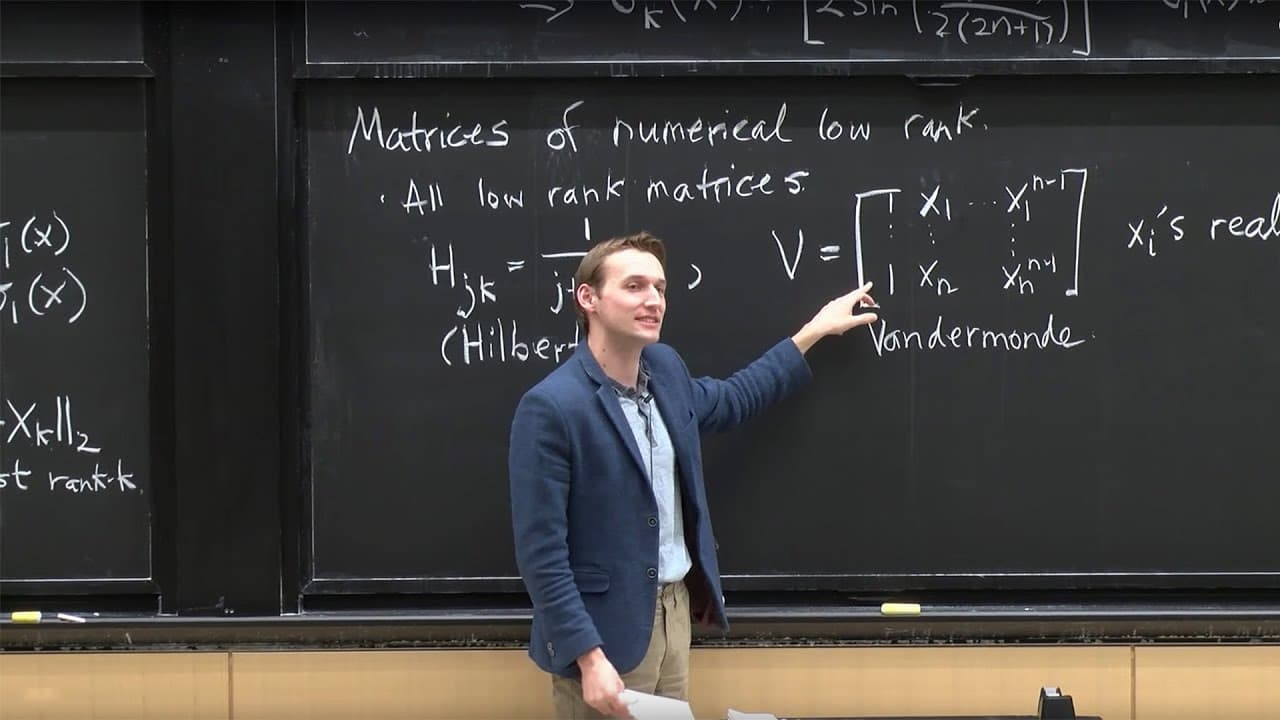
Matrices that are numerically low rank can be explained by the satisfaction of Sylvester equations, which can be achieved by sampling smooth functions or through a polynomial approximation.
Transcript
GILBERT STRANG: So let me use the mic to introduce Alex Townsend, who taught here at MIT-- taught Linear Algebra 18.06 very successfully. And then now he's at Cornell on the faculty, still teaching very successfully. And he was invited here yesterday for a big event over in Engineering. And he agreed to give a talk about a section of the book-- sec... Read More
Key Insights
- 😘 Matrices that are numerically low rank can be explained by the satisfaction of Sylvester equations.
- 🎴 The Zolotarev number, determined by the separation of eigenvalue sets, plays a crucial role in understanding numerical low rank.
Install to Summarize YouTube Videos and Get Transcripts
Explore YouTube Video Summarizer or Get YouTube Transcript Extractor
Questions & Answers
Q: What are the singular values of a matrix and how do they relate to its rank?
Singular values are a sequence of numbers that tell us various properties about a matrix, including its rank. The number of nonzero singular values corresponds to the rank of the matrix.
Q: What is the difference between low rank and numerical low rank?
Low rank refers to the exact rank of a matrix, while numerical low rank accounts for some tolerance or wiggle room in the singular values due to numerical approximations.
Q: How does satisfying Sylvester equations relate to numerical low rank?
Matrices that satisfy Sylvester equations have been shown to have low numerical rank. The bound on the singular values of such matrices can be determined by considering Zolotarev numbers, which relate to the eigenvalues of the involved matrices.
Q: What is the significance of the Hilbert matrix in understanding numerical low rank?
The Hilbert matrix has been studied extensively in relation to its numerical rank. The separation of eigenvalue sets of the involved matrices contributes to the smallness of the Zolotarev number, which leads to a bound on the numerical rank of the Hilbert matrix.
Summary & Key Takeaways
-
Low-rank matrices have many practical applications in computational mathematics.
-
The singular values of a matrix provide information about its rank and how well it can be approximated by a low-rank matrix.
-
Reade's explanation that matrices sampled from smooth functions are numerically low rank is not sufficient for explaining the low rank of matrices like the Hilbert matrix.
Read in Other Languages (beta)
Share This Summary 📚
Summarize YouTube Videos and Get Video Transcripts with 1-Click
Try YouTube Summary with ChatGPT & Claude or YouTube Transcript Generator
Explore More Summaries from MIT OpenCourseWare 📚



Summarize YouTube Videos and Get Video Transcripts with 1-Click
Try YouTube Summary with ChatGPT & Claude or YouTube Transcript Generator