How We Learned That Water Isn't An Element
TL;DR
In ancient times, water was believed to be an element, but through experiments and discoveries by chemists, it was revealed that water is composed of two hydrogen atoms and one oxygen atom (H2O).
Transcript
Today, the contents of the water molecule are pretty much common knowledge, but two centuries ago, that molecule looked very different. And even longer ago, it was a fundamental substance of the universe. So how did water become H2O? Hi, I’m Ever and this is MinuteEarth. In ancient times, people thought water was an element, one of the basic buildi... Read More
Key Insights
- 💦 Water was believed to be an element in ancient times.
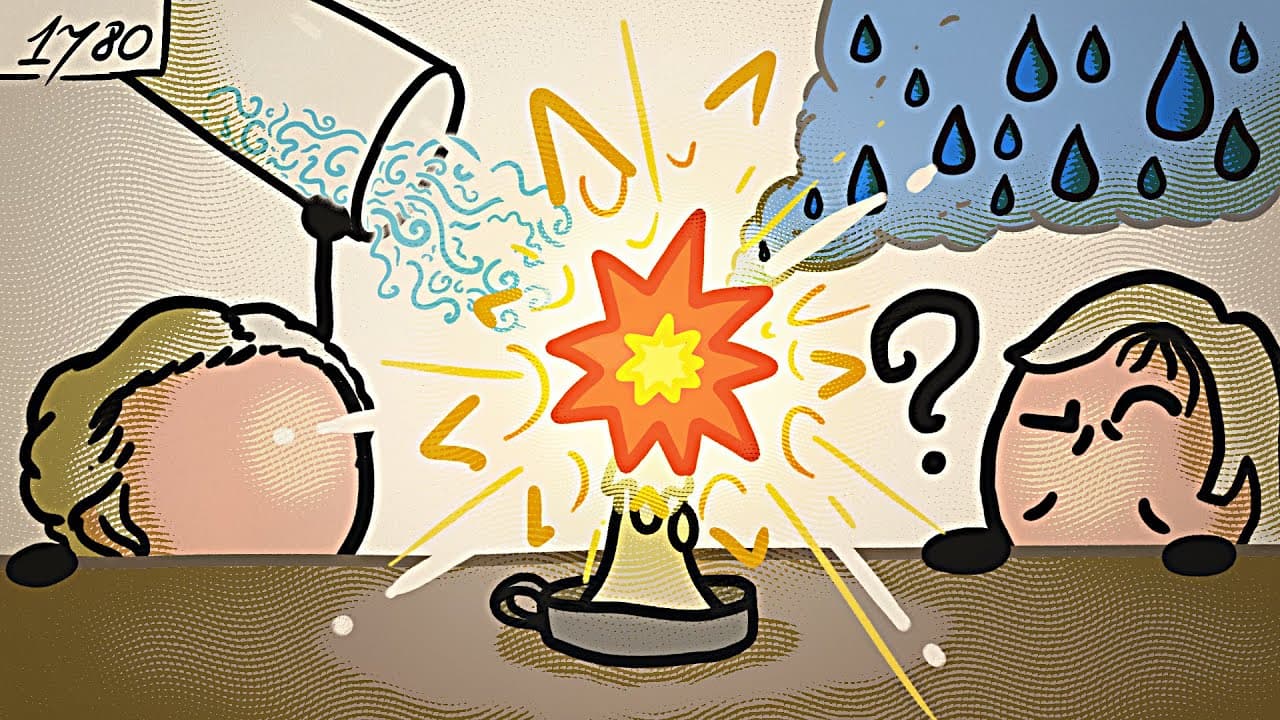
- 🫢 Chemists in the 1780s discovered that water can be created by burning a certain gas.
- 🫢 Electrolysis is a method used to split water into hydrogen and oxygen gases.
- 🫢 The composition of water as H2O was determined through experiments and the understanding of equal volumes of different gases having the same number of molecules.
- 💦 John Dalton made the first drawing of the water molecule, but it was later refined with more information.
- 🤬 The symbols for hydrogen (H) and oxygen (O) used in the video come from Dalton's New System of Chemical Philosophy.
- ⚛️ Dalton's drawings of atoms and molecules are no longer used, as there are more precise and advanced symbols and models in chemistry.
Install to Summarize YouTube Videos and Get Transcripts
Explore YouTube Video Summarizer or Get YouTube Transcript Extractor
Questions & Answers
Q: How did ancient people view water?
Ancient people believed that water was an element, one of the basic building blocks of the universe, and couldn't be split or created from simpler substances.
Q: How did chemists in the 1780s discover the composition of water?
Chemists noticed that burning a certain gas produced water, prompting them to conduct experiments in airtight vessels to prove that water can be created from simpler substances.
Q: What process is used to split water into its component gases?
Electrolysis is used to split water into hydrogen and oxygen gases using an electric current.
Q: How did chemists determine the composition of water as H2O?
An Italian chemist discovered that equal volumes of different gases have the same number of molecules, confirming that two molecules of hydrogen combine with one molecule of oxygen to form two molecules of water (H2O).
Summary & Key Takeaways
-
In ancient times, people thought water was an element and couldn't be split or created from simpler substances.
-
Chemists in the 1780s discovered that burning a certain gas produced water, leading to the realization that water can be created from simpler substances.
-
Through experiments and breakthroughs, chemists discovered the composition of water as two hydrogen atoms and one oxygen atom (H2O).
Read in Other Languages (beta)
Share This Summary 📚
Summarize YouTube Videos and Get Video Transcripts with 1-Click
Try YouTube Summary with ChatGPT & Claude or YouTube Transcript Generator
Explore More Summaries from MinuteEarth 📚



Summarize YouTube Videos and Get Video Transcripts with 1-Click
Try YouTube Summary with ChatGPT & Claude or YouTube Transcript Generator