Lead compensator | Effects | CS | Control Systems | Lec-131
TL;DR
The session explains lead compensators, focusing on their transfer functions, magnitude, and phase plots.
Transcript
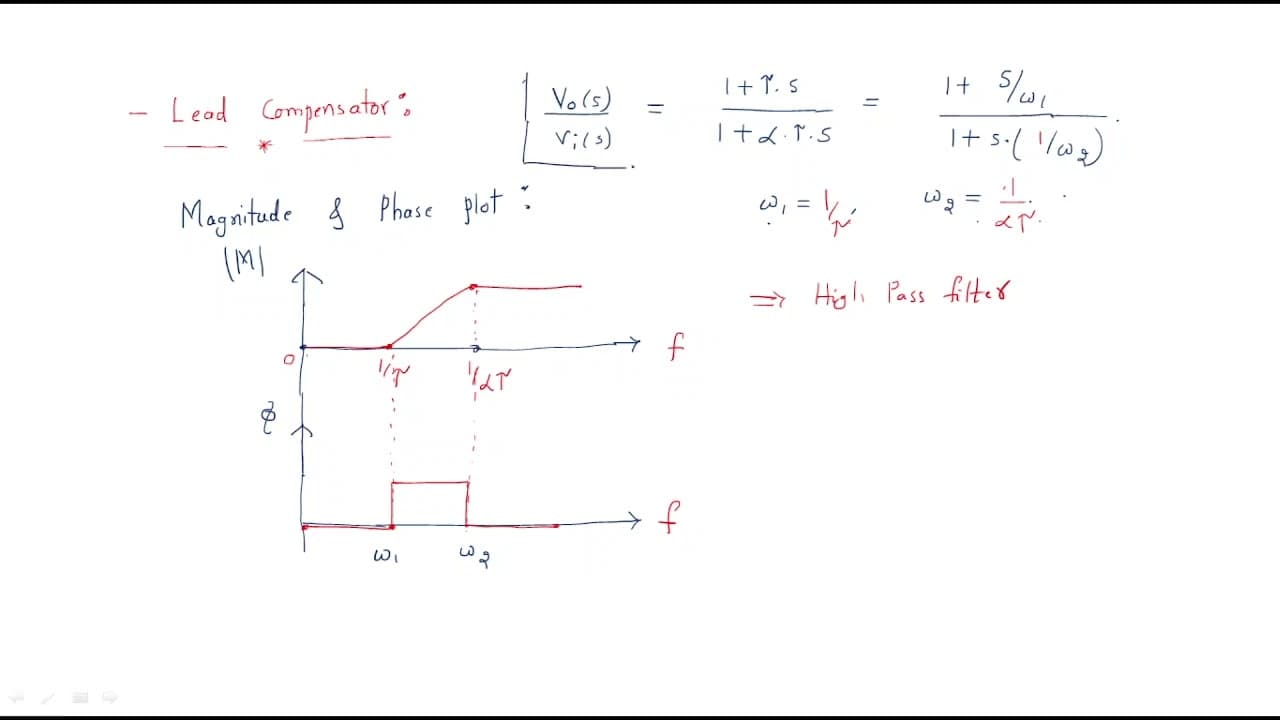
so in this session hello everyone in this session this is the continuation of the lead compensator in the last session we find out the transfer function of the lead compensator is that is v naught of s by v i of s that is output voltage by input voltage is 1 plus tau into s by 1 plus alpha into tau into s so this is the we are getting the transfer ... Read More
Key Insights
- 🎮 The transfer function of lead compensators plays a crucial role in analyzing system dynamics, facilitating interventions in control systems.
- 🥺 Magnitude and phase plots provide essential insights into how lead compensators influence system performance across various frequencies.
- 🥺 Lead compensators improve bandwidth, leading to a decrease in rise time and effective transient response, critical for controlling fast systems.
- 🥳 An increased damping ratio associated with lead compensators reduces oscillations and peak overshoot, enhancing stability in control systems.
- ✋ However, high frequencies can introduce noise into the system, potentially harming overall signal quality, which is a main drawback.
- 📶 Signal strength can diminish due to attenuation when using lead compensators, necessitating amplifiers to counterbalance this effect.
- 🥺 Lead compensators are a valuable tool for engineers when designing systems that require fast response times and stability under varying conditions.
Install to Summarize YouTube Videos and Get Transcripts
Explore YouTube Video Summarizer or Get YouTube Transcript Extractor
Questions & Answers
Q: What is the transfer function of a lead compensator?
The transfer function of a lead compensator is expressed as the ratio of output voltage to input voltage, given by the formula V₀(s)/Vᵢ(s) = (1 + τs) / (1 + αστs). This function allows us to analyze system behavior across different frequencies, showcasing how the compensator enhances performance.
Q: How are magnitude and phase plots constructed for the lead compensator?
To construct magnitude and phase plots, the lead compensator's transfer function is first converted into a frequency model. This involves identifying corner frequencies where system characteristics change, which is essential for analyzing how the compensator affects signal gain and phase shift across a range of frequencies.
Q: What advantages do lead compensators provide in system performance?
Lead compensators enhance bandwidth, which reduces rise time and settling time while improving the gain and phase margin. They also increase the damping ratio, which minimizes oscillations and peak overshoot, leading to a more stable and faster transient response in control systems.
Q: Are there any drawbacks associated with using lead compensators?
While lead compensators improve many aspects of system performance, they can also introduce challenges such as increased noise sensitivity since they operate as high-pass filters. Additionally, they can cause signal attenuation, which may necessitate the addition of amplifiers to maintain signal strength.
Summary & Key Takeaways
-
The session discusses the transfer function of lead compensators, which is expressed as a ratio of output to input voltage, enabling analysis of system behavior.
-
It covers the process of drawing magnitude and phase plots, detailing the conversion to frequency models and explaining corner frequencies for understanding system dynamics.
-
Key characteristics of lead compensators are highlighted, including improvements in bandwidth, damping ratio, and transient response, as well as the potential for increased noise and attenuation.
Read in Other Languages (beta)
Share This Summary 📚
Summarize YouTube Videos and Get Video Transcripts with 1-Click
Try YouTube Summary with ChatGPT & Claude or YouTube Transcript Generator