Transformers | Induction Machines | Comparison | Machines | Lec-03
TL;DR
This session covers induction motors and generators, their principles, and differences from transformers.
Transcript
hello everyone in this session we will discuss the continuation part of the induction machine in the last session we discussed about the introduction of the machines and the working principles of the induction machines here we will discuss some points regarding the induction missions a simply induction machine it can be a motor or a generator if if... Read More
Key Insights
- 🐎 Induction machines convert electrical energy to mechanical energy and vice versa, categorized into motors and generators based on their operating speed relative to synchronous speed.
- 🐎 The synchronous speed formula indicates its dependency on supply frequency and the number of poles in the machine, emphasizing the relationship between these parameters.
- 🐎 Induction motors function below the synchronous speed while induction generators operate above it, with equal speeds resulting in inactivity.
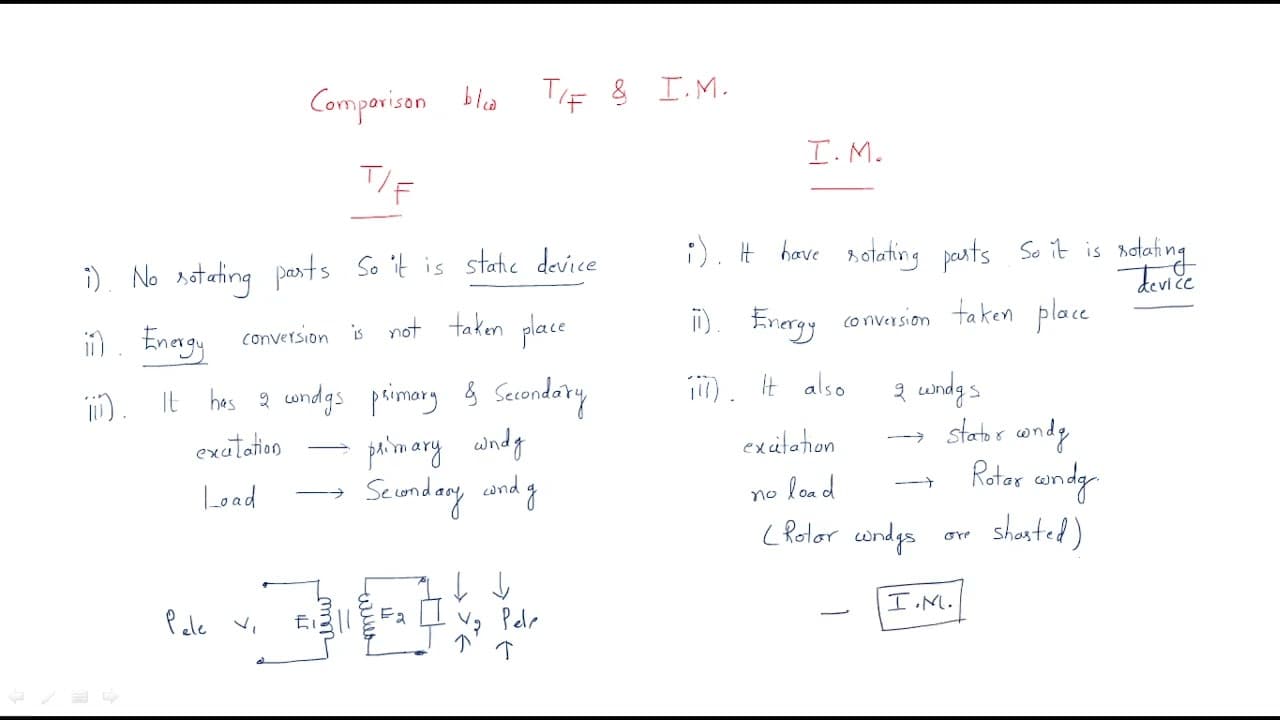
- 🥳 Transformers differ from induction machines as they do not facilitate energy conversion; they transfer electrical energy without changes in frequency or the presence of rotating parts.
- 🥳 The fact that induction machines possess rotating parts classifies them as dynamic devices, whereas transformers are static, making them useful in different applications.
- 👻 Energy conversion in induction machines allows flexibility in applications, especially in industries that require varying speed and torque levels.
- 🎰 Induction machines’ operation and efficiency hinge on the interaction between rotor and stator windings and their respective magnetic circuits.
Install to Summarize YouTube Videos and Get Transcripts
Explore YouTube Video Summarizer or Get YouTube Transcript Extractor
Questions & Answers
Q: What defines an induction motor compared to an induction generator?
An induction motor converts electrical power into mechanical power, operating below synchronous speed, while an induction generator converts mechanical power into electrical power, functioning above synchronous speed. When both speeds are equal, the machine neither operates as a motor nor a generator.
Q: Why are induction machines referred to as asynchronous machines?
Induction machines are called asynchronous because their rotor speed is always less than the synchronous speed during motor operation. This term highlights the difference in speed management between them and synchronous machines, which operate at constant speed aligned with the supply frequency.
Q: How does the energy conversion process differ between transformers and induction machines?
In transformers, energy conversion does not occur; electrical power is merely transferred without transformation, keeping frequency constant. In contrast, induction machines facilitate energy conversion by transforming electrical energy into mechanical energy or vice versa, along with changes in frequency during the process.
Q: What key similarities exist between transformers and induction motors?
Both transformers and induction motors share similar construction with windings and magnetic circuits. However, transformers lack rotating parts, designating them static, while induction motors have rotating components, making them dynamic devices. They also both operate based on mutual induction principles.
Q: What role does synchronous speed play in the operation of induction machines?
Synchronous speed is crucial as it determines the operational mode of induction machines. Motors operate below this speed, ensuring mechanical output, while generators require operation above synchronous speed to produce electrical energy. If both speeds are equal, the machine is inactive, illustrating the importance of varying speeds.
Q: Can you explain the importance of the rotor and stator windings in induction machines?
In induction machines, the stator winding receives supply voltage, generating a magnetic field that induces current in the rotor winding. The interaction between these windings enables energy conversion. The rotor is usually shorted at no load, allowing the machine to operate effectively and maintain variable speed functionality.
Q: What is the significance of labeling induction machines as variable frequency devices?
Induction machines are termed variable frequency devices because they can operate at different speeds, resulting in varying frequency outputs during power transfer. This flexibility is critical for applications requiring adjustable speed and torque, contrasting with transformers' consistent frequency operation.
Q: In what ways do induction motors and transformers differ in their magnetic circuits?
Induction motors have a discontinuous magnetic circuit, as they consist of separate magnetic paths for both primary and secondary windings. Transformers, on the other hand, possess a continuous magnetic circuit with a single magnetic core interacting with both windings, impacting their operational principles and energy efficiency.
Summary & Key Takeaways
-
The session elaborates on induction machines, differentiating between induction motors, which convert electrical power to mechanical power, and induction generators, which operate in the reverse manner.
-
It explains that induction machines, or asynchronous machines, operate below synchronous speed for motors and above for generators, emphasizing the significance of synchronous speed in their functionality.
-
A comparison is drawn between induction machines and transformers, highlighting the differences in structure, operation, and energy conversion, particularly the rotating components in induction machines versus the static nature of transformers.
Read in Other Languages (beta)
Share This Summary 📚
Summarize YouTube Videos and Get Video Transcripts with 1-Click
Try YouTube Summary with ChatGPT & Claude or YouTube Transcript Generator