Bar graph | Students Study | Data Interpretation | Reasoning | Part - 10 | Bharath Kumar
TL;DR
Analyzes bar graph data on students in various colleges.
Transcript
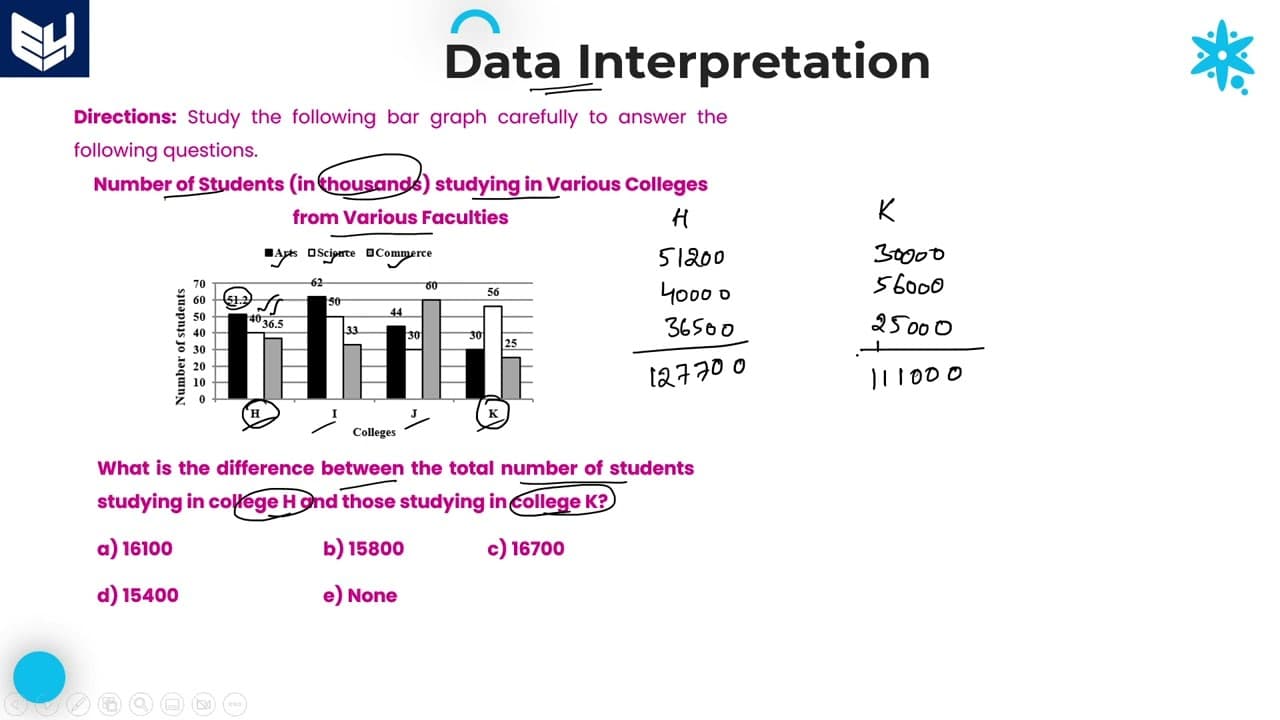
hi everyone welcome to this session in this session I am continuing bar graph data and operation first of all we need to read the information carefully and then we need to solve the questions according to the given information here the information is about what number of students studying in various colleges from various faculties here the informat... Read More
Key Insights
- 🉐 Understanding bar graphs is essential for accurate data interpretation in educational settings.
- 😑 Each value in the graph is expressed in thousands, necessitating multiplication for actual numbers.
- 👻 Adding individual college data allows for a comprehensive total, which is vital for understanding overall student demographics.
- 🥳 Ratios provide a clear comparison of student populations by faculty, essential for identifying trends and making informed decisions.
- 🎓 Specific calculations, like differences between colleges, require systematic steps for accuracy.
- ➗ The process of averaging requires careful addition and division while also considering the correct numerical representation.
- 🦻 Educational data analysis aids in resource planning and enhances understanding of student distribution across faculties.
Install to Summarize YouTube Videos and Get Transcripts
Explore YouTube Video Summarizer or Get YouTube Transcript Extractor
Questions & Answers
Q: How do you calculate the total number of students in a college based on bar graph data?
To calculate the total number of students in a college from a bar graph, first identify the numbers assigned to each faculty. Each value represents thousands, so you multiply these values by 1,000 to convert them into actual numbers. Finally, add the values from all faculties together to get the total student count.
Q: What is the importance of understanding ratios in student populations?
Understanding ratios is crucial as it helps compare different groups effectively. In contexts like student populations for various faculties, ratios can indicate proportions of students in arts, science, or commerce, illustrating trends and highlighting which faculties are more populated, guiding decisions on resource allocation and programs.
Q: Can you explain the process for finding the difference in student numbers between two colleges?
To find the difference in student numbers between two colleges, first calculate the total student counts for each college by summing the values across faculties. Then, subtract the total of one college from the other. Ensure all numbers are multiplied by 1,000 to account for the original data representation.
Q: How do you find the average number of students studying a specific faculty across multiple colleges?
To find the average number of students studying a specific faculty, sum the total number of students in that faculty across all colleges and then divide by the number of colleges. Remember to multiply the values by 1,000 for the actual student count; this will provide an accurate average across campuses.
Summary & Key Takeaways
-
The session discusses how to interpret and analyze a bar graph that represents student populations in different colleges and faculties.
-
Specific mathematical operations demonstrate how to calculate total student numbers and differences between colleges, particularly focusing on arts, science, and commerce faculties.
-
The video concludes with a summary of averages and ratios of student numbers across specified colleges, emphasizing calculation methods and interpretation of results.
Read in Other Languages (beta)
Share This Summary 📚
Summarize YouTube Videos and Get Video Transcripts with 1-Click
Try YouTube Summary with ChatGPT & Claude or YouTube Transcript Generator