Persuasive Speaking Strategies

TL;DR
This video explains the basic persuasive strategies and organizational patterns that are effective in persuasive speeches.
Transcript
are you any good at getting your way when your friends want to go to one place to eat and you want to go to another are you able to change their minds what about asking for favors can you usually get people to help you out without resorting to brute force let's think about politics when the conversation turns political but wait maybe we'd better no... Read More
Key Insights
- 👥 Persuasion is a fundamental aspect of our daily lives, whether it's convincing friends, asking for favors, or engaging in political discussions.
- 💪 Ethos, logos, and pathos are the three key elements of persuasion identified by Aristotle, with ethos focusing on credibility, logos on logical appeals, and pathos on emotional appeals.
- 🧠 Logos appeals to the mind through evidence and reasoning, while pathos appeals to the heartstrings of the audience, creating an emotional connection.
- 🔍 Research shows that audiences opposed to a topic are more likely to be persuaded by facts and evidence, while audiences in favor can have their stance reinforced through emotional appeals.
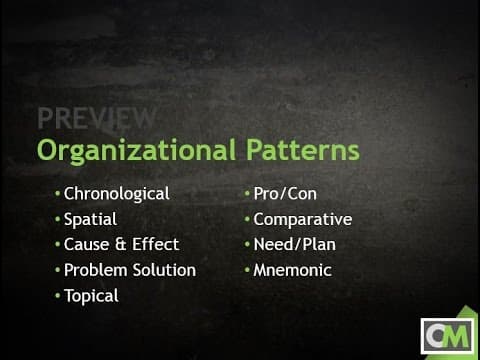
- 📝 Choosing the right organizational pattern is essential for persuasive speeches, with patterns like cause-effect, problem-solution, comparative advantages, and topical organization being useful.
- 🗣️ The need-plan pattern is a straightforward approach that establishes the need for change and details the plan to accomplish it, with the level of explanation varying based on the audience's familiarity with the need.
- ⚖️ The Monroe's motivated sequence, commonly used in advertising, follows a five-step pattern involving attention, need, satisfaction, visualization, and action to elicit immediate response from the audience.
- 🤔 Planning and preparation are crucial in persuasive speeches, even in seemingly simple situations, as effective persuasion requires careful thought and strategy.
Install to Summarize YouTube Videos and Get Transcripts
Explore YouTube Video Summarizer or Get YouTube Transcript Extractor
Questions & Answers
Q: What are the three elements of persuasion according to Aristotle?
According to Aristotle, the three elements of persuasion are ethos, logos, and pathos. Ethos refers to credibility, logos refers to logic, and pathos refers to emotional appeal.
Q: What is the importance of finding the right balance between ethos, logos, and pathos in a persuasive speech?
Finding the right balance between ethos, logos, and pathos is important because it allows the speaker to connect with the audience on multiple levels. Ethos establishes credibility, logos provides logical arguments, and pathos creates an emotional connection, increasing the chances of persuading the audience.
Q: What are the two organizational patterns discussed in the video for persuasive speeches?
The two organizational patterns discussed in the video are the need-plan pattern and Monroe's motivated sequence. The need-plan pattern focuses on establishing the need for change and presenting a plan to accomplish it. Monroe's motivated sequence follows a five-step pattern, including attention, need, satisfaction, visualization, and action.
Q: Why is Monroe's motivated sequence effective in persuasive speeches?
Monroe's motivated sequence is effective in persuasive speeches because it grabs the audience's attention, presents the problem, proposes solutions, paints a vivid picture of the outcomes, and compels the audience to take action. This sequence has been used by advertisers for decades due to its ability to elicit a strong response from the audience.
Summary & Key Takeaways
-
Aristotle's three elements of persuasion: ethos (credibility), logos (logic), and pathos (emotional appeal).
-
The importance of finding the right balance between ethos, logos, and pathos for effective persuasion.
-
Two organizational patterns for persuasive speeches: need-plan and Monroe's motivated sequence.
Read in Other Languages (beta)
Share This Summary 📚
Summarize YouTube Videos and Get Video Transcripts with 1-Click
Try YouTube Summary with ChatGPT & Claude or YouTube Transcript Generator
Explore More Summaries from COMMpadres Media 📚
Summarize YouTube Videos and Get Video Transcripts with 1-Click
Try YouTube Summary with ChatGPT & Claude or YouTube Transcript Generator