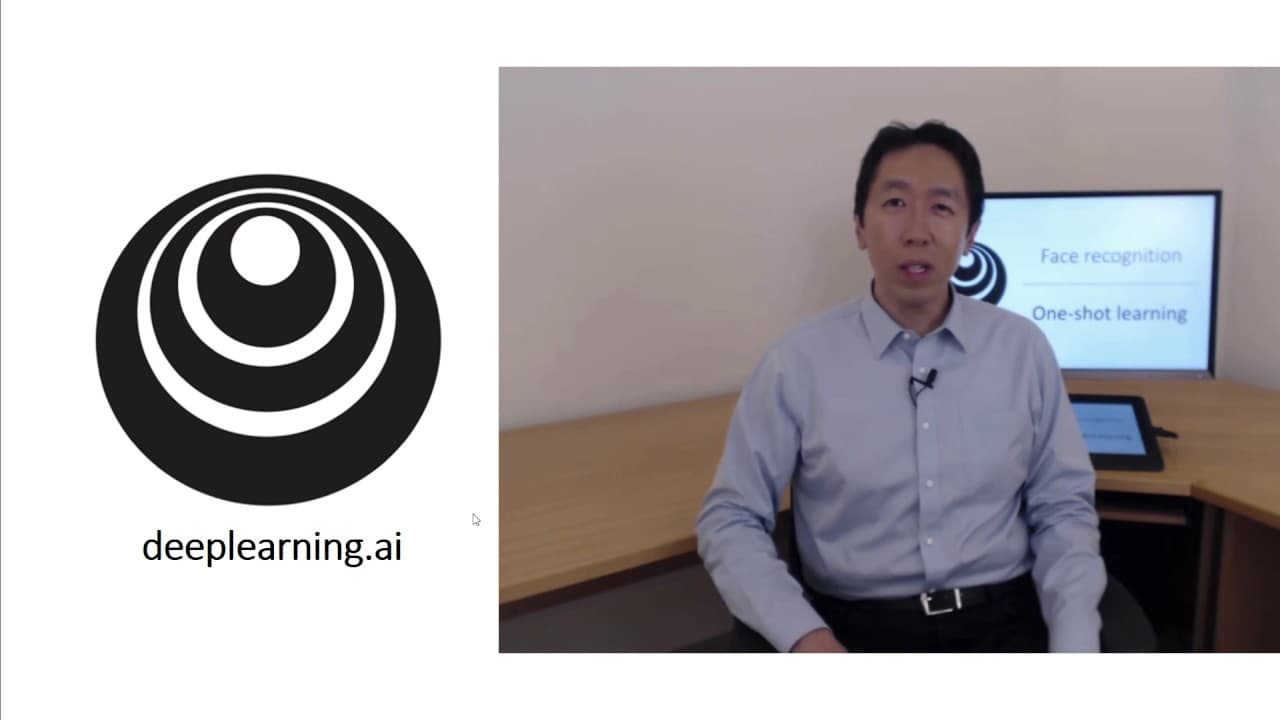
C4W4L02 One Shot Learning
TL;DR
Face recognition algorithms often struggle with one-shot learning, where they need to recognize a person with just one image. One approach is to learn a similarity function that compares two images and determines if they are of the same person or not.
Transcript
one of the challenges of face recognition is that you need to solve the one-shot learning problem what that means is that for most face recognition applications you need together recognize a person given just one single image or given just one example of that person's face and historically deep learning algorithms don't work well if you have only o... Read More
Key Insights
- 🙎 Face recognition often requires solving the one-shot learning problem, recognizing a person with just one image.
- 💄 Deep learning algorithms struggle with limited training examples, making one-shot learning challenging.
- 🏷️ Instead of predicting labels, a better approach is to learn a similarity function to compare images.
- 😀 The similarity function determines the degree of difference between two images and facilitates face verification.
- 😫 A threshold is set to determine if images are of the same or different individuals.
- 🌚 Learning the similarity function allows for easy addition of new individuals to the face recognition system without retraining the whole system.
- 👶 By comparing a new image with the existing database, the system can identify and recognize individuals accurately.
Install to Summarize YouTube Videos and Get Transcripts
Explore YouTube Video Summarizer or Get YouTube Transcript Extractor
Questions & Answers
Q: What is the one-shot learning problem in face recognition?
The one-shot learning problem refers to the challenge where face recognition systems need to recognize a person with just one image or example of their face. This is a common scenario in many applications and poses difficulties for traditional deep learning algorithms.
Q: Why doesn't training a neural network with limited examples work well for face recognition?
Training a neural network with a small number of training examples, such as one image per person, is not sufficient to create a robust model. The network may struggle to generalize and accurately recognize new individuals, especially when new people join the system.
Q: How does learning a similarity function address the one-shot learning problem?
Instead of directly predicting labels based on one image, learning a similarity function allows the system to compare two images and determine the degree of difference between them. By setting a threshold, the system can predict if the images are of the same person or different individuals.
Q: How does the similarity function help with the addition of new individuals to the face recognition system?
When a new person joins the system, the similarity function allows for the comparison of their image with the existing database. The model can calculate the degree of difference between the new image and all stored images. This approach eliminates the need to retrain the entire system for each new individual.
Summary & Key Takeaways
-
Face recognition systems often need to recognize a person with just one image, presenting a challenge known as the one-shot learning problem.
-
Deep learning algorithms historically do not perform well with limited training examples, making it difficult to train robust neural networks for face recognition.
-
Instead of using a softmax unit to predict a label based on one image, a better approach is to learn a similarity function that measures the degree of difference between two images.
Read in Other Languages (beta)
Share This Summary 📚
Summarize YouTube Videos and Get Video Transcripts with 1-Click
Try YouTube Summary with ChatGPT & Claude or YouTube Transcript Generator
Explore More Summaries from DeepLearningAI 📚
![#20 AI for Good Specialization [Course 1, Week 2, Lesson 2] thumbnail](/_next/image?url=https%3A%2F%2Fi.ytimg.com%2Fvi%2F1X9cLvqOPhg%2Fhqdefault.jpg&w=750&q=75)
![#33 Machine Learning Specialization [Course 1, Week 3, Lesson 1] thumbnail](/_next/image?url=https%3A%2F%2Fi.ytimg.com%2Fvi%2F0az8RjxLLPQ%2Fhqdefault.jpg&w=750&q=75)
![#25 Machine Learning Engineering for Production (MLOps) Specialization [Course 1, Week 3, Lesson 1] thumbnail](/_next/image?url=https%3A%2F%2Fi.ytimg.com%2Fvi%2F0aDhjrs8FMw%2Fhqdefault.jpg&w=750&q=75)
Summarize YouTube Videos and Get Video Transcripts with 1-Click
Try YouTube Summary with ChatGPT & Claude or YouTube Transcript Generator