How to Convert 4-Bit Binary Numbers to Gray Code?
TL;DR
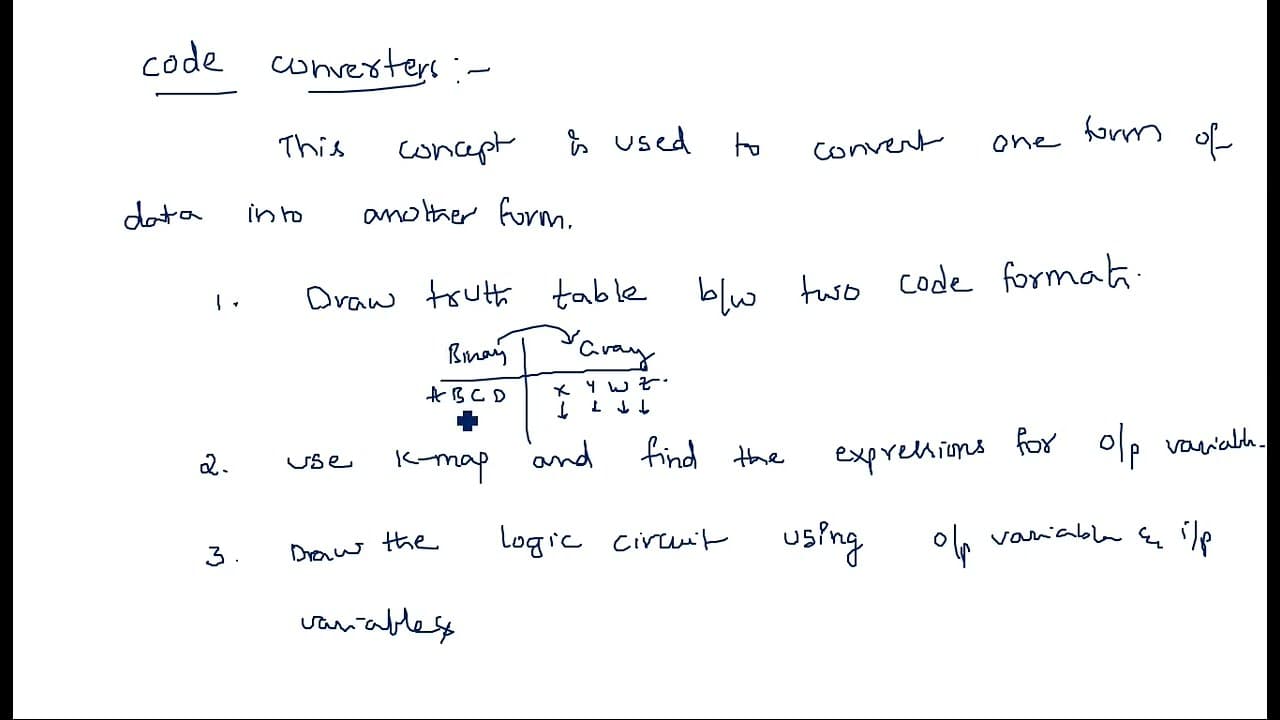
To convert a 4-bit binary number to Gray code, first create a truth table mapping binary values to their corresponding Gray code outputs. Then, derive logical expressions for the Gray code bits using Karnaugh maps. Finally, design a logic circuit based on these expressions to implement the binary to Gray code conversion.
Transcript
hi everyone in this video I'm going to explain about 4bit binary to gray code converter code converters are very important to convert one form of data into another form so that particular concept is known as code converters code converters so code converters this concept is used to convert one form of data one form of data into another form one for... Read More
Key Insights
- 💁 Code converters facilitate the transition from one data format to another, crucial for applications in digital systems.
- 👨💻 Binary to Gray code conversion requires careful mapping and logical analysis to preserve data integrity and minimize errors.
- 🫦 The unique property of Gray code reduces the chance of inaccuracies during bit transitions, enhancing reliability in digital communications.
- 🎃 Designing a logic circuit based on K-map derived functions allows for efficient implementation of binary to Gray code conversion.
- 🤩 Understanding the significance of each step in the conversion process is key to mastering coding techniques in digital electronics.
- 👨💻 The correct mapping of binary values to their respective Gray code outputs is vital for successful conversion.
- 👌 The systematic approach to creating truth tables, K-maps, and circuit designs helps simplify complex conversions and improve understanding.
Install to Summarize YouTube Videos and Get Transcripts
Explore YouTube Video Summarizer or Get YouTube Transcript Extractor
Questions & Answers
Q: What is the primary purpose of code converters in data representation?
Code converters are essential tools for transforming data from one coding format to another. This transformation allows for different representations like binary code, Gray code, and other formats, facilitating various data processing applications. Each code serves specific needs, like reducing errors in digital communication or simplifying logic circuits.
Q: Why is Gray code referred to as a "unit distance code"?
Gray code is termed a "unit distance code" because successive numbers in its sequence differ from one another by only a single bit. This property minimizes the chance of errors during transitions, making Gray code particularly useful in applications like digital encoders and error detection systems.
Q: What role do Karnaugh maps (K-maps) play in the conversion process?
K-maps are utilized to simplify Boolean expressions during the conversion from binary to Gray code. By visually organizing binary inputs, they aid in grouping terms that can be simplified, thus generating concise logical expressions that define the Gray code outputs, which can then be implemented in logic circuits.
Q: Can you explain the process to create a truth table for binary to Gray code conversion?
To create a truth table for binary to Gray code conversion, start by listing all possible 4-bit binary values. Simultaneously, determine the corresponding Gray code values. Each binary input is mapped to its Gray code equivalent, allowing for a clear comparison of both formats, which sets the stage for further logic analysis.
Q: What are the three main steps involved in converting binary data to Gray code?
The three main steps include: first, drawing a truth table to establish the relationship between binary and Gray code; second, utilizing K-maps to derive logical expressions governing Gray code outputs; and finally, designing the logic circuit that implements these expressions to automate the conversion process.
Q: What is the significance of the mirror image code in Gray code formation?
The mirror image approach is significant in Gray code formation because it ensures that only one bit changes at each step while transitioning between codes. This method helps derive the Gray code from binary by appending zeros and visualizing the bit inversions, which is vital for achieving the desired unit distance property.
Q: How do you derive the expressions for the Gray code outputs?
To derive the expressions for Gray code outputs, use K-maps to group binary inputs based on their outputs. Analyze the K-map for each Gray code output—G3, G2, G1, and G0—identifying common patterns and simplifying them into logical expressions that describe how each Gray code bit relates to the binary inputs.
Q: What is the typical structure of the logic circuit for a binary to Gray code converter?
The typical structure of a binary to Gray code converter logic circuit consists of XOR gates that represent the relationships derived from the Gray code expressions. Each output bit of the Gray code is obtained through the XOR operation between specific binary input bits, creating a compact and efficient circuit layout.
Summary & Key Takeaways
-
The process of converting 4-bit binary to Gray code involves drawing a truth table that compares the two coding formats, identifying the outputs needed for Gray code.
-
Using Karnaugh maps (K-maps) is essential for deriving logical expressions for the Gray code outputs based on the binary inputs.
-
Finally, the logic circuit design utilizes the derived expressions, helping create a functional binary to Gray code converter based on logical operations.
Read in Other Languages (beta)
Share This Summary 📚
Summarize YouTube Videos and Get Video Transcripts with 1-Click
Try YouTube Summary with ChatGPT & Claude or YouTube Transcript Generator