Thalidomide - Periodic Table of Videos
TL;DR
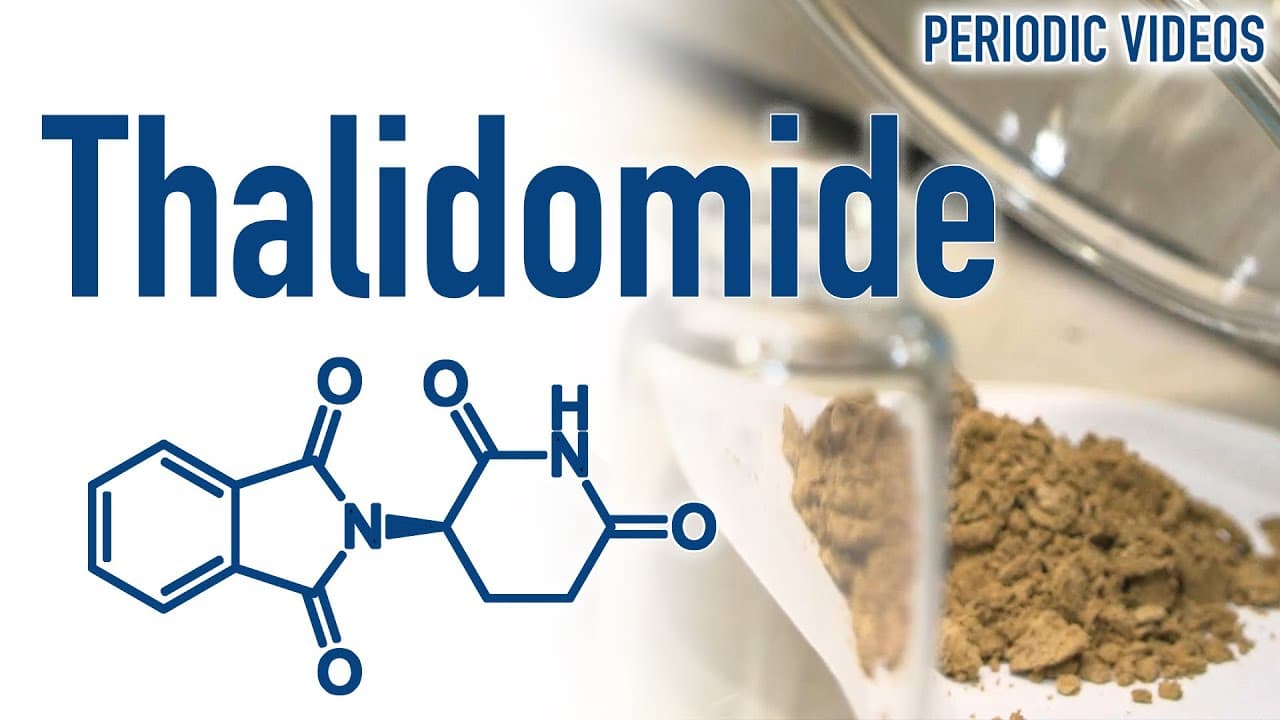
A young boy who visited a chemistry lab years ago has now grown up to become a chemist and published a paper on the synthesis of the historic molecule thalidomide.
Transcript
a little boy who visited our lab in 2012 when he was 10 years old is now grown up and become a chemist and published his first paper and the paper is making a really interesting molecule historic molecule thalidomide and my colleague Miriam is going to repeat this preparation the synthesis that Eduardo has devised I'll grab some gloves and and then... Read More
Key Insights
- 🔬 Even small visits to scientific labs can inspire young minds to pursue a career in science.
- 🥺 Thalidomide synthesis has significance beyond academic research, as it can lead to new applications of the molecule.
- 😒 The use of traditional lab techniques like pestle and mortar is being replaced by more efficient and environmentally friendly methods.
- 💦 Thalidomide's complex structure and properties make it a challenging molecule to work with.
- 👶 Thalidomide has a dark history, with its harmful effects on unborn babies.
- 🥼 Chemical reactions that change color visually indicate progress, which is not always the case in the lab.
- 🤕 Making new discoveries in chemistry can be exciting and fulfilling for scientists of all ages.
Install to Summarize YouTube Videos and Get Transcripts
Explore YouTube Video Summarizer or Get YouTube Transcript Extractor
Questions & Answers
Q: What is the significance of Eduardo's paper on thalidomide synthesis?
Eduardo's paper provides a simple synthesis method for thalidomide, a drug with a complex history. It allows for further study and potential new applications of the molecule.
Q: What is the purpose of using a pestle and mortar in the lab?
While pestle and mortar are not commonly used in labs anymore, they are still useful for certain reactions. However, a more popular method called ball milling is gaining popularity as it reduces solvent usage and promotes greener reactions.
Q: What is the history of thalidomide and its effects on babies?
Thalidomide was developed as a treatment for morning sickness but led to severe deformities in babies when taken by pregnant women. This happened because thalidomide exists in two different forms, and only one form is safe while the other causes harm.
Q: Is thalidomide still used today?
Thalidomide is still used to treat some rare diseases, such as leprosy. However, its usage is not as widespread as it was in the past due to its potential harmful effects on unborn babies.
Summary & Key Takeaways
-
A young boy named Eduardo visited a chemistry lab years ago and now as a chemist, he has published a paper on the synthesis of thalidomide.
-
The lab technician, Miriam, is repeating Eduardo's synthesis in the lab.
-
Thalidomide has a tragic history as a drug developed for morning sickness in pregnant women, causing deformities in babies.
Read in Other Languages (beta)
Share This Summary 📚
Summarize YouTube Videos and Get Video Transcripts with 1-Click
Try YouTube Summary with ChatGPT & Claude or YouTube Transcript Generator
Explore More Summaries from Periodic Videos 📚





Summarize YouTube Videos and Get Video Transcripts with 1-Click
Try YouTube Summary with ChatGPT & Claude or YouTube Transcript Generator