Unit 10: Utility Analysis and Multidimensional Evaluation, Video 5: There's No Valid Group Utility
TL;DR
Group decision-making is complex and challenging because different stakeholders have different interests and preferences, making it difficult to find a single, optimal solution.
Transcript
[SQUEAKING] [RUSTLING] [CLICKING] RICHARD DE NEUFVILLE: So the question I wanted next to come to, does the valuation function, and I should have an underscore for the X to indicate that it's a vector, does it mean apply to groups? And the basic issue is, do all members of the group have the same sets of preferences? Well, that's not excluded. But i... Read More
Key Insights
- 👥 Valuation functions may not apply to groups because different stakeholders have different preferences.
- ✊ Group decision-making involves managing diverse interests, such as profit for investors, power for managers, product quality for users, and better working conditions for workers.
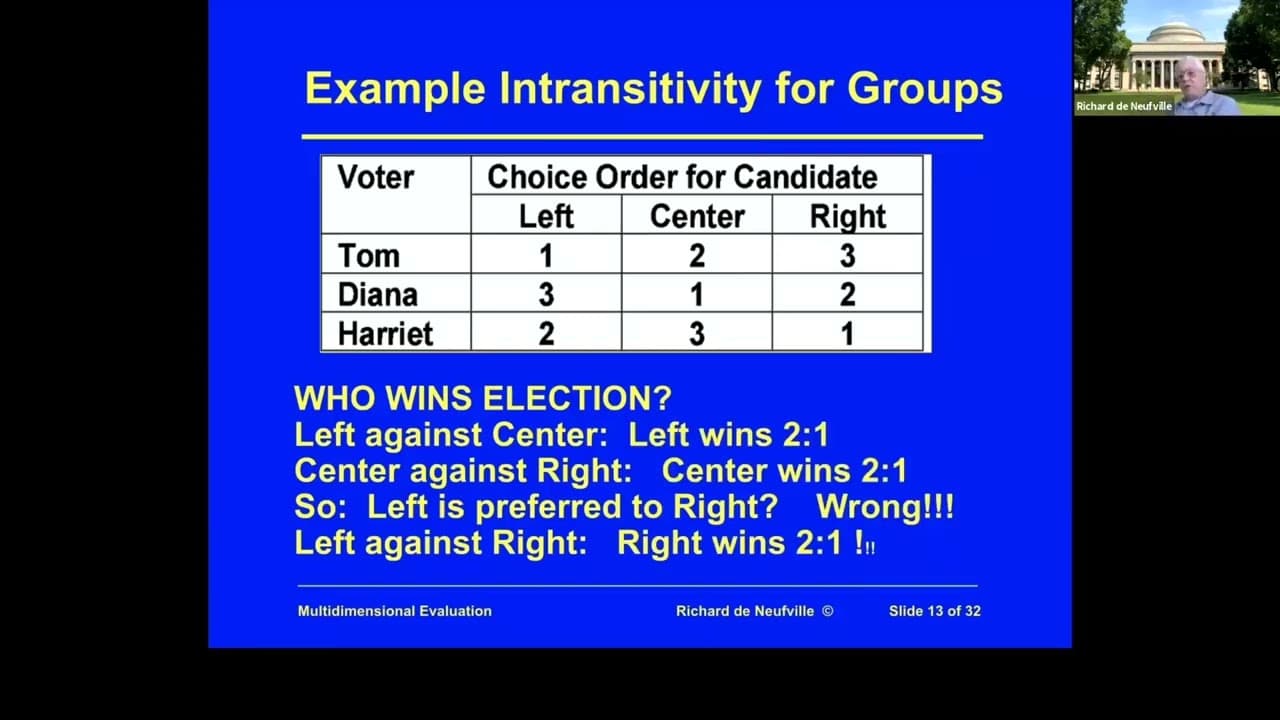
- 😜 Intransitive situations, where preferences cannot be ranked consistently, are common in group decision-making.
- 👋 The concept of "best" is not meaningful in complex systems because preferences and rankings vary among stakeholders.
- 🍃 While a consensus can be reached through a voting system, it will not satisfy everyone and may leave some individuals unhappy.
- 🤑 Mathematical optimization can only be achieved when there is a single objective function or a unified value system, such as with money.
- 🍵 Preferred solutions can be identified and agreed upon, but a single, optimal solution that satisfies all stakeholders is unrealistic.
Install to Summarize YouTube Videos and Get Transcripts
Explore YouTube Video Summarizer or Get YouTube Transcript Extractor
Questions & Answers
Q: How do different stakeholders' interests complicate group decision-making?
Different stakeholders, such as investors, managers, users, and workers, have conflicting interests and preferences. This diversity makes it challenging to reach a consensus or find a solution that satisfies everyone's goals.
Q: Why is it difficult to have a unique valuation function for groups?
A unique valuation function that optimizes group decision-making is challenging because people have different rankings and preferences for various options. It is almost impossible to find a single objective function that satisfies everyone's interests.
Q: Can group decision-making lead to intransitive situations?
Yes, group decision-making often results in intransitive situations, where preferences are not transitive and cannot be consistently ranked. This occurs when individuals have different rankings for options, making it impossible to find a single, preferred outcome.
Q: Is it possible to have a completely satisfying voting system in elections?
No, even the most well-designed voting systems cannot satisfy everyone. There will always be some individuals who are unhappy with the outcome because of their different preferences and rankings.
Summary & Key Takeaways
-
Valuation functions, which determine the value or preference of different options, may not apply to groups because members often have different sets of preferences.
-
Groups are composed of stakeholders with different interests, such as investors, managers, users, and workers, making it unlikely that they will agree on a single preferred outcome.
-
Intransitive situations are common in group decision-making, where preferences are not transitive and cannot be ranked in a consistent order.
Read in Other Languages (beta)
Share This Summary 📚
Summarize YouTube Videos and Get Video Transcripts with 1-Click
Try YouTube Summary with ChatGPT & Claude or YouTube Transcript Generator
Explore More Summaries from MIT OpenCourseWare 📚



Summarize YouTube Videos and Get Video Transcripts with 1-Click
Try YouTube Summary with ChatGPT & Claude or YouTube Transcript Generator