CMOS inverter | Stick diagram | VLSI | Lec-27
TL;DR
The video explains how to create a stick diagram for a CMOS inverter.
Transcript
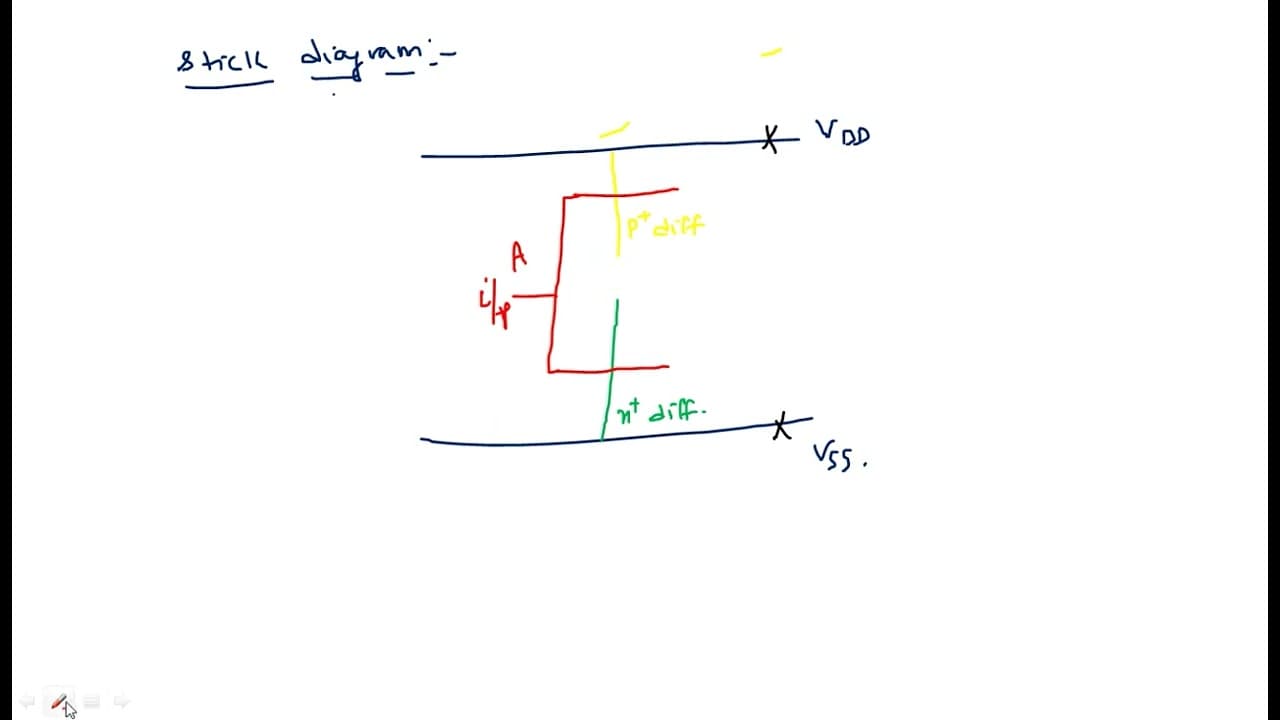
hi everyone in this video I am going to explain about the CMOS inverter stick diagram so how to draw the CMOS inverter stick diagram I will explain here before going into the stick diagram or layout diagram one should know how to draw the CMS inverter that means CMOS realization we should know whatever the circuit it is okay even any generic formul... Read More
Key Insights
- 💋 Understanding CMOS realization is fundamental to successfully drawing a stick diagram for an inverter, as it lays the groundwork for circuit understanding.
- 🤩 The stick diagram illustrates key components like PMOS and NMOS transistors, which are essential for digital logic applications in electronic circuits.
- 💋 Color codes serve as vital visual aids in stick diagrams, helping differentiate between various components, ensuring clarity and accuracy in design representation.
- 🥺 Designing CMOS inverters requires adhering to specific rules, including the percentage of polysilicon usage, which can lead to errors if exceeded, affecting the final product.
- 🎨 Different layouts of CMOS inverters can influence performance; thus, understanding various design strategies enhances circuit development capabilities.
- 🫥 Utilizing correct interconnection techniques, like black contacts and metal line representation, is crucial for integrating components within the inverter effectively.
- 🌍 The layout process involves drawing and connecting different components systematically to ensure the inverter functions as intended in both simulation and real-world applications.
Install to Summarize YouTube Videos and Get Transcripts
Explore YouTube Video Summarizer or Get YouTube Transcript Extractor
Questions & Answers
Q: What is a CMOS inverter, and why is it important?
A CMOS inverter is a fundamental circuit used in digital electronics that converts a single input signal into its opposite output. It is significant due to its low power consumption and high noise immunity, making it vital for designing integrated circuits in various applications.
Q: How many transistors are involved in a CMOS inverter, and what types are they?
A CMOS inverter consists of two transistors: one PMOS (pull-up) and one NMOS (pull-down). These transistors work together to provide the inverter function, creating an output that is the logical inversion of the input.
Q: Why is circuit realization critical before drawing a stick diagram?
Circuit realization is crucial because it provides a clear understanding of how the transistor components interact and connect. Without this knowledge, one cannot accurately produce a stick diagram, which serves as the blueprint for the layout in integrated circuits.
Q: What are the color codes used for different components in the stick diagram?
In the stick diagram, blue is typically used for metal lines (VDD and VSS), yellow represents PMOS diffusion, green denotes NMOS diffusion, red is for gate terminals, and black indicates contact points for interconnections.
Q: How does the layout representation change between different types of CMOS inverters?
Different types of CMOS inverters may have variations in the orientation of polysilicon and diffusion. For instance, one design may feature vertical polysilicon while another could use horizontal arrangements, impacting the overall layout and performance characteristics.
Q: What common errors should be avoided when drawing stick diagrams for CMOS inverters?
It's essential to avoid exceeding design rules such as the limit on the percentage of polysilicon used in a design. Overuse can lead to Design Rule Checking (DRC) errors, which can hinder successful fabrication and functionality.
Q: Can you explain the process of joining metal layers in the diagram?
Joining metal layers involves using contacts, represented in black, to connect different layers, such as tying PMOS and NMOS together. Proper joining is crucial for establishing the necessary electrical paths for the inverter's operation.
Q: What is the significance of the demarcation line in the stick diagram?
The demarcation line serves as a visual separator between PMOS and NMOS transistors in the stick diagram, aiding in clear identification and organization of components within the design, which enhances readability and prevents circuit confusion.
Summary & Key Takeaways
-
The video emphasizes the importance of understanding the CMOS realization before attempting to draw a stick diagram, as it is essential for accurate layout representation.
-
It outlines the process of drawing a CMOS inverter's stick diagram, highlighting key components like PMOS and NMOS transistors and their connections.
-
The tutorial provides insights on material color codes used in the stick diagram, demonstrating how to correctly represent metal lines and contacts.
Read in Other Languages (beta)
Share This Summary 📚
Summarize YouTube Videos and Get Video Transcripts with 1-Click
Try YouTube Summary with ChatGPT & Claude or YouTube Transcript Generator