Universal shift register | IC74LS194 | Truth table | Digital Systems Design | Lec-91
TL;DR
The video explains the Universal Shift Register 74LS194 and its functionalities.
Transcript
hi everyone in this video I'm going to explain about Universal shift register and its IC number is 74 LS1 194 74 LS1 194 LS means low power short key that means the transistor which are used inside the implementation of universal shift register that belongs to low power shortkey devices low power short key the short key transistors are there which ... Read More
Key Insights
- 🤩 The 74LS194 Universal Shift Register is designed to be energy-efficient, evidenced by its low-power short-key transistors.
- 😃 Its ability to shift data bi-directionally enhances versatility in applications requiring flexible data manipulation.
- 🛰️ Understanding the function and relationship between control bits and different modes of operations is critical for utilizing this IC effectively.
- 🈸 The truth table of the 74LS194 provides vital insights into how the IC behaves under various input conditions, aiding in its application design.
- 👻 The register supports both synchronous and asynchronous operations, allowing for a range of timing requirements in digital systems.
- 👶 The clear function is an integral part of resetting the register, ensuring all outputs can be cleared before new data is processed.
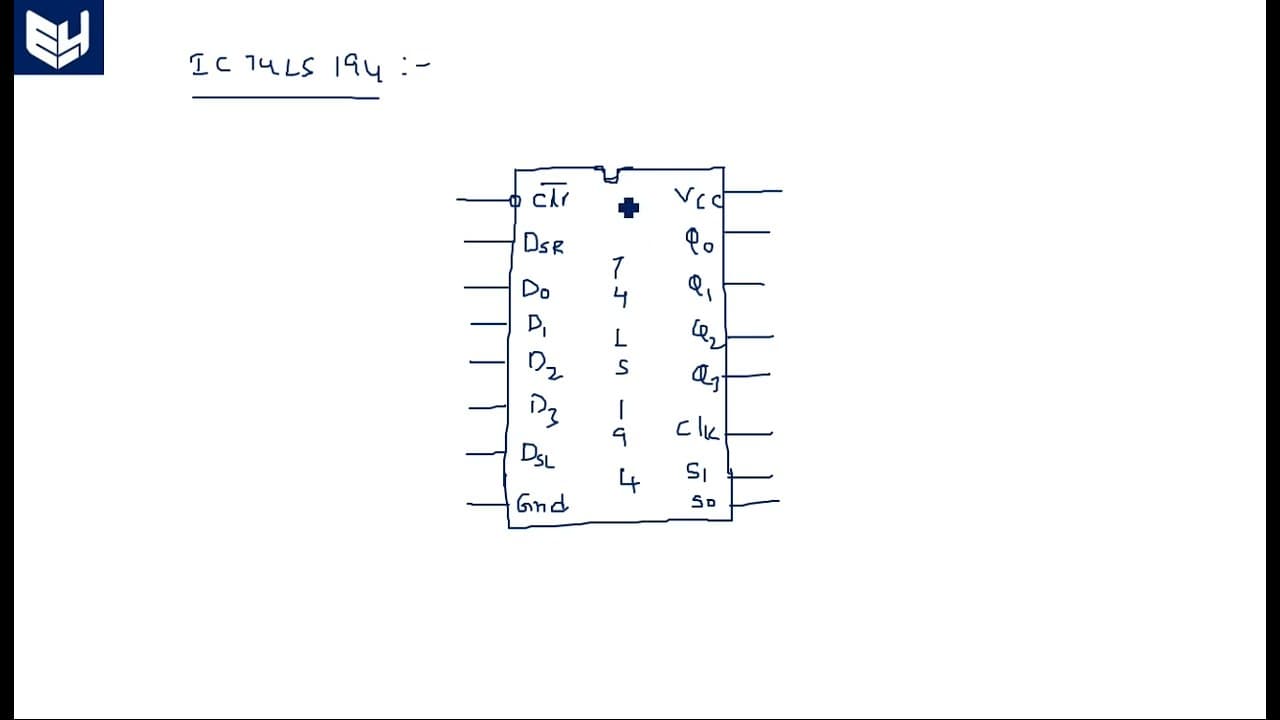
- 😴 The pin configuration emphasizes clear distinctions between input and output roles, allowing straightforward integration into circuit designs.
Install to Summarize YouTube Videos and Get Transcripts
Explore YouTube Video Summarizer or Get YouTube Transcript Extractor
Questions & Answers
Q: What is the primary function of the Universal Shift Register 74LS194?
The Universal Shift Register 74LS194 performs a variety of data shifting operations, including serial input serial output, parallel input serial output, and parallel input parallel output, making it a versatile tool for managing digital data flow. Its ability to shift data bi-directionally enhances its application in various electronic circuits.
Q: What do the control bits S1 and S0 do in the 74LS194?
The control bits S1 and S0 determine the operation mode of the Universal Shift Register. For example, the combination of S1=1 and S0=1 initiates a shift left operation, while S1=0 and S0=1 triggers a shift right. Understanding these bit combinations is essential for programming the shift register correctly for desired functions.
Q: How is data loaded into the 74LS194?
Data can be loaded into the 74LS194 through parallel input using the pins D0 to D3. When a loading operation is initiated, multiple data bits are entered simultaneously, allowing for efficient data transfer directly into the flip-flops of the register, while the control bits are set to specify load mode.
Q: What happens when the clear pin is activated on the 74LS194?
Activating the clear pin resets the Universal Shift Register, setting all outputs to zero regardless of the input states on other pins. This is particularly useful for initializing the register or clearing previous data before new operations commences.
Q: Can the Universal Shift Register perform multiple operations simultaneously?
No, the various operations of the Universal Shift Register cannot occur simultaneously. Instead, the control bits choose one specific operation at a time—whether loading data, shifting left or right, or holding the previous state—allowing for a structured flow of data handling.
Q: How many pins does the 74LS194 have and what are they used for?
The 74LS194 has 16 pins. These include data input pins for parallel loading, shift right and left data inputs, control bit pins for operation selection, ground and VCC pins for power, and output pins that deliver the shifted data, facilitating its various functions in digital circuits.
Summary & Key Takeaways
-
The Universal Shift Register 74LS194 is a versatile digital component that supports multiple shifting operations, including serial and parallel data input and output, facilitating various data handling methods.
-
This shift register can operate in both directions, allowing data to enter from either side and utilizing two control bits to determine the specific operation mode it should execute.
-
The IC's pin configuration includes control bits and data inputs for parallel loading, with detailed operations defined in a truth table outlining how different input conditions affect the shifting process.
Read in Other Languages (beta)
Share This Summary 📚
Summarize YouTube Videos and Get Video Transcripts with 1-Click
Try YouTube Summary with ChatGPT & Claude or YouTube Transcript Generator