8. Kinetic Theory of Gases Part 2
TL;DR
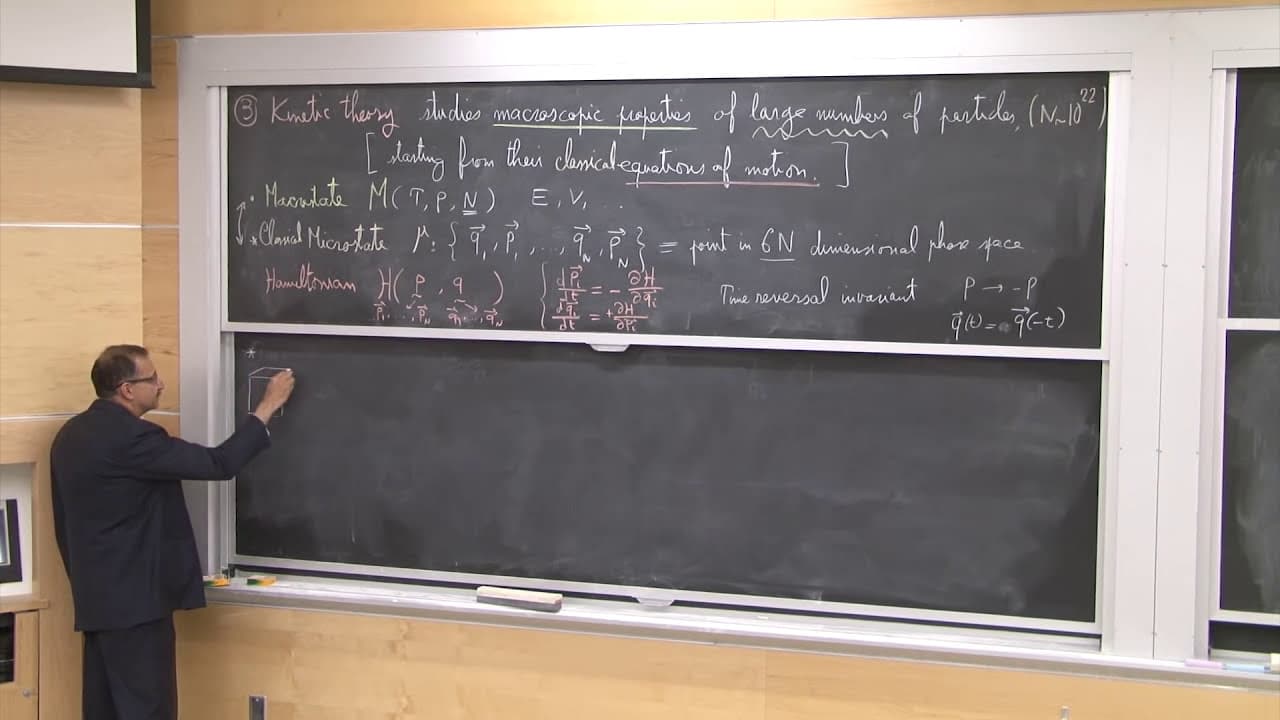
The content discusses the concept of equilibrium and microstates in statistical mechanics, focusing on the relationship between macroscopic and microscopic properties of a system.
Transcript
The following content is provided under a Creative Commons license. Your support will help MIT OpenCourseWare continue to offer high-quality educational resources for free. To make a donation or view additional materials from hundreds of MIT courses, visit MIT OpenCourseWare at ocw.mit.edu. PROFESSOR: Let's say that I tell you that I'm interested i... Read More
Key Insights
- 🦾 Equilibrium in statistical mechanics is characterized by a density function that does not depend on time.
- ⌛ The Liouville's equation relates the time evolution of the density function to the Poisson bracket of the Hamiltonian with the density function.
- 🛟 Conserved quantities, such as energy and angular momentum, have zero Poisson brackets with the Hamiltonian and are preserved in equilibrium systems.
- 🆘 The concept of ensemble helps in understanding the probabilistic nature of systems and their relationship with macroscopic properties.
Install to Summarize YouTube Videos and Get Transcripts
Explore YouTube Video Summarizer or Get YouTube Transcript Extractor
Questions & Answers
Q: What is the concept of macrostates and microstates?
Macrostates represent the macroscopic properties of a system, such as temperature and pressure, while microstates describe the specific positions and momenta of individual particles in the system.
Q: How does the concept of ensemble help in understanding the relationship between microstates and macrostates?
Ensembles allow us to consider multiple microstates that correspond to the same macrostate, providing a statistical description of the system's properties.
Q: What is the Liouville's equation and what does it describe?
Liouville's equation describes the time evolution of the density function that represents the probability of finding a system in a particular microstate.
Q: What is the significance of the Poisson bracket in statistical mechanics?
The Poisson bracket provides a mathematical tool to calculate the time dependence of observables in a system, determining how they change as a function of time.
Summary & Key Takeaways
-
The content explores the correspondence between macrostates (described by temperature, pressure, and number of particles) and microstates (described by positions and momenta of individual particles).
-
The concept of an ensemble, which includes multiple possible microstates that correspond to the same macrostate, is introduced.
-
The Liouville's equation is derived, which describes the time evolution of the density function that represents the probability of finding a system in a particular microstate.
-
It is shown that in equilibrium, the density function does not depend on time, and the Poisson bracket of the Hamiltonian with any observable is zero, indicating that equilibrium distributions are independent of specific observables.
Read in Other Languages (beta)
Share This Summary 📚
Summarize YouTube Videos and Get Video Transcripts with 1-Click
Try YouTube Summary with ChatGPT & Claude or YouTube Transcript Generator
Explore More Summaries from MIT OpenCourseWare 📚


Summarize YouTube Videos and Get Video Transcripts with 1-Click
Try YouTube Summary with ChatGPT & Claude or YouTube Transcript Generator