Two Dimensional Motion (1 of 4) An Explanation
TL;DR
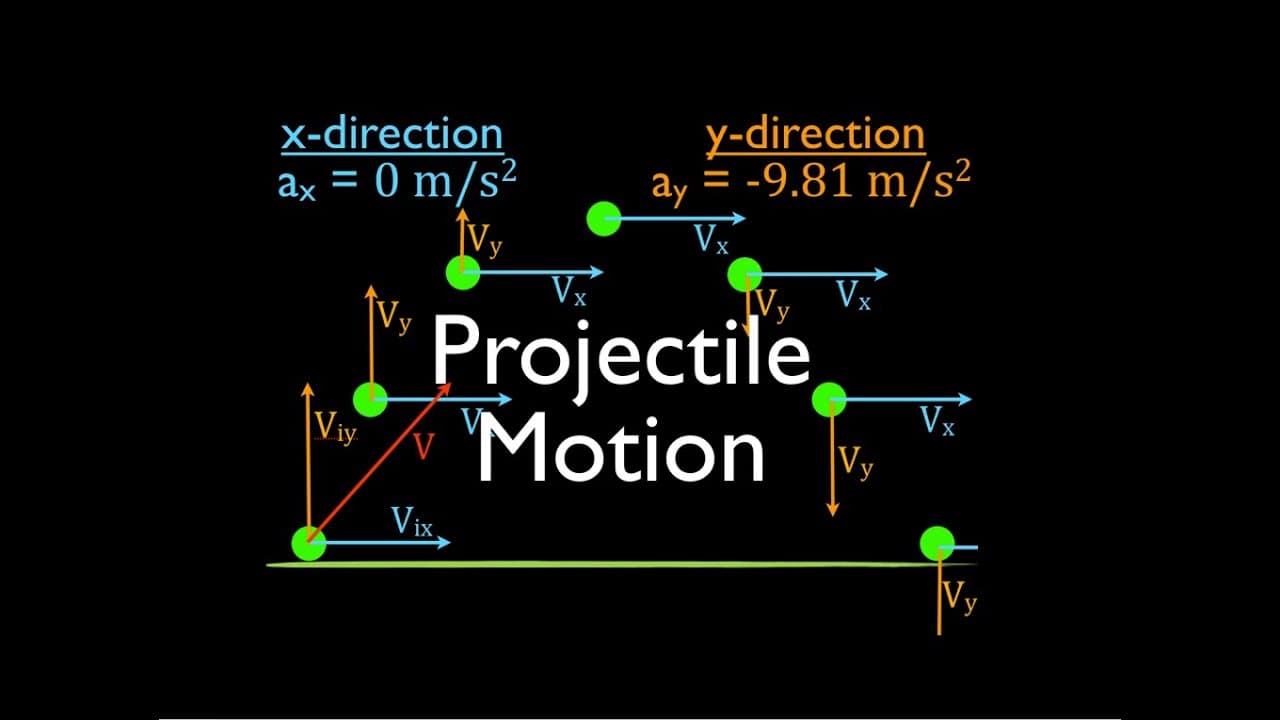
This video provides a qualitative explanation of two-dimensional projectile motion, discussing the independent motion in the X and Y directions and the forces at play.
Transcript
okay in today's video I'm going to go over a qualitative description of two-dimensional projectile motion when an object is projected with some initial velocity at some angle above the Horizon and this is the situation that we have we have this object it's going to be projected with some initial velocity at some angle above the Horizon and when it ... Read More
Key Insights
- 🇾🇪 Two-dimensional projectile motion involves independent motion in the X and Y directions.
- ❓ The X direction motion does not experience any forces, resulting in a constant velocity.
- 🥺 In the Y direction, the force of gravity causes the object to accelerate, leading to changing velocity.
- 🇾🇪 The object follows a parabolic path due to the combination of the X and Y motions.
- ☺️ The initial velocity in the X direction remains constant throughout.
- ☠️ The initial velocity in the Y direction determines the rate of change in the object's velocity.
- 🧑🏭 The force of gravity acts as the only force in projectile motion.
Install to Summarize YouTube Videos and Get Transcripts
Explore YouTube Video Summarizer or Get YouTube Transcript Extractor
Questions & Answers
Q: What are the two motions that occur in two-dimensional projectile motion?
In two-dimensional projectile motion, the object moves in the X direction and the Y direction simultaneously, with the two motions being independent of each other.
Q: Why does the object follow a parabolic path?
The object follows a parabolic path because there are no forces acting on it in the X direction, allowing it to maintain a constant velocity, while in the Y direction, the force of gravity causes it to accelerate, resulting in a changing velocity.
Q: What causes the object's velocity to change in the Y direction?
The force of gravity causes the object's velocity to change in the Y direction. As the object goes up, it slows down due to the negative acceleration, and as it comes back down, it speeds up in the negative direction.
Q: How does the initial velocity affect the object's motion?
The initial velocity determines the magnitude and direction of the object's motion. In the X direction, the initial velocity remains constant throughout, while in the Y direction, it determines the initial velocity and the rate at which the object slows down and speeds up during its path.
Summary & Key Takeaways
-
When an object is projected with an initial velocity at an angle above the horizon, it follows a parabolic path due to independent motion in the X and Y directions.
-
The X direction motion does not experience any forces and has no acceleration, resulting in a constant velocity.
-
In the Y direction, the force of gravity causes the object to accelerate in the negative direction, leading to a changing velocity.
Read in Other Languages (beta)
Share This Summary 📚
Summarize YouTube Videos and Get Video Transcripts with 1-Click
Try YouTube Summary with ChatGPT & Claude or YouTube Transcript Generator
Explore More Summaries from Step by Step Science 📚

Summarize YouTube Videos and Get Video Transcripts with 1-Click
Try YouTube Summary with ChatGPT & Claude or YouTube Transcript Generator