Caselet DI | Question solving | Reasoning | Part - 17 | Bharath Kumar
TL;DR
This content explains data interpretation involving JRF holders in three universities.
Transcript
hi everyone welcome to the session in this session I am continuing select data interpretation here first of all we need to read the information which is provided in the given Passage once you read the entire uh passage and you need to understand the passage what is the given in data and based on the data you need to get some values from the data on... Read More
Key Insights
- 💁 Effective data interpretation requires a thorough understanding of provided information to extract necessary values.
- 🕵️♀️ The relationships between different categories, such as male and female JRF holders, can be established through percentage comparisons.
- 🥳 Average calculations and simple ratios can effectively summarize the data presented for more straightforward problem-solving.
- 💄 Understanding percentage differences is vital for making comparisons across different institutions or categories within the data.
- 🔬 The ability to categorize information, such as identifying science versus non-science subjects, enhances data comprehension and analysis.
- ❓ The process emphasizes logical reasoning and systematic calculations to arrive at accurate results in data interpretation tasks.
- 🦻 Recognizing patterns in data can aid in predicting outcomes or understanding broader trends within educational statistics.
Install to Summarize YouTube Videos and Get Transcripts
Explore YouTube Video Summarizer or Get YouTube Transcript Extractor
Questions & Answers
Q: What is the significance of understanding the passage before solving the problems?
Understanding the passage is crucial as it provides the foundational data needed to extract values critical to answering the associated questions. Without a clear grasp of the provided information, attempting the problems becomes nearly impossible, leading to misunderstandings or incorrect answers.
Q: How is the number of males in DU related to females in JNU?
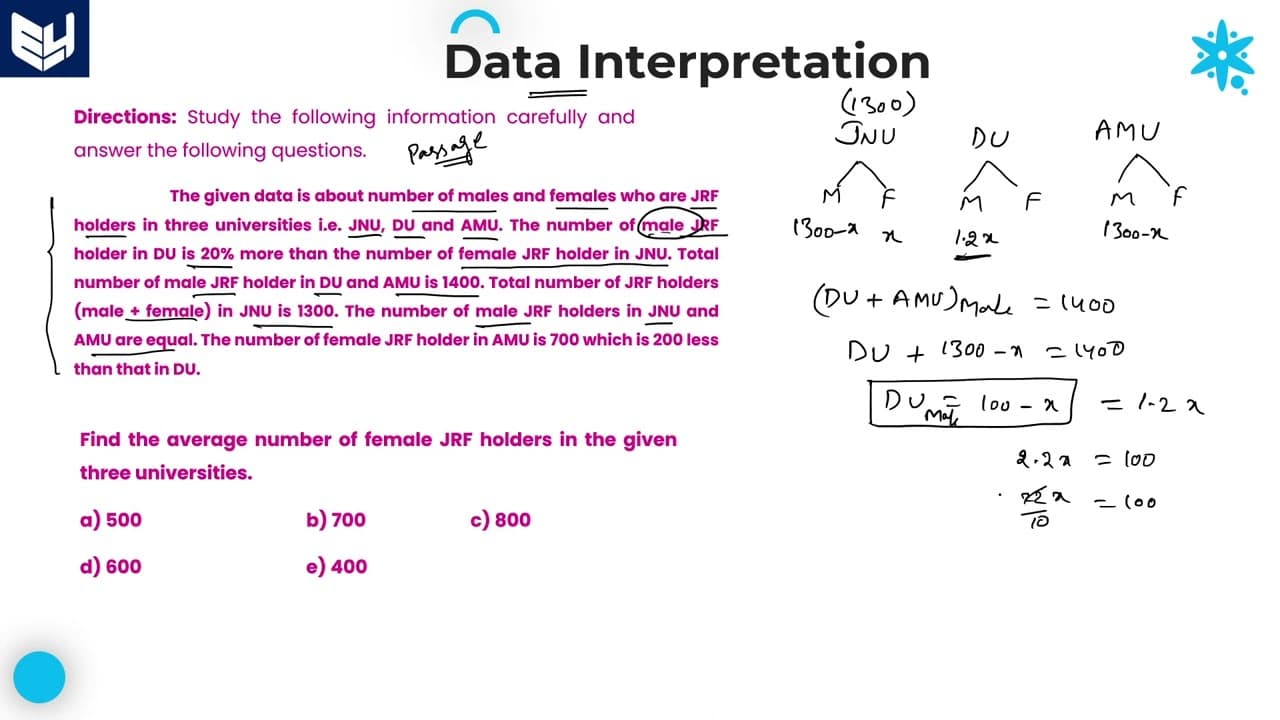
The number of males who are JRF holders in DU is stated to be 20% more than the number of female JRF holders in JNU. This means if there are X females in JNU, then the males in DU would be calculated as 1.2X, establishing a direct ratio between the two.
Q: What was the average number of female JRF holders across the universities?
The average number of female JRF holders across JNU, DU, and AMU is calculated by summing the total number of females, which is 500 (JNU) + 900 (DU) + 700 (AMU) = 2100, then dividing by the number of universities, resulting in an average of 700 female JRF holders.
Q: How do we calculate the percentage difference between DU female holders and AMU male holders?
To find the percentage difference, we identify that there are 900 female JRF holders in DU and 800 male JRF holders in AMU. The calculation involves finding the difference (100), dividing it by the smaller value (800), and multiplying by 100 to express it as a percentage, which results in a 12.5% increase.
Q: How do you find the ratio of male JRF holders in DU to total JRF holders in AMU?
The number of male JRF holders in DU is 600, and total JRF holders in AMU is 1500. The ratio can be simplified by canceling the zeros, leading to a ratio of 2:5, indicating that for every 5 JRF holders in AMU, there are 2 in DU.
Q: What is the calculation for the total number of JRF holders across all universities?
The total number of JRF holders across JNU, DU, and AMU is found by summing their totals: JNU (1300) + DU (1500) + AMU (1500) = 4300. This value provides a baseline for calculating percentages and comparisons in subsequent questions.
Q: How are the JRF holders' subjects categorized, and what percentage are subjects other than science?
Out of the total JRF holders, 40% are categorized as science subjects, while the remaining 60% represents other subjects. To find the number of JRF holders that are not in the sciences, we take 60% of the total 4300, resulting in 2580 holders from other subjects.
Summary & Key Takeaways
-
The session emphasizes the importance of thoroughly understanding a passage containing data about JRF holders before attempting associated problems.
-
It details the number of male and female JRF holders at JNU, DU, and AMU, requiring calculations to solve complex queries about the data.
-
Multiple problems are presented, including average calculations and percentage comparisons, demonstrating data-driven problem-solving skills.
Read in Other Languages (beta)
Share This Summary 📚
Summarize YouTube Videos and Get Video Transcripts with 1-Click
Try YouTube Summary with ChatGPT & Claude or YouTube Transcript Generator