6.4.9 R6. Segmenting Images - Video 7: Comparing Methods
TL;DR
This video provides a comprehensive comparison and review of different predictive analysis methods, including linear regression, logistic regression, CART, random forest, hierarchical clustering, and k-means clustering.
Transcript
In this video we will compare all the different methods we have seen so far in this course and review what they are used for, their benefits, and limitations. Linear regression is used to predict a continuous outcome. Linear regression is simple and commonly used, and it works on small and large data sets. The downside is that it assumes a linear r... Read More
Key Insights
- ❓ Linear regression predicts continuous outcomes with a linear relationship assumption.
- 💻 Logistic regression predicts categorical outcomes and computes probabilities.
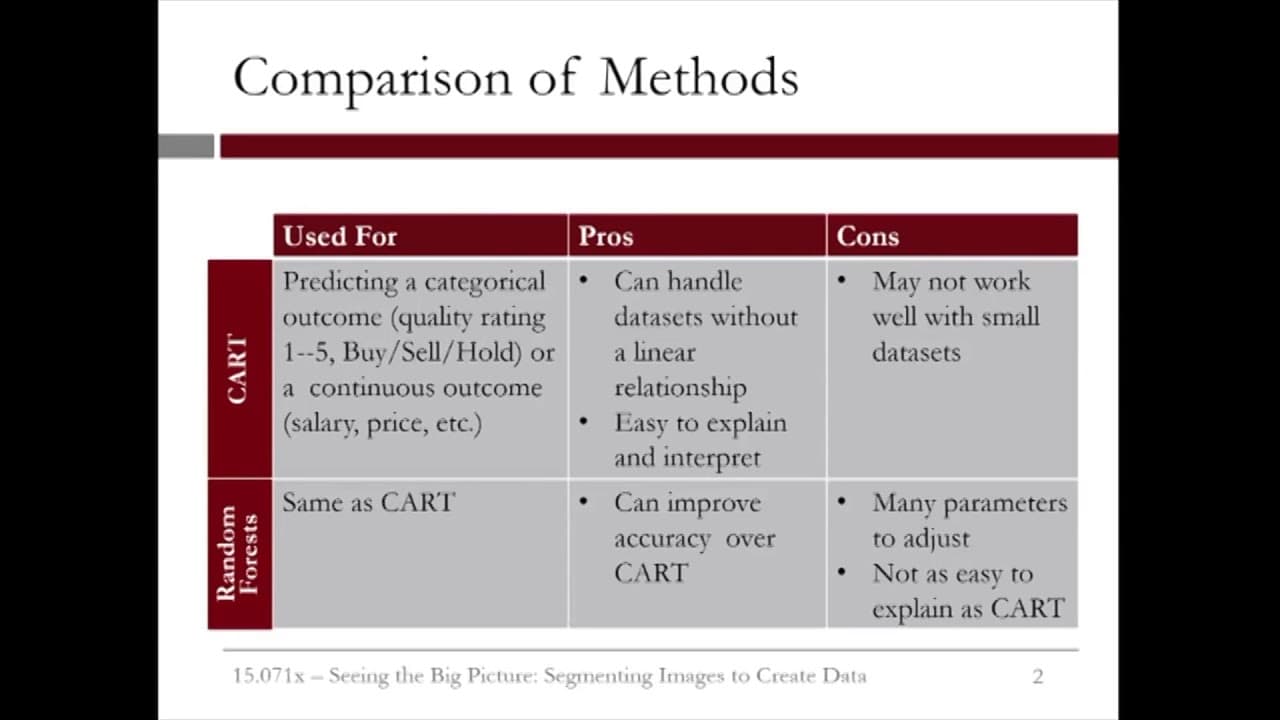
- 🌲 CART is a tree-based method for prediction, handling non-linear relationships.
- ❓ Random forest improves prediction accuracy over CART but requires parameter adjustments.
- 👥 Hierarchical clustering identifies similar groups and can enhance prediction accuracy.
Install to Summarize YouTube Videos and Get Transcripts
Explore YouTube Video Summarizer or Get YouTube Transcript Extractor
Questions & Answers
Q: What is the primary purpose of linear regression?
Linear regression is primarily used to predict continuous outcomes based on a linear relationship between variables. It is simple and works well with small and large datasets.
Q: What are the limitations of linear regression?
The main limitation of linear regression is that it assumes a linear relationship between variables. If there is a non-linear relationship, additional variables may need to be included in the analysis.
Q: How does logistic regression differ from linear regression?
Logistic regression is specifically used to predict categorical outcomes. It computes probabilities and is commonly applied to binary outcomes like yes/no or accept/reject. However, it shares the limitation of assuming a linear relationship.
Q: What are the advantages of using CART for prediction?
CART (Classification and Regression Trees) can handle non-linear relationships between variables and is easy to visualize and interpret. It can be used for both categorical and continuous outcome prediction.
Summary & Key Takeaways
-
Linear regression is used to predict continuous outcomes and works well on small and large datasets, but assumes a linear relationship.
-
Logistic regression is used to predict categorical outcomes and computes probabilities, but has a similar limitation as linear regression.
-
CART is used for categorical and continuous outcome prediction, handles nonlinear relationships, and is easy to interpret, but may not work well on small datasets.
-
Random forest improves prediction accuracy over CART, but requires parameter adjustments and is more complex to explain.
-
Hierarchical clustering is used for finding similar groups and can improve prediction accuracy, but is challenging to use on large datasets.
-
K-means clustering works well on datasets of any size but requires specifying the number of clusters beforehand.
Read in Other Languages (beta)
Share This Summary 📚
Summarize YouTube Videos and Get Video Transcripts with 1-Click
Try YouTube Summary with ChatGPT & Claude or YouTube Transcript Generator
Explore More Summaries from MIT OpenCourseWare 📚



Summarize YouTube Videos and Get Video Transcripts with 1-Click
Try YouTube Summary with ChatGPT & Claude or YouTube Transcript Generator