C4W1L09 Pooling Layers
TL;DR
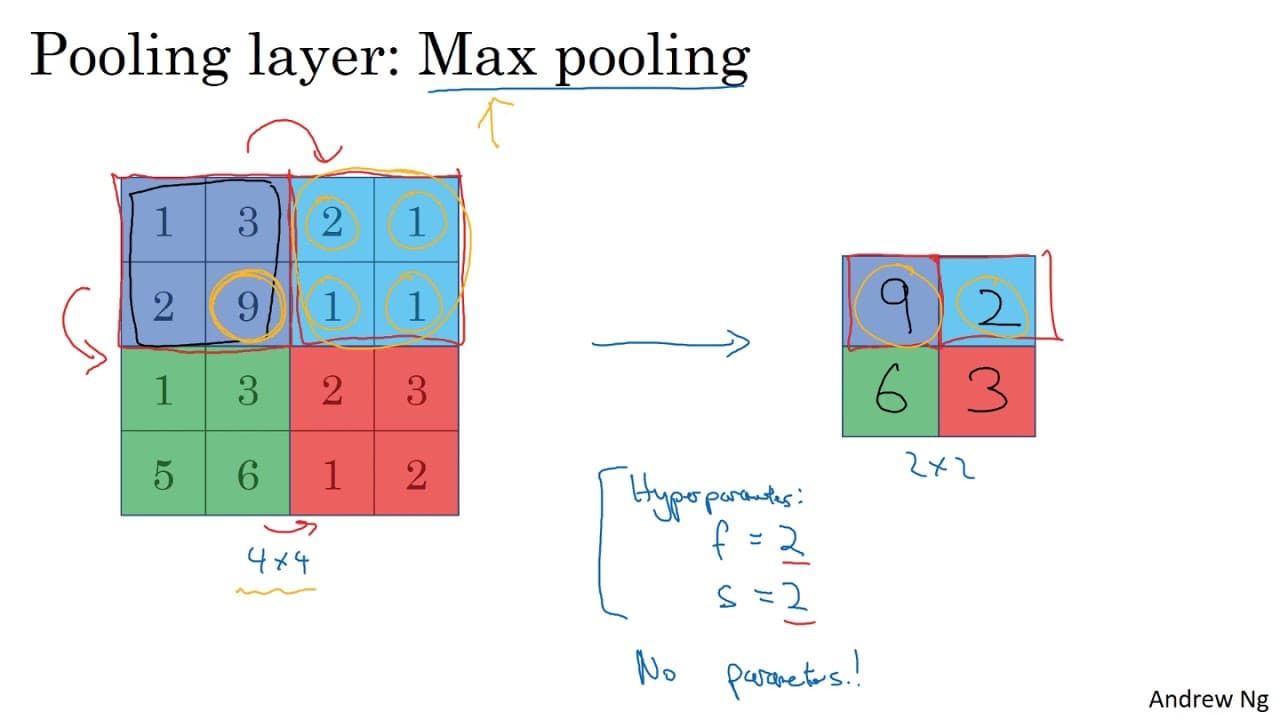
Pooling layers in CNNs help reduce the size of feature representations and make the detected features more robust. Max pooling is commonly used, with hyperparameters determined by experimentation.
Transcript
other than convolutional layers confidence often also use pooling layers to reduce the size of the representation to speed the computation as well as make some of the features it detects a bit more robust let's take a look let's go through an example of pooling and then we'll talk about why you might want to do this suppose you have a four by four ... Read More
Key Insights
- 🎱 Pooling layers in CNNs reduce the size of representations and improve computational efficiency.
- 🛟 Max pooling preserves important features by selecting the maximum value from each region.
- ❓ The reason behind the effectiveness of max pooling is still not fully understood.
- 🎱 Pooling layers have hyperparameters, such as filter size and stride, that determine their behavior.
- 🎱 There are no parameters to learn in pooling layers; they are fixed functions.
- ❓ Max pooling is commonly used in CNNs, while average pooling is occasionally used for collapsing spatial dimensions.
- 🔠 Pooling can be applied to 3D inputs, treating each channel independently.
- 0️⃣ Padding is rarely used in max pooling, and the most common padding value is zero.
Install to Summarize YouTube Videos and Get Transcripts
Explore YouTube Video Summarizer or Get YouTube Transcript Extractor
Questions & Answers
Q: How does max pooling work?
Max pooling divides the input into regions and selects the maximum value from each region, reducing the size of the representation while preserving important features.
Q: Why is max pooling commonly used in CNNs?
Max pooling has been found to work well in experiments, but the exact reason for its effectiveness is not fully understood. It may help preserve important features and discard irrelevant information.
Q: Can pooling layers have parameters that are learned through gradient descent?
No, pooling layers have no parameters to learn. They are fixed functions determined by hyperparameters such as filter size and stride. The pooling operation itself is not adaptable through backpropagation.
Q: Are there other types of pooling besides max pooling?
Yes, another type is average pooling, where the average value of each region is selected. However, max pooling is more commonly used, except for cases where collapsing spatial dimensions is desired.
Summary & Key Takeaways
-
Pooling layers in CNNs reduce the size of feature representations and improve computation speed.
-
Max pooling works by dividing the input into regions and taking the maximum value from each region.
-
Max pooling helps preserve detected features while discarding irrelevant information.
-
Pooling layers have hyperparameters such as filter size and stride.
Read in Other Languages (beta)
Share This Summary 📚
Summarize YouTube Videos and Get Video Transcripts with 1-Click
Try YouTube Summary with ChatGPT & Claude or YouTube Transcript Generator
Explore More Summaries from DeepLearningAI 📚

![#25 Machine Learning Engineering for Production (MLOps) Specialization [Course 1, Week 3, Lesson 1] thumbnail](/_next/image?url=https%3A%2F%2Fi.ytimg.com%2Fvi%2F0aDhjrs8FMw%2Fhqdefault.jpg&w=750&q=75)


![#20 AI for Good Specialization [Course 1, Week 2, Lesson 2] thumbnail](/_next/image?url=https%3A%2F%2Fi.ytimg.com%2Fvi%2F1X9cLvqOPhg%2Fhqdefault.jpg&w=750&q=75)
Summarize YouTube Videos and Get Video Transcripts with 1-Click
Try YouTube Summary with ChatGPT & Claude or YouTube Transcript Generator