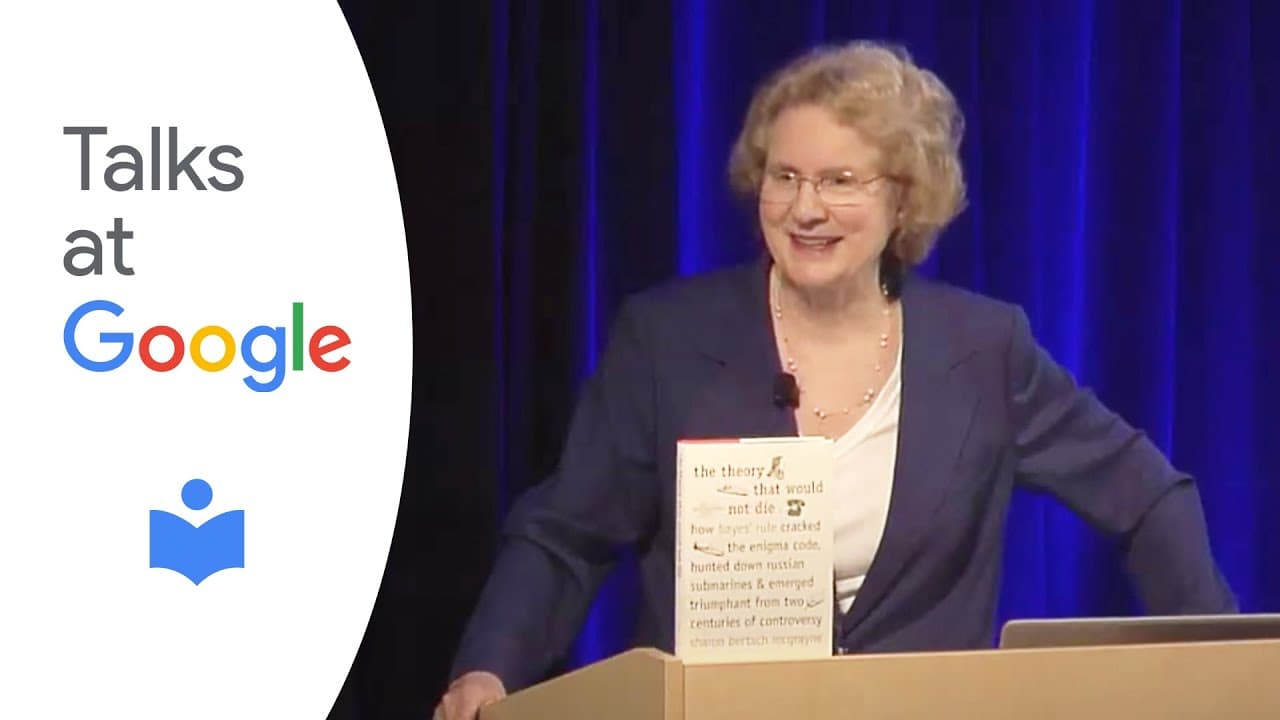
The Theory That Would Not Die | Sharon Bertsch McGrayne | Talks at Google
TL;DR
Bayesian statistics, a method based on Bayes' theorem, has gone from being highly criticized and controversial to being widely accepted and used in various fields, thanks to advancements in computing and the recognition of its practical applications.
Transcript
Male Presenter: Hello everyone. And welcome to Sharon Bertsch McGrayne's talk on "The Theory That Would Not Die." When I got the announcement of the book and I asked for a copy of it, I said, "This looks like a very Googley book." Bayes' theorem is used all over the place and when I asked you guys if you're interested, it was either the first or ... Read More
Key Insights
- ❓ Bayes' theorem, initially developed in the 18th century by Thomas Bayes, was largely overlooked and criticized by the academic community, particularly frequentist statisticians, for much of the 20th century.
- 🎖️ The military secretly used Bayesian methods during the Second World War and Cold War, recognizing its practical applications in decoding messages, predicting probabilities, and decision-making under uncertainty.
- 🥺 Advancements in computing technology and the development of software for Bayesian analysis in the 1980s led to a resurgence of interest in Bayesian methods, making them more accessible and efficient.
Install to Summarize YouTube Videos and Get Transcripts
Explore YouTube Video Summarizer or Get YouTube Transcript Extractor
Questions & Answers
Q: Why was Bayes' theorem largely ignored and criticized by the academic community for much of the 20th century?
One reason was the emphasis on frequentist statistics, which focused on using statistical methods based on observed frequencies. Bayes' theorem, on the other hand, relied on subjective prior beliefs and approximations, which critics felt was too subjective and imprecise for scientific analysis.
Q: How did advancements in computing technology contribute to the revival of Bayesian statistics?
The availability of powerful workstations in the 1980s enabled the development of fast and efficient algorithms for Bayesian analysis, such as Markov chain Monte Carlo (MCMC). These algorithms made it easier to compute Bayesian probabilities and process large amounts of data, leading to renewed interest and adoption of Bayesian methods.
Q: What were some practical applications of Bayesian statistics during the Second World War and Cold War?
Bayesian methods were used by military personnel to decode encrypted messages, predict the probability of accidents and incidents, and make decision-making in conditions of uncertainty. For example, Bayesian analysis helped in predicting the locations of wreckage from a missing airplane and identifying the probability of accidental H-bomb explosions.
Q: What led to the widespread acceptance of Bayesian statistics in various fields?
The development of off-the-shelf software, such as BUGS (Bayesian Statistics Using Gibbs Sampling), made Bayesian analysis more accessible and user-friendly. Additionally, researchers from different disciplines started recognizing the practicality and effectiveness of Bayesian methods, leading to its widespread adoption and increased recognition.
Summary & Key Takeaways
-
Bayes' theorem, a mathematical theorem that allows for updating beliefs based on new evidence, was largely ignored and even criticized by the academic community for much of the 20th century.
-
The military secretly used Bayesian methods during the Second World War and Cold War, but in the civilian world, it faced criticism and skepticism.
-
Advancements in computing technology and the emergence of software for Bayesian analysis in the 1980s led to a resurgence of interest in Bayesian methods.
-
Bayesian statistics has since gained acceptance and is now widely used in various fields, including image restoration, medical diagnostics, and physics.
Read in Other Languages (beta)
Share This Summary 📚
Summarize YouTube Videos and Get Video Transcripts with 1-Click
Try YouTube Summary with ChatGPT & Claude or YouTube Transcript Generator
Explore More Summaries from Talks at Google 📚
Summarize YouTube Videos and Get Video Transcripts with 1-Click
Try YouTube Summary with ChatGPT & Claude or YouTube Transcript Generator