Problem 04 on Non Determinstic PDA
TL;DR
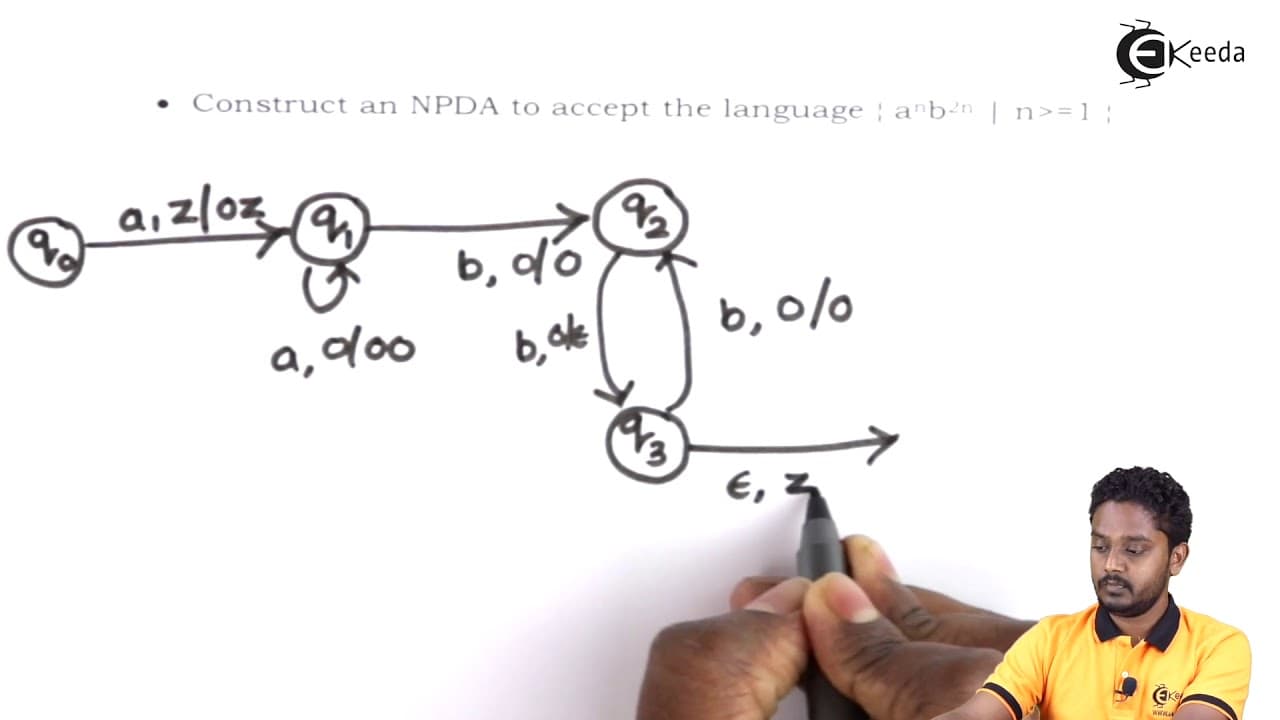
A non-deterministic pushdown automaton (PDA) is designed to compare the number of "a"s and "b"s, with the constraint that the number of "b"s must be twice the number of "a"s.
Transcript
click the bell icon to get latest videos from akira hello friends let us solve the next question on non deterministic PDA that is over here we are asked to solve a PDA for comparing a's and b's but now we need number of Me's double the number of e's that is the strings a to the power n B to the power 2 in there are various ways to design this parti... Read More
Key Insights
- 🤬 Non-deterministic PDAs can be used to solve specific problems, such as comparing the number of certain symbols in a string.
- ⚾ Different approaches can be used to design a non-deterministic PDA based on the problem's requirements.
- 🍵 Multiple states and transitions are necessary to handle different scenarios and constraints in the PDA.
- 🏃 The PDA can be tested by running example strings and observing whether they are accepted or rejected.
Install to Summarize YouTube Videos and Get Transcripts
Explore YouTube Video Summarizer or Get YouTube Transcript Extractor
Questions & Answers
Q: What is the purpose of the non-deterministic PDA in this video?
The PDA is designed to compare the number of "a"s and "b"s, ensuring that the number of "b"s is twice the number of "a"s.
Q: What are the two approaches presented for designing the PDA?
The two approaches are: pushing 0s for every "a" and popping 0s for every second "b", or pushing 2 0s for every "a" and popping 1 0 for every "b".
Q: How many states are used in the construction of the PDA?
The PDA is constructed using 5 states: q0, q1, q2, q3, and q4.
Q: Can you explain how the PDA processes the example string "aaBBBB"?
Starting from the initial state (q0), the PDA transitions through q1, q2, q3, and q2 again before reaching the final state (q4). The input string is accepted because the number of "b"s is twice the number of "a"s.
Summary & Key Takeaways
-
The video discusses the design of a non-deterministic PDA to compare the number of "a"s and "b"s.
-
Two possible approaches are presented: pushing 0s for every "a" and popping 0s for every second "b", or pushing 2 0s for every "a" and popping 1 0 for every "b".
-
The PDA is constructed using 5 states: q0, q1, q2, q3, and q4, with various transitions to ensure the constraint is satisfied.
-
An example string, "aaBBBB", is used to demonstrate how the PDA processes and accepts/rejects strings.
Read in Other Languages (beta)
Share This Summary 📚
Summarize YouTube Videos and Get Video Transcripts with 1-Click
Try YouTube Summary with ChatGPT & Claude or YouTube Transcript Generator
Explore More Summaries from Ekeeda 📚






Summarize YouTube Videos and Get Video Transcripts with 1-Click
Try YouTube Summary with ChatGPT & Claude or YouTube Transcript Generator