AI, Explained: Why It’s Different This Time | WSJ Tech News Briefing
TL;DR
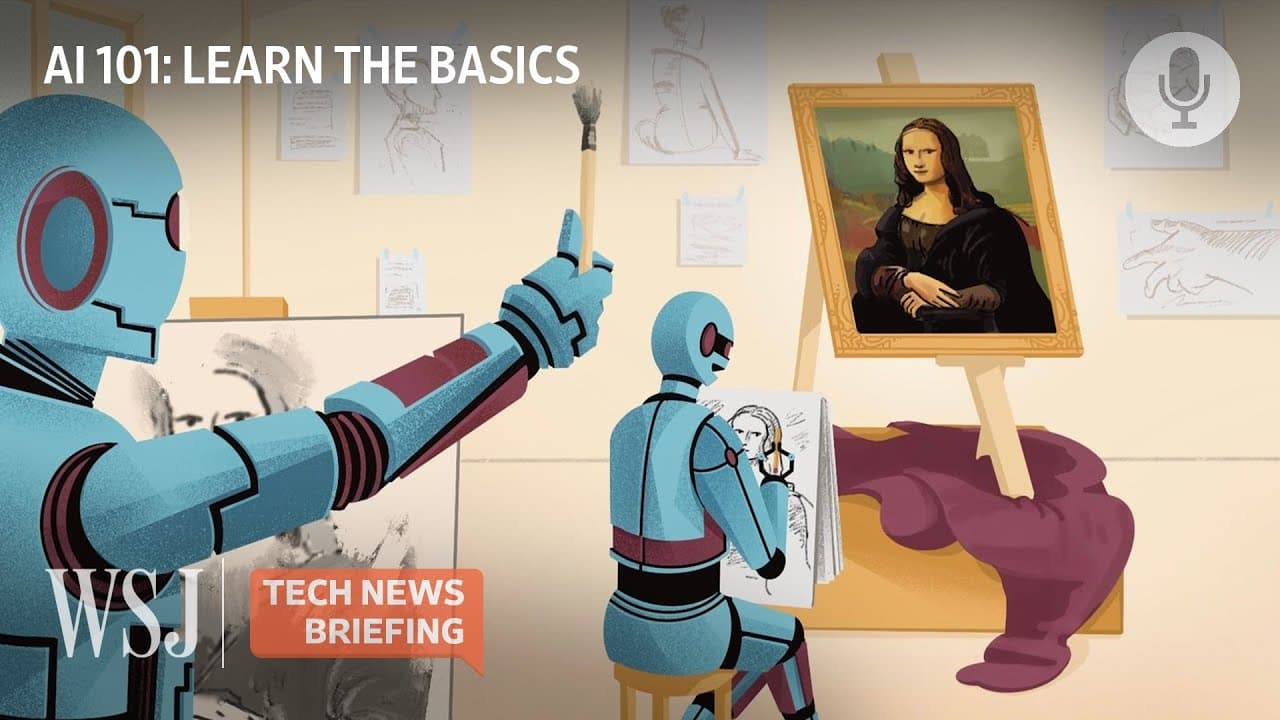
Learn the fundamentals of artificial intelligence (AI), including machine learning, neural networks, and the use of AI in everyday life.
Transcript
welcome to a special episode of tech news briefing for Monday April 3rd I'm Zoe Thomas for The Wall Street Journal you've probably been hearing a lot about artificial intelligence AI seems to be everywhere these days Google meta slash Facebook Microsoft are in a race to introduce new artificial intelligence systems the AI race for for search it's o... Read More
Key Insights
- 🔍 AI Race: Companies like Google, Facebook, and Microsoft are in a race to introduce new artificial intelligence systems, indicating the significance and widespread adoption of AI technology.
- 💭 Generative AI: Generative AI is changing the game, allowing AI systems to reason, learn, and make decisions similar to human intelligence. This advancement has promising implications for various industries.
- 📚 AI Basics: Artificial intelligence refers to any technology capable of reasoning, learning, planning, and decision-making tasks that require human intelligence. It has evolved from statistical methods to a more complex and sophisticated system.
- 🔢 Machine Learning: A form of AI, machine learning enables systems to learn a specific task on their own by analyzing patterns in data and making inferences. It is used in various applications, from predicting demand in car-sharing apps to identifying cancer tumors in medical scans.
- 💬 Chat GPT: Chat GPT is an example of a generative AI tool that learns by assimilating vast amounts of text data into a large language model. It can process language quickly and make associations between questions and existing information to generate responses.
- 🧠 Neural Network: A neural network is a computer program that mimics the processing functions of the human brain. By working on multiple levels and nodes, it can identify images, patterns, facial expressions, and other elements, similar to how our brain processes information.
- 💡 Pervasive AI: AI technology is already present in our daily lives, from navigation apps to optimizing delivery routes. It is also being used in the legal field to search vast amounts of case law and in various other industries. Understanding AI's impact on society is crucial.
- ⚖️ AI Risks: Risks associated with AI include accuracy and bias in facial recognition, system failures, and potential existential risks. To mitigate these risks, more data for training is needed, along with diverse training sets and better algorithms. However, the risk of AI overtaking or going beyond human control is unlikely in the near future.
- 🌍 Global AI Regulations: While there are few rules governing AI in the United States, some attempts have been made to restrict its use in law enforcement. In Europe, there are stricter regulations regarding AI use, which may impact businesses and society as a whole.
Install to Summarize YouTube Videos and Get Transcripts
Explore YouTube Video Summarizer or Get YouTube Transcript Extractor
Questions & Answers
Q: What is the difference between artificial intelligence and machine learning?
Artificial intelligence is a broader concept that encompasses technologies capable of reasoning, learning, planning, and decision-making. Machine learning, on the other hand, is a subset of AI that allows algorithms to learn and improve from data without being explicitly programmed.
Q: How do neural networks work and what are their applications?
Neural networks are computer programs that mimic the processing abilities of the human brain. By working on different levels and nodes of processing, they can identify images, patterns, facial expressions, and more. Some applications of neural networks include image and speech recognition, natural language processing, and medical diagnostics.
Q: How is AI being used in everyday life?
AI has become integrated into our daily lives through various applications. Navigation apps on our phones, search engines like Google, and delivery route optimization algorithms are all examples of AI in action. Law firms also use AI to search large databases of cases for references and applicable language.
Q: What are some risks associated with AI?
Some risks associated with AI include accuracy bias in facial recognition, system failures, and the potential for AI to go beyond programmed boundaries. To mitigate these risks, more data, better lighting, and diverse training sets can be used to improve accuracy in facial recognition algorithms. The risk of AI taking over like in science fiction movies is considered unlikely in the near future.
Summary & Key Takeaways
-
Artificial intelligence (AI) encompasses technologies that can reason, learn, plan, and make decisions, tasks that typically require human intelligence.
-
Machine learning is a form of AI that allows algorithms to learn and perform specific tasks by recognizing patterns in data.
-
Neural networks are computer programs that mimic the processing capabilities of the human brain, allowing them to identify images, patterns, and more.
-
AI is already being integrated into our daily lives through navigation apps, search engines, and other applications.
-
The risks associated with AI include accuracy bias in facial recognition, system failures, and the potential for AI to go beyond programmed boundaries.
Read in Other Languages (beta)
Share This Summary 📚
Summarize YouTube Videos and Get Video Transcripts with 1-Click
Try YouTube Summary with ChatGPT & Claude or YouTube Transcript Generator
Explore More Summaries from WSJ News 📚


Summarize YouTube Videos and Get Video Transcripts with 1-Click
Try YouTube Summary with ChatGPT & Claude or YouTube Transcript Generator