What Is Fleming's Left Hand Rule and How Do You Use It?
TL;DR
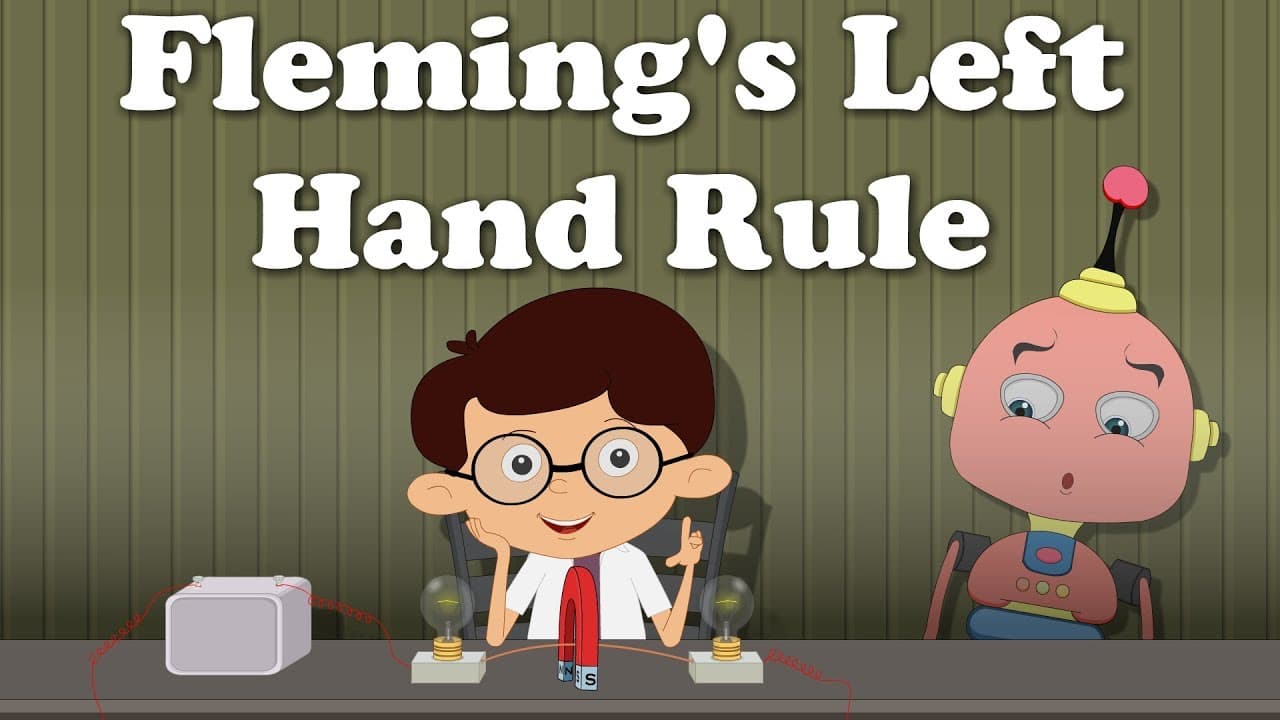
Fleming's Left Hand Rule determines the direction of force on a current-carrying conductor in a magnetic field. To use it, extend your left hand with the thumb, forefinger, and middle finger perpendicular to each other: the forefinger points to the magnetic field direction, the middle finger to the current, and the thumb indicates the force's direction. This principle is essential in electric motors used in various appliances.
Transcript
Fleming's Left Hand Rule. What happened? Bulbs are not glowing properly. Junk box. Whenever a current carrying conductor is placed in a magnetic field, it experiences a force due to the magnetic field. What will happen if I reverse the poles of the magnet? How can we find the direction of force acting on the conductor? Wait, I will search in my dat... Read More
Key Insights
- 🏑 Fleming's Left Hand Rule is a principle that helps determine the direction of force on a current-carrying conductor in a magnetic field.
- 🫰 Understanding the orientation of the thumb, forefinger, and middle finger in Fleming's Left Hand Rule is vital for correctly determining the force's direction.
- 🥺 Reversing the poles of the magnet in the rule leads to a change in the force's direction on the conductor.
- 🧑🦼 Electric motors employed in fans, mixers, printers, etc., rely on Fleming's Left Hand Rule to function appropriately.
- 📏 The rule highlights the interaction between electricity and magnetism and is crucial in electromagnetism.
- 🙈 Demonstrations of Fleming's Left Hand Rule can be seen in science exhibitions to depict its practical application.
- 🫰 The thumb in the rule represents the force or motion on the conductor, the forefinger represents the magnetic field, and the middle finger represents the current.
Install to Summarize YouTube Videos and Get Transcripts
Explore YouTube Video Summarizer or Get YouTube Transcript Extractor
Questions & Answers
Q: What is Fleming's Left Hand Rule and why is it important?
Fleming's Left Hand Rule is a principle used to find the direction of force acting on a current-carrying conductor in a magnetic field. It is important because it helps understand the interaction between electricity and magnetism and is crucial in many applications.
Q: How do you use Fleming's Left Hand Rule?
To use Fleming's Left Hand Rule, stretch your left hand, ensuring the thumb, forefinger, and middle finger are at right angles to each other. The thumb represents the force, the forefinger indicates the magnetic field, and the middle finger represents the current. The relationship between these fingers determines the direction of force.
Q: What happens if you reverse the poles of the magnet in Fleming's Left Hand Rule?
If you reverse the poles of the magnet, the direction of the force on the conductor will change accordingly. This emphasizes the importance of understanding the orientation of the magnetic field and the current in determining the force's direction.
Q: Where is Fleming's Left Hand Rule commonly used?
Fleming's Left Hand Rule finds applications in various devices, particularly in electric motors used in fans, mixers, printers, and other appliances. It helps in understanding the direction of the force acting on the conductor in these devices.
Summary & Key Takeaways
-
Fleming's Left Hand Rule explains the relationship between a current-carrying conductor, magnetic field, and the direction of force.
-
By understanding the rule, one can determine the direction of force acting on the conductor.
-
This rule is widely used in various applications, including electric motors used in fans, mixers, printers, etc.
Read in Other Languages (beta)
Share This Summary 📚
Summarize YouTube Videos and Get Video Transcripts with 1-Click
Try YouTube Summary with ChatGPT & Claude or YouTube Transcript Generator
Explore More Summaries from It's AumSum Time 📚






Summarize YouTube Videos and Get Video Transcripts with 1-Click
Try YouTube Summary with ChatGPT & Claude or YouTube Transcript Generator