Odd Equations - Numberphile
TL;DR
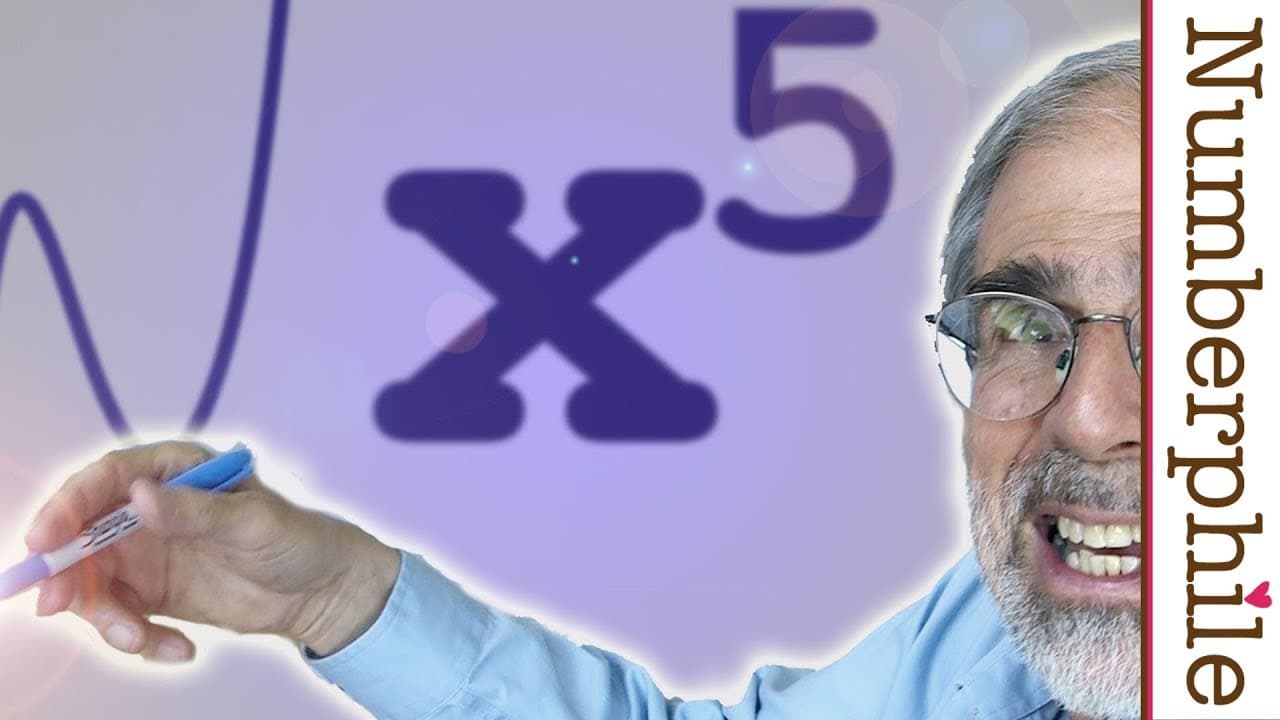
This content introduces the concept of polynomials and roots, explaining how they are used to solve equations and find solutions or values for x. It also explores the relationship between odd degree polynomials and their roots in real numbers.
Transcript
So let's start with some algebra. So there are nice simple equations like x plus 1 equals 5; course it's not too hard to solve that equation, we get x equals 4. Now this is an equation in whole numbers and we solved it in whole numbers; pretty soon if you write down equations you get things you can't solve in whole numbers. If the equation had been... Read More
Key Insights
- #️⃣ Equations involving simple whole numbers can be solved algebraically, but as equations become more complex, additional mathematical concepts like negative numbers, fractions, and polynomials are necessary.
- ✊ Polynomials are expressions that involve variables raised to different powers and can represent functions rather than equations.
- 🫰 Polynomial functions can be graphed to visualize the points where the function crosses the x-axis, which are the roots or solutions to the equation.
- ✊ Odd degree polynomials always have at least one real root due to the behavior of positive and negative numbers raised to odd powers.
Install to Summarize YouTube Videos and Get Transcripts
Explore YouTube Video Summarizer or Get YouTube Transcript Extractor
Questions & Answers
Q: What are polynomials and how are they different from equations?
Polynomials are expressions involving variables raised to different powers, while equations involve an equal sign. Polynomials can represent functions, and solving them requires finding the roots or solutions of the function.
Q: How can graphing a polynomial help find its roots?
Graphing a polynomial function allows us to visually identify the points where the function crosses the x-axis, which are the roots or solutions of the equation.
Q: Why do odd degree polynomials always have at least one real root?
The proof relies on the fact that positive numbers raised to an odd power are positive, while negative numbers raised to an odd power are negative. By considering extremely large positive and negative values for x, the dominating term of the polynomial will determine the overall sign, ensuring at least one root.
Q: What is the significance of Dedekind cuts in relation to real numbers?
Dedekind cuts define real numbers as a partitioning of rational numbers into two sets, representing the numbers that are less than and greater than a particular real number. This construction eliminates the possibility of "holes" or gaps in the real number system.
Summary & Key Takeaways
-
The content begins with simple equations in whole numbers and progresses to equations with negative numbers and fractions, highlighting the need for additional mathematical concepts to solve them.
-
It explains that polynomials are expressions involving variables raised to different powers, and they can represent functions rather than equations.
-
The video emphasizes the importance of understanding roots, which are equivalent to solutions, and demonstrates how to graph a polynomial function to find roots.
Read in Other Languages (beta)
Share This Summary 📚
Summarize YouTube Videos and Get Video Transcripts with 1-Click
Try YouTube Summary with ChatGPT & Claude or YouTube Transcript Generator
Explore More Summaries from Numberphile 📚


Summarize YouTube Videos and Get Video Transcripts with 1-Click
Try YouTube Summary with ChatGPT & Claude or YouTube Transcript Generator