8. Quasi-Newton-Raphson Methods
TL;DR
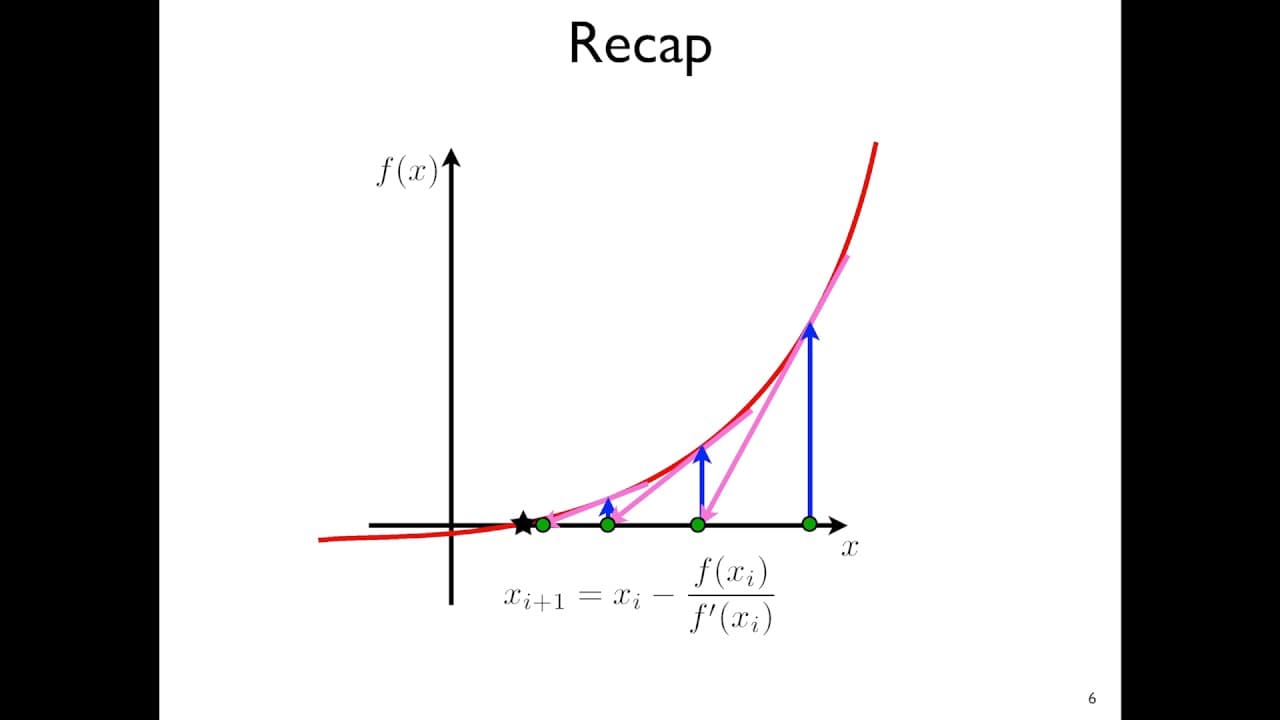
Introducing Broyden's method, damped Newton-Raphson method, and finite difference approximation for solving nonlinear equations.
Transcript
The following content is provided under a Creative Commons license. Your support will help MIT OpenCourseWare continue to offer high-quality educational resources for free. To make a donation or to view additional materials from hundreds of MIT courses, visit MIT OpenCourseWare at ocw.mit.edu. JAMES SWAN: OK. Should we begin? Let me remind you, we ... Read More
Key Insights
- 😜 Broyden's method approximates the Jacobian matrix through a rank one update, providing a simpler but effective solution.
- 🧑🏭 The damped Newton-Raphson method introduces a damping factor to ensure a reduction in the function value during each iteration.
- ❓ Finite difference approximation offers an alternative to directly calculating the Jacobian matrix, reducing computational complexity.
Install to Summarize YouTube Videos and Get Transcripts
Explore YouTube Video Summarizer or Get YouTube Transcript Extractor
Summary & Key Takeaways
-
Broyden's method is a rank one update approximation for the Jacobian matrix, allowing for an iterative approach to solving nonlinear equations.
-
The damped Newton-Raphson method introduces a damping factor to the Newton-Raphson method, improving convergence and ensuring a reduction in the function value.
-
Finite difference approximation is a method of approximating the Jacobian matrix by calculating the difference in function values for small perturbations in the input vector.
Read in Other Languages (beta)
Share This Summary 📚
Summarize YouTube Videos and Get Video Transcripts with 1-Click
Try YouTube Summary with ChatGPT & Claude or YouTube Transcript Generator
Explore More Summaries from MIT OpenCourseWare 📚
Summarize YouTube Videos and Get Video Transcripts with 1-Click
Try YouTube Summary with ChatGPT & Claude or YouTube Transcript Generator