6.4.3 R6. Segmenting Images - Video 2: Clustering Pixels
TL;DR
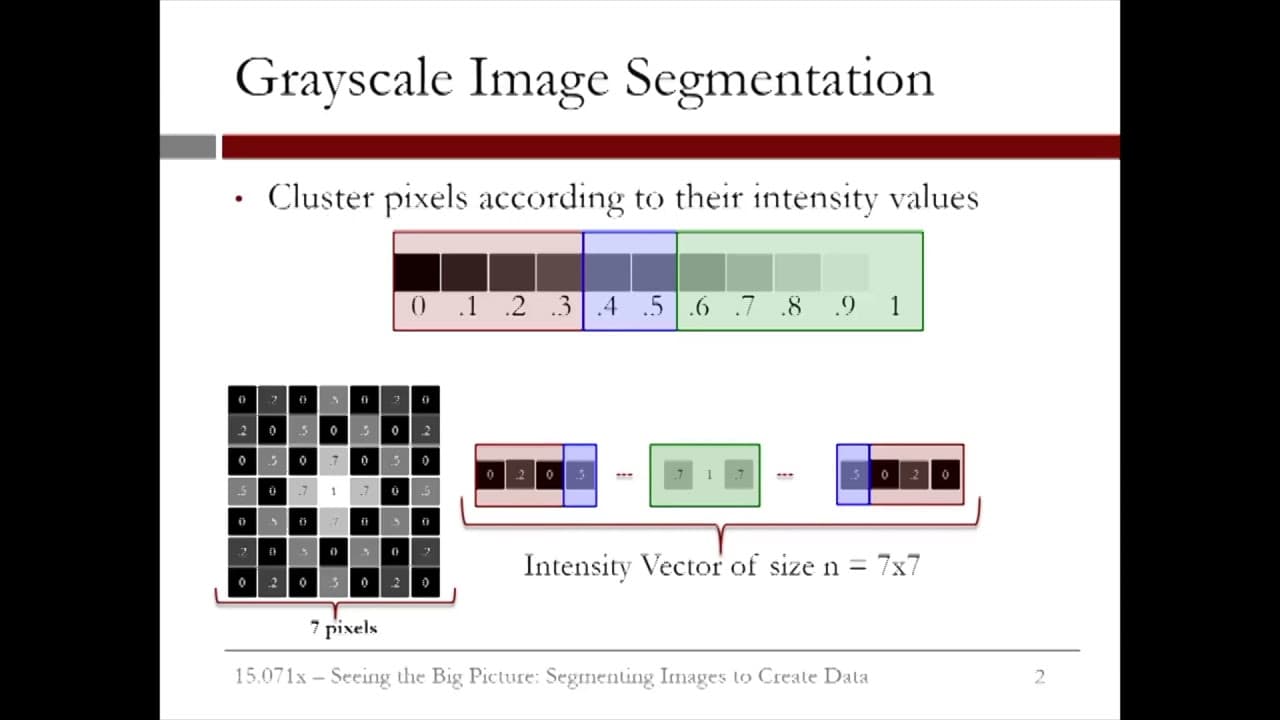
Grayscale image segmentation involves clustering pixels based on their intensity values, and in this analysis, we explore the process using a flower image dataset.
Transcript
Let us try to understand the format of the data handed to us in the CSV files. Grayscale images are represented as a matrix of pixel intensity values that range from zero to one. The intensity value zero corresponds to the absence of color, or black, and the value one corresponds to white. For 8 bits per pixel images, we have 256 color levels rangi... Read More
Key Insights
- 🖤 Grayscale images are represented as matrices, where zero represents black and one represents white.
- ⚾ Grayscale image segmentation involves clustering pixels based on their intensity values.
- ❓ Converting the intensity matrix to a vector is essential before applying the clustering algorithm.
- ❓ Hierarchical clustering is a common approach for grayscale image segmentation.
- ❓ Distance matrices are used in hierarchical clustering to calculate pairwise distances between intensity values.
- #️⃣ The number of pairwise distance calculations can be determined using the formula n*(n-1)/2, where n is the size of the intensity vector.
- 🫠 The structure of the data should be modified to correctly read the intensity matrix in R.
Install to Summarize YouTube Videos and Get Transcripts
Explore YouTube Video Summarizer or Get YouTube Transcript Extractor
Questions & Answers
Q: How are grayscale images represented in matrix form?
Grayscale images are represented as matrices, where each element corresponds to a pixel's intensity value ranging from zero to one. Zero represents black, and one represents white.
Q: How does grayscale image segmentation work?
Grayscale image segmentation involves clustering pixels based on their intensity values. The goal is to divide the spectrum of intensity values into intervals or clusters.
Q: What input is required for the clustering algorithm in grayscale image segmentation?
The input to the clustering algorithm should be a vector containing all the intensity values of the image. Each pixel's intensity value is considered as an observation.
Q: Why is it necessary to convert the matrix of intensity values into a vector before clustering?
The clustering algorithm operates on a vector input, not a matrix. Thus, it is crucial to convert the intensity matrix to a vector to perform clustering effectively.
Q: What is the purpose of the distance matrix in hierarchical clustering?
The distance matrix calculates the pairwise distances between intensity values in the vector. It helps determine the similarities or dissimilarities between pixel intensity values, which are used in hierarchical clustering.
Summary & Key Takeaways
-
Grayscale images are represented as matrices of pixel intensity values ranging from zero to one, with zero being black and one being white.
-
To perform grayscale image segmentation, we need to convert the intensity matrix into a vector and feed it into a clustering algorithm.
-
Hierarchical clustering is one approach used, where a distance matrix is computed to calculate the pairwise distances between intensity values.
Read in Other Languages (beta)
Share This Summary 📚
Summarize YouTube Videos and Get Video Transcripts with 1-Click
Try YouTube Summary with ChatGPT & Claude or YouTube Transcript Generator
Explore More Summaries from MIT OpenCourseWare 📚


Summarize YouTube Videos and Get Video Transcripts with 1-Click
Try YouTube Summary with ChatGPT & Claude or YouTube Transcript Generator