Intense Cross Examination of Cardiologist Dr Jonathan Rich
TL;DR
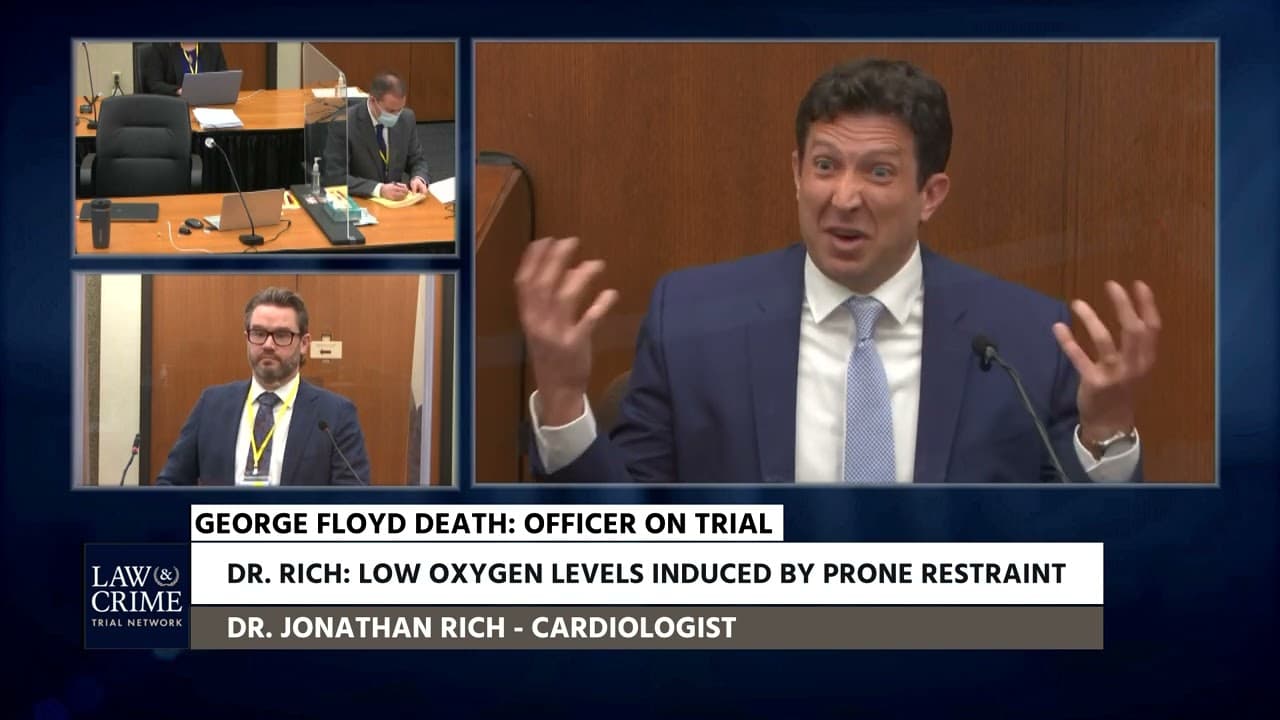
Testimony discusses how George Floyd's restraint and prone position contributed to his death, and the potential implications of different circumstances.
Transcript
so in other words if he had gotten in the squat car he'd be alive um testified that Mr Floyd based on your review of the video did start complaining of shortness of breath prior to being placed in the prone to complaint the prone position right yes I heard on more than one occasion he say the words I can't breathe and if um Mr Floyd had simply gott... Read More
Key Insights
- ❓ George Floyd complained of shortness of breath before being restrained and repeatedly stated he couldn't breathe.
- 😨 If Floyd had chosen to get into the squad car instead of being restrained, he might have survived.
- 😷 The prone position itself is generally not dangerous for an ordinary individual, but for patients with specific medical conditions, it can be risky.
- 🧘 In the ICU, the prone position is used to enhance oxygenation for patients with ARDS, who are on a respirator and sedation.
- 🫤 Agonal breaths, which occur after cardiac arrest, may result in a person taking a few extra breaths but are not well understood.
- 🧘 Floyd's death was attributed to the combination of his restraint and the prone position.
- 😷 The witness emphasizes the importance of considering medical perspectives when evaluating the events leading to Floyd's death.
Install to Summarize YouTube Videos and Get Transcripts
Explore YouTube Video Summarizer or Get YouTube Transcript Extractor
Questions & Answers
Q: Did George Floyd complain of shortness of breath before being restrained?
Yes, according to the testimony, Floyd mentioned experiencing shortness of breath prior to being placed in the prone position and repeatedly said he couldn't breathe.
Q: Would George Floyd have survived if he had gotten into the squad car instead of being restrained?
The witness opines that if Floyd had chosen to get into the squad car, he likely would have survived that day, as the prone and positional restraint had a significant impact on his fate.
Q: Is the prone position inherently dangerous for an average individual?
No, for an average person, lying flat in the prone position wouldn't be dangerous. However, there are specific medical conditions where being in the prone position can pose a risk.
Q: In what situations is the prone position used in the ICU?
Patients in the ICU are placed in the prone position in cases of acute respiratory distress syndrome (ARDS) as a last-ditch effort to save their lives. It helps open up certain lung segments for ventilation when combined with a respirator and sedation.
Summary & Key Takeaways
-
The testimony reveals that George Floyd complained of shortness of breath before being restrained in the prone position and stated multiple times that he couldn't breathe.
-
The witness believes that if George Floyd had gotten into the squad car instead of being subjected to the prone position, he may have survived.
-
The witness explains that the prone position can be dangerous for individuals with specific medical conditions, but for an average person, lying flat in that position wouldn't be inherently dangerous.
Read in Other Languages (beta)
Share This Summary 📚
Summarize YouTube Videos and Get Video Transcripts with 1-Click
Try YouTube Summary with ChatGPT & Claude or YouTube Transcript Generator
Explore More Summaries from Law&Crime Network 📚





Summarize YouTube Videos and Get Video Transcripts with 1-Click
Try YouTube Summary with ChatGPT & Claude or YouTube Transcript Generator