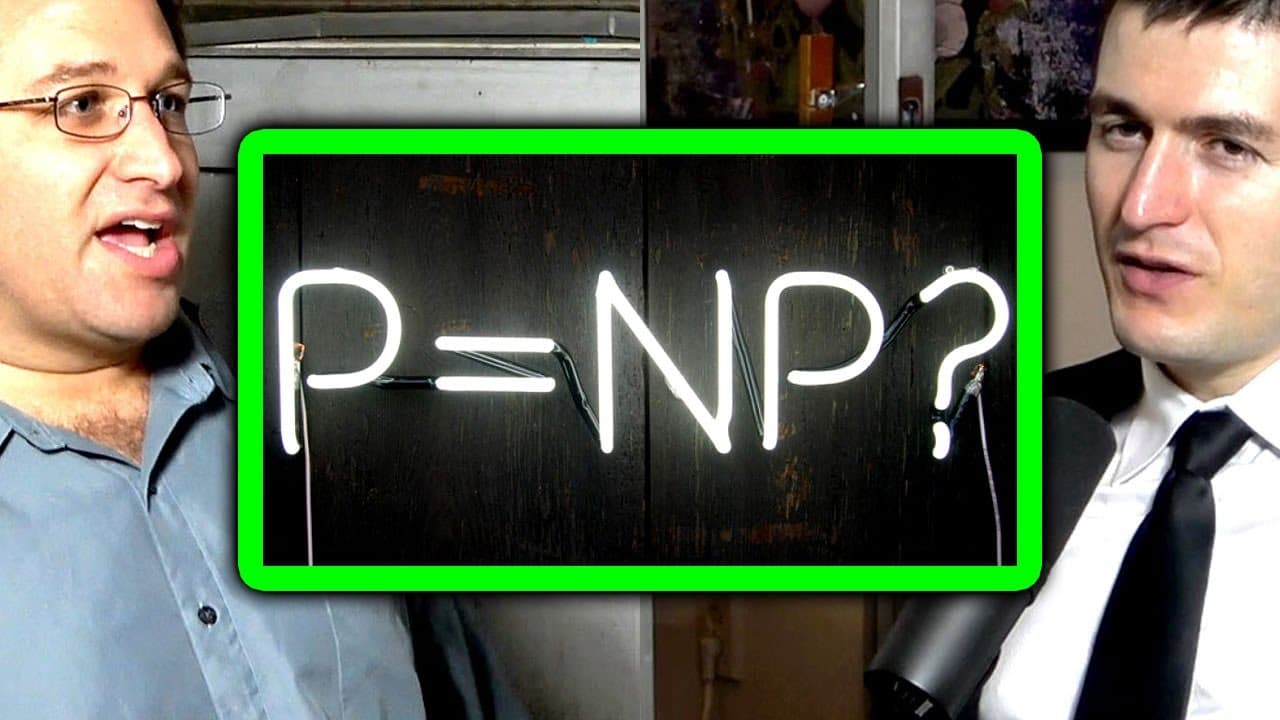
The odds that P=NP is 3% | Scott Aaronson and Lex Fridman
TL;DR
P includes problems that can be solved efficiently with conventional computers, while NP includes problems that are easy to check if a solution is given. The question of whether P equals NP is still unsolved.
Transcript
so what kind of interesting classes are there yeah i mean you could have just maybe say what are the if you you take any kind of computer science class what are the classes you learn good let me let me tell you sort of the the the biggest ones the ones that you would learn first so you know first of all there is p that's what it's called okay it st... Read More
Key Insights
- 😀 P represents problems that can be solved efficiently, while NP represents problems that are easy to verify if a solution is given.
- 💻 The question of whether P equals NP is one of the most famous and intriguing problems in theoretical computer science.
- 😀 Finding an answer to the P vs NP question has implications for various fields, including cryptography and optimization.
- 😀 P is a subset of NP, as every problem in P is also in NP.
- 👍 While the consensus among experts is that P is not equal to NP, no one has been able to prove or disprove it.
- 🥺 Solving the P vs NP problem would have significant implications for computer science and could lead to breakthroughs in algorithm design.
- 🎈 Even if P is not equal to NP, there may still be efficient algorithms for NP-complete problems that have not been discovered yet.
Install to Summarize YouTube Videos and Get Transcripts
Explore YouTube Video Summarizer or Get YouTube Transcript Extractor
Questions & Answers
Q: What is the difference between the classes P and NP?
P includes problems that can be solved efficiently using a deterministic algorithm, while NP includes problems where solutions can be verified easily in polynomial time.
Q: Can all problems in P also be categorized as NP problems?
Yes, every problem in P is also in NP because if a problem is in P, it means there exists a polynomial time algorithm to solve it.
Q: Is there a known solution to the P vs NP problem?
No, the question of whether P equals NP or not is still an open problem in computer science and has not been proven either way.
Q: What are the implications if P equals NP?
If P equals NP, it would mean that problems that are currently considered difficult to solve can actually be solved efficiently, potentially revolutionizing fields like cryptography and optimization.
Summary & Key Takeaways
-
P refers to the class of problems that can be solved efficiently using a deterministic algorithm on a conventional computer.
-
NP refers to the class of problems where solutions can be verified easily in polynomial time, even though finding the solution may be difficult.
-
The question of whether P equals NP is a famous and unsolved problem in theoretical computer science.
Read in Other Languages (beta)
Share This Summary 📚
Summarize YouTube Videos and Get Video Transcripts with 1-Click
Try YouTube Summary with ChatGPT & Claude or YouTube Transcript Generator
Explore More Summaries from Lex Clips 📚


Summarize YouTube Videos and Get Video Transcripts with 1-Click
Try YouTube Summary with ChatGPT & Claude or YouTube Transcript Generator